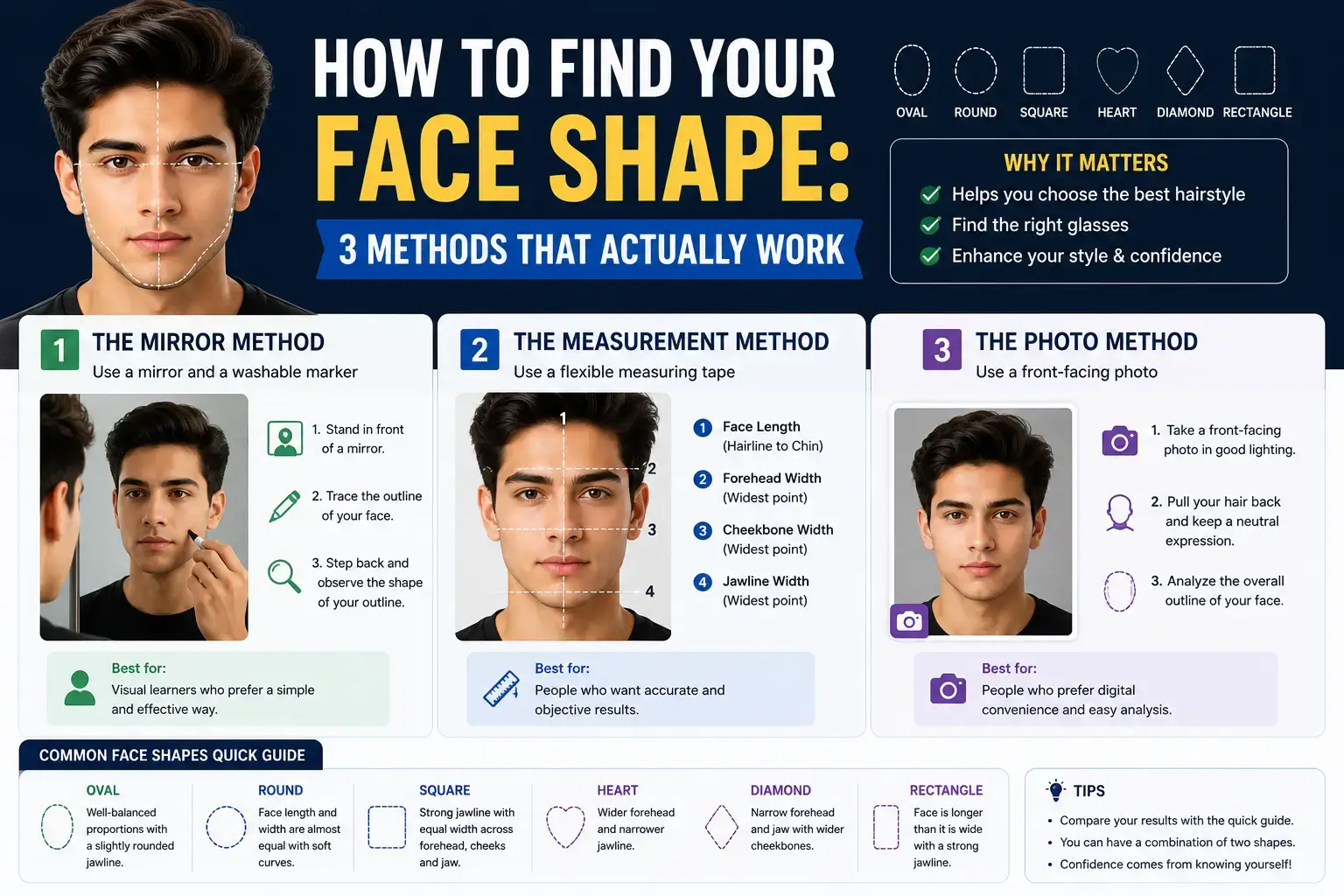
Direct answer:
To find your face shape, compare four numbers — face length, forehead width, cheekbone width, and jaw width. If your face is much longer than wide with even widths, it is oblong. If your cheekbones are widest and the face is slightly long, it is oval. If your forehead is widest with a narrow chin, it is heart-shaped. If your jaw is widest, it is triangle. The full cheek takes under 5 minutes.
There are three ways to do it: the mirror method (30 seconds, rough), the tape measure method (3 minutes, most accurate), and a free AI photo tool (instant, from a selfie). All three are below — pick the one that matches what you have in hand right now.
Why Most People Get Their Face Shape Wrong
The most common mistake is guessing from a mirror without measuring anything. Mirrors trick your brain — you adjust for what you expect to see, and most people default to calling themselves “oval” because guides lead with it.
The second mistake is vague quizzes that ask “is your face round or long?” — that needs the same judgment you are trying to avoid. A good face shape quiz asks about specific features instead, like jaw corners, widest point, and chin shape. That is why it works when a mirror guess does not.
The only fully reliable approach is measurement — with a tape, or from a photo with a tool that calculates the ratios for you.
Method 1: The Mirror Method (30 Seconds, Rough Result)
Good for a quick starting category. Works best when your shape is strongly pronounced.
- Pull all your hair completely back — bangs, temple hair, everything. Your hairline must be visible.
- Stand arm’s length from a mirror and look straight ahead. No tilting.
- Trace your face outline mentally from hairline to chin.
What you’re looking for:
- About as wide as it is tall, soft curves, no sharp jaw corners → Round
- Slightly taller than wide, widest at cheekbones, gentle chin taper → Oval
- Clearly longer than wide, similar widths top to bottom → Oblong
- Widest at the forehead, narrowing to a pointed chin → Heart
- Dramatically widest at the cheekbones, narrow forehead and chin → Diamond
- Widest at the jaw, narrower going up → Triangle
- Even widths with strong, angular jaw corners → Square
If you get a clear match, you are done. If you are stuck between two shapes, go to Method 2.
Method 2: The Tape Measure Method (3 Minutes, Most Accurate)
This is what stylists and optometrists use. You need a soft measuring tape. Use cm or inches — just stay consistent.
The four measurements:
| Measurement | Where to Measure |
|---|---|
| Face length | Centre of hairline straight down to chin tip |
| Forehead width | Widest point, about one finger above the eyebrows |
| Cheekbone width | Between the highest points, below the outer eye corners |
| Jaw width | Straight across the jaw corners — not chin to ear |
The calculation:
- Add the three widths and divide by 3. This is your average width.
- Divide face length by average width. This is your length-to-width ratio.
What your ratio means:
| Ratio | Shape Direction |
|---|---|
| 1.0–1.15 | Round territory |
| 1.15–1.25 | Round or square (jaw corners decide) |
| 1.25–1.45 | Oval territory |
| 1.45–1.5 | Borderline oval or oblong |
| 1.5+ | Oblong |
- Then check which width is largest: forehead widest → heart. Cheekbones clearly widest → oval or diamond. Jaw widest → triangle. All three roughly equal → square (if ratio is near 1.0–1.2) or oblong (if 1.5+).
- Worked example: face length 22 cm, forehead 14, cheekbones 15, jaw 13. Average width = 14. Ratio = 22 ÷ 14 = 1.57 with even widths → oblong face shape. Want the math done for you? Enter your four numbers in the free face shape calculator — it shows your exact ratio plus confidence scores for all 7 shapes.
Method 3: Free AI Photo Tool (Instant Result)
No tape? The AI face shape detector does the whole job from one photo. Upload a front-facing picture or take a selfie, and the AI automatically maps 68 points on your face — no manual marking, nothing to place. It reads your proportions and classifies your shape in about 3 seconds, right in your browser, so your photo is never uploaded anywhere.
Why the ratio matters more than the label: two people can both be “oblong” at very different strengths. A ratio of 1.55 is mild oblong with lots of styling freedom. A ratio of 1.85 is strong oblong and benefits from more deliberate hairstyle choices. Tools give you the number; a mirror never will.
How to Know if Your Result Is Accurate
Three things cause wrong results:
- Hair covering the forehead. The number one error. Bangs or temple wisps shrink your measured forehead width. Pull everything back.
- Smiling. Raised cheek muscles widen the mid-face reading. Measure with a neutral expression.
- Tilting your chin. Even a small tilt compresses face length in photos and mirrors. Keep your chin parallel to the floor.
Still unsure after all three? Your face probably sits between two shapes — which is genuinely common. Face shapes are a spectrum, not boxes. A borderline oval-oblong face (ratio 1.45–1.5) can borrow styling from both. Run two methods and compare: if the tape and the AI detector agree, that is your answer.
Face Shape Types: Quick Reference
| Shape | Ratio | Widest Point | % of People |
|---|---|---|---|
| Oval | 1.25–1.45 | Cheekbones | 28.4% — most common |
| Oblong | 1.5+ | Even across all 3 | 21.7% |
| Round | 1.0–1.15 | Cheekbones (soft) | 17.3% |
| Heart | 1.1–1.4 | Forehead | 14.1% |
| Square | 1.0–1.25 | Even, angular jaw | 9.5% |
| Triangle | Any | Jaw | 8.6% |
| Diamond | 1.2–1.45 | Cheekbones (dramatic) | ~5% — rarest |
Percentages come from 51,247+ analyses across this site’s free tools. The four measurement points follow facial anthropometry standards (Farkas, 1994).
Frequently Asked Questions
How do I know my face type without measuring?
Use the mirror method: pull all hair back, look straight ahead, and trace your outline. Much longer than wide means oblong; as wide as tall with soft curves means round; cheekbones clearly widest means oval. For anything less obvious, use a tape or the free AI photo detector.
What is the most common face shape?
Oval, at about 28.4% of people. Oblong is next at 21.7%, then round at 17.3%. Diamond is the rarest at roughly 5%.
How many face shapes are there?
Seven: oval, oblong, round, heart, square, triangle, and diamond. Older guides list six and skip triangle — that classification is outdated.
Is my face shape oblong or oval?
The ratio decides. Oval sits at roughly 1.25–1.45; oblong is 1.5 or above. Both have fairly even widths — length is the difference. Measure and divide, or let the calculator do it for you.
Can your face shape change?
Adult bone structure does not change, but soft tissue does. Big weight changes can make a face read rounder or sharper, and age-related volume loss can shift borderline results. If your weight changed a lot recently, re-measure before making styling decisions.
Next Steps
Your shape decides your styling rules directly. Confirm it with the AI detector for an instant photo result, the calculator for the most precise check from your numbers, or the 60-second quiz if you have no tools at all. Then jump straight to the guide for your result — like the heart face shape, diamond face shape, or triangle face shape styling guides.
