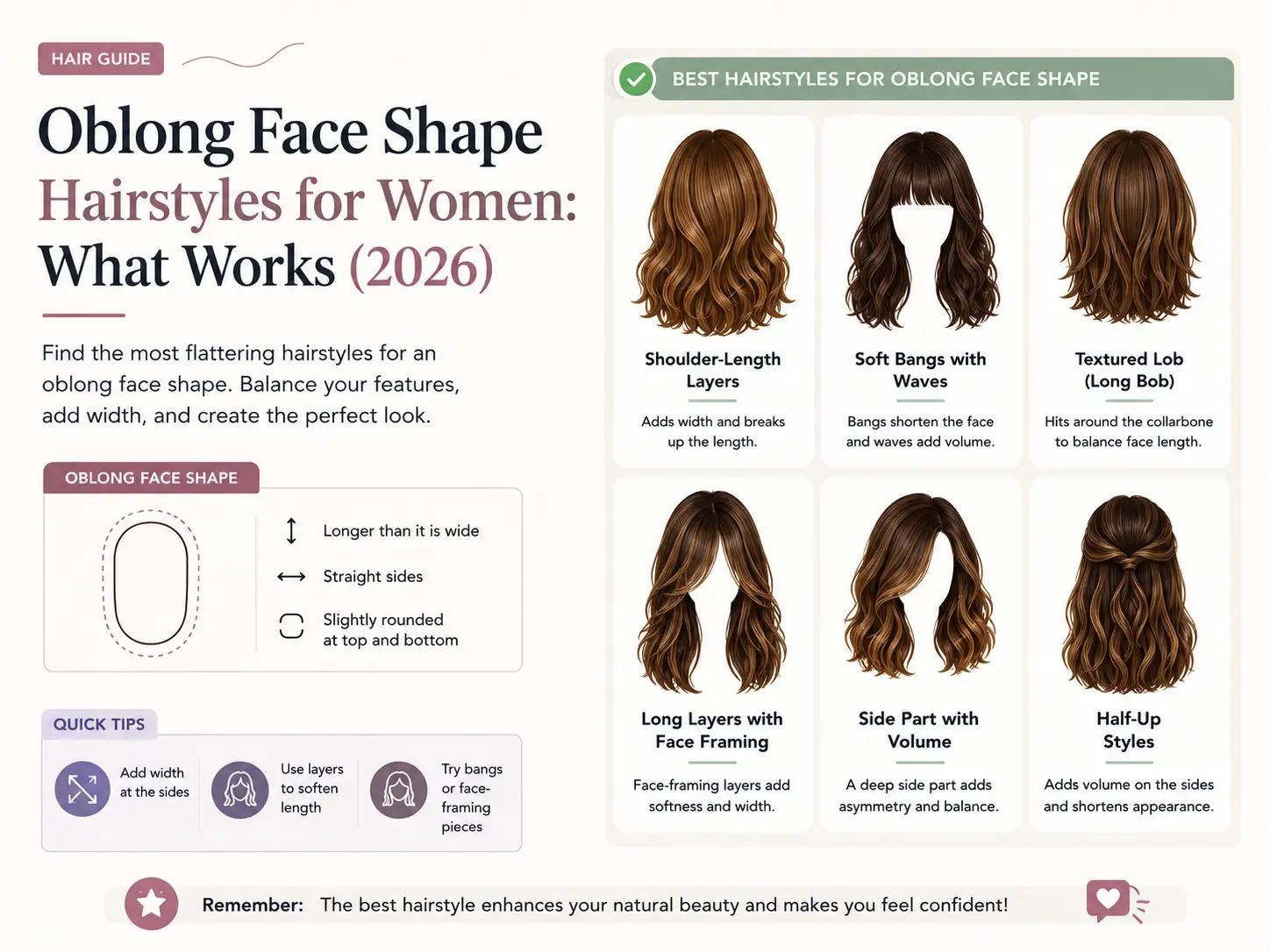
Quick answer:
The best hairstyles for an oblong face shape add horizontal width and break up the face’s vertical length. Curtain bangs, wolf cuts, chin-length bobs, and textured shags all do this. Straight, flat, centre-parted long hair makes an oblong face look longer. Every recommendation on this page follows one rule: add width across the face, not height above it.
Not sure if you have an oblong face? Confirm your shape free with the face shape calculator → It takes 2 minutes with a tape measure and tells you your exact length-to-width ratio — which matters, because how severely oblong your face is changes which options work best for you.
First: Oblong Is Not the Same as “Long Face”
Most hairstyle guides lump oblong and long faces together. They are different, and that difference changes your options.
An oblong face has a length-to-width ratio of 1.5 or higher, with the forehead, cheekbones, and jaw all measuring at roughly similar widths. The sides of the face are relatively straight — no single horizontal point is dramatically wider than the others. This is why oblong faces often look like an elongated rectangle when traced.
A “long face“ can describe an oval face that is simply on the taller side (ratio 1.3–1.45). That face has different proportions — cheekbones still wider than jaw, chin more tapered. The corrective techniques overlap, but they are not the same.
If you have been told you have a long face but you are not sure it is actually oblong, use the face shape calculator to measure your actual ratio before choosing a cut. The distinction changes which hairstyles help the most.
How Severe Your Oblong Proportions Are Changes Everything
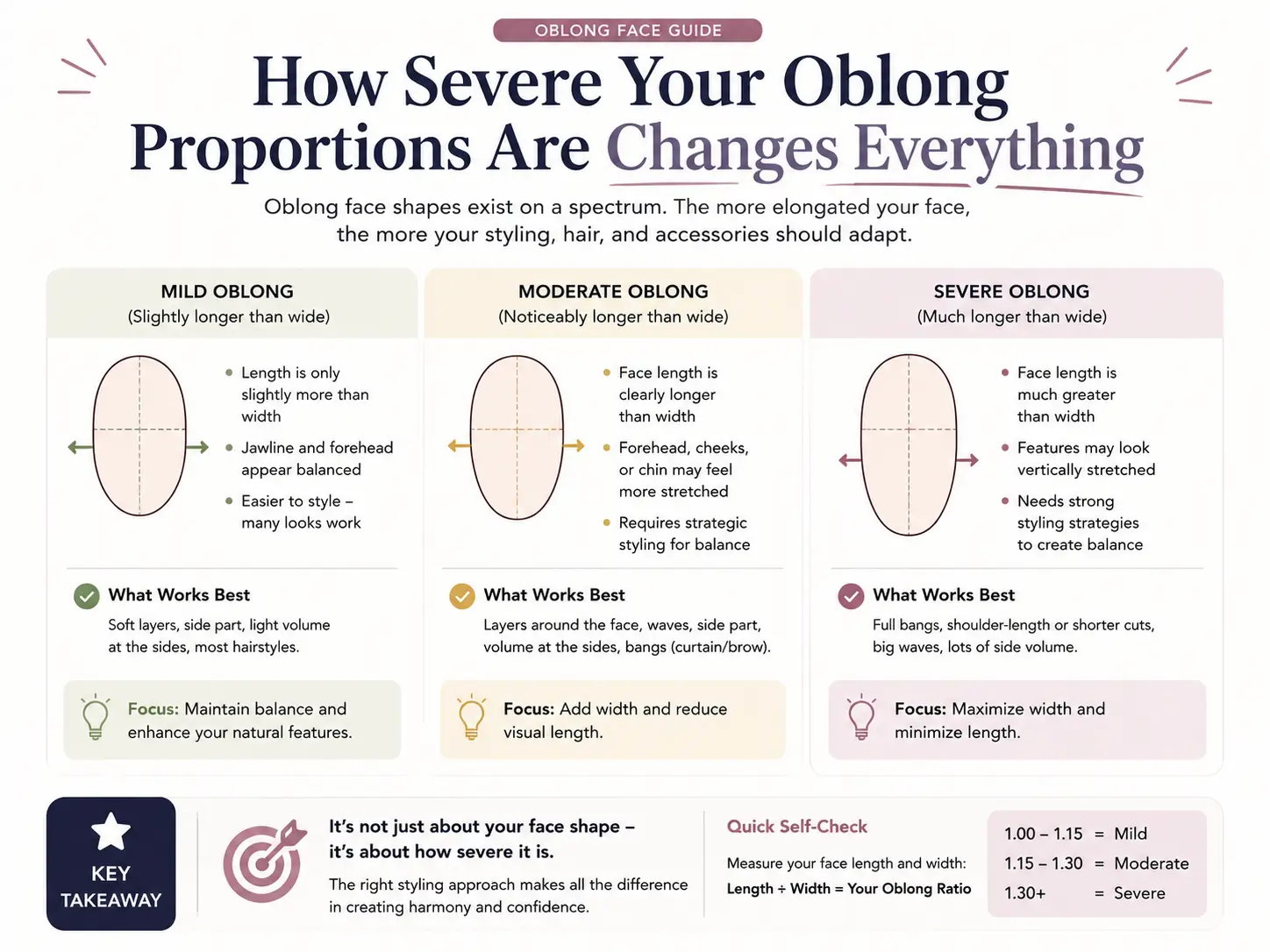
This is the most important thing on this page, and almost no guide mentions it.
An oblong face with a ratio of 1.5 sits just above the oval category. It has real flexibility — many styles work without strong correction techniques. A face with a ratio of 1.8 or above is significantly elongated and needs more deliberate horizontal techniques to look balanced.
Here is what that means in practice:
- Mild oblong (ratio 1.5–1.65): Light waves, face-framing layers, a soft side part — these moderate adjustments are enough. You do not need a full curtain fringe or a drastic bob.
- Moderate oblong (ratio 1.65–1.75): Curtain bangs, a layered lob, a wolf cut. These are the right-sized tools. Subtle adjustments alone will not noticeably change how balanced the face appears.
- Strong oblong (ratio 1.75+): Full fringe, blunt chin bob, wolf cut with strong side volume. You need the most deliberate horizontal techniques. Subtle options will feel ineffective.
If you do not know your ratio, the face shape detector calculates it from four measurements. Most women who have never measured are surprised — they expect a higher number than they have, because the visual experience of having an oblong face can feel more extreme than the actual ratio.
The One Styling Rule
Add width. Do not add height.
Every style below follows this principle. Anything that creates volume at the sides of the face, a horizontal visual line across the face, or movement that pulls the eye across rather than down — those are your friends. Anything that adds height at the crown or falls straight down alongside the face without texture — those work against you.
This rule does not mean every style is equally effective. The ones below are ranked within their sections by how strongly they serve the rule.
The Best Hairstyles — Organised by Hair Texture
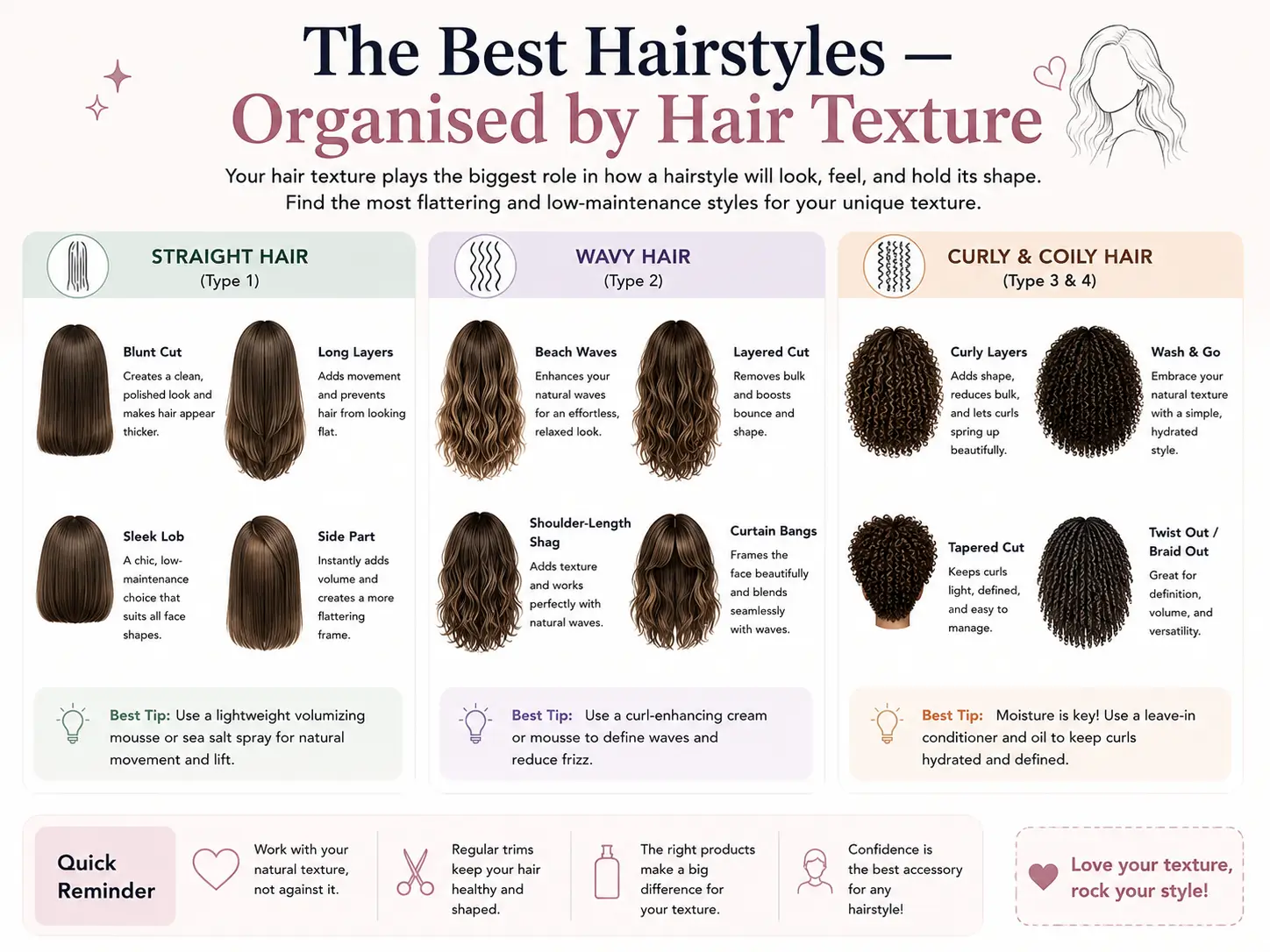
The biggest gap in existing oblong face shape guides: they treat all hair as the same. A wolf cut on fine straight hair and a wolf cut on thick coily hair are fundamentally different experiences. The principles are the same, but the specific techniques, products, and stylist instructions differ completely. This section organises the recommendations by hair texture so the advice is actually usable.
If You Have Straight or Fine Hair
Straight and fine hair does not create volume on its own, which means horizontal width needs to come from the haircut structure rather than natural texture. These are the most effective options.
Curtain Bangs
The highest-impact single change for straight-haired women with oblong faces. Curtain bangs part at the centre and sweep outward toward the temples, drawing a clear horizontal line across the forehead. On straight hair, they land cleanly and frame the face with minimal effort — a light blow-dry with a round brush or even air-drying with a small amount of smoothing product is enough.
What makes them work: the horizontal sweep interrupts the vertical line of the face immediately. The eye catches the fringe line before it travels the full face length. For straight-haired women, this is the single most visible improvement available without a full haircut change.
What to tell your stylist: “I want curtain bangs that sit between my brow line and my eyelashes, sweeping outward toward my temples. Keep them long enough to pin back on days I want them out of my face.”
Blunt Chin-Length Bob
A blunt bob ending at or just below the jaw creates a strong horizontal frame at the face’s lowest point. On straight hair, the blunt line has maximum visual impact — there is no wave or texture to soften it. This is a deliberate, graphic choice that works well for women who want a clean, modern result.
The version that works best for oblong faces on straight hair: ending 2–3 cm below the jaw rather than at it. A bob that ends exactly at the jaw can look like it is chopping off the face rather than framing it. Just below the jaw is more balanced.
On fine hair specifically, the blunt line also adds the appearance of thickness — the even, unbroken edge reads as denser than layered ends.
Side Part with Face-Framing Layers
For women with straight hair who want to keep length, a side part combined with face-framing layers is the minimum adjustment that improves oblong proportions. Centre-parted straight hair on an oblong face creates a near-perfect vertical column — two parallel straight sections falling alongside the face with nothing to draw the eye sideways. A side part breaks the symmetry. Face-framing layers at cheekbone level add width at the sides.
This combination is not as dramatically corrective as curtain bangs or a bob, but it is the most low-maintenance option for straight hair at longer lengths.
Collarbone Lob with a Flicked-Out Curl
A lob cut at collarbone length, styled with a slight outward curl at the ends using a large-barrel curling iron or roller, creates horizontal width at the bottom of the hairstyle. The outward flip adds perceived width right where the face needs it most — at jaw level and below. On straight hair, this requires light heat styling, but it holds well with a small amount of flexible hold product on the ends.
If You Have Wavy or Textured Hair
Wavy hair naturally creates horizontal volume, which is one of the most useful properties for oblong faces. The goal is to amplify that horizontal quality and direct it to the right parts of the face — the sides, at cheekbone level and below.
Wolf Cut
The wolf cut is one of the best contemporary choices for wavy-haired women with oblong faces because its entire structure is built on horizontal volume. The shaggy layers at crown level fan outward rather than upward, and the curtain fringe element (standard in most wolf cuts) handles the forehead.
On wavy hair, the wolf cut is close to self-styling — the natural wave amplifies the layered texture and side volume without any additional effort. It is one of the most low-maintenance options in this guide for women with natural wave patterns.
For oblong faces specifically, keep the overall length at shoulder level or shorter — very long wolf cuts can exaggerate the vertical proportion. Build fullness at the sides rather than at the crown.
What to tell your stylist: “I want the layers to build outward at cheekbone level, not upward at the crown. I need horizontal volume, not height.”
Textured Shag
The shag is a heavier, more densely layered version of the wolf cut. It creates more volume at the sides and typically sits shorter at the crown, making it particularly suited to wavy-haired women with moderate to strong oblong proportions who want maximum horizontal correction.
On wavy hair, a shag essentially self-styles — scrunch some curl cream in damp hair, air-dry, and the layers fall into place with natural volume at the sides. This makes it one of the most effortlessly low-maintenance options for wavy hair.
The soft wolf cut represents a natural evolution of the original wolf cut. Less shaggy and more controlled, it offers blended gradations and precisely placed volumes — easy to style every morning with very few products.
This softer version suits women who want the horizontal volume effect without a heavy, very layered result.
Wavy Lob at Collarbone Length
A lob on wavy hair does something straight hair cannot: the waves naturally flare outward from the cut ends, creating horizontal volume at jaw and collarbone level automatically. The wavy lob is one of the most effortless width-adding styles available for oblong faces because the correction is built into the hair’s natural movement.
The one instruction that matters: the waves need to start at cheekbone level, not only at the ends. If only the ends wave and the rest of the hair is straight, the horizontal width effect appears only at the bottom — which is helpful but not as complete as waves from mid-length downward.
If You Have Curly or Coily Hair
Curly and coily hair naturally creates volume in all directions, which means the challenge for oblong faces is different: the goal is to direct the volume outward and sideways rather than upward, which is where curly hair naturally wants to go.
Side-Parted Curls with Volume at the Sides
A side part on curly hair is one of the most effective adjustments for oblong-faced women with natural texture. The centre part on curly hair can create a vertical column of curl mass that emphasises face length. A side part shifts the balance and creates more horizontal volume on the fuller side.
On 3A–3B curls, this is often enough of an adjustment on its own, combined with keeping the length at shoulder level or shorter.
On 4A–4C coils, shrinkage means the effective length is shorter than it appears when dry. This can actually work in your favour — the shrunken coil at shoulder level creates significant side volume that adds horizontal width naturally. Focus on keeping volume at the sides equal to or greater than volume at the top.
Blowout Bob with Volume at the Sides
A bob on curly/coily hair, styled with a blowout or twist-out that builds volume outward at the sides rather than upward, creates strong horizontal width. The key instruction for your stylist: “Cut this to chin or just-below-jaw length with the expectation of shrinkage, and layer it to allow volume to expand sideways.”
On 4C hair specifically, a chin-length blowout bob can create dramatic horizontal width that is extremely flattering for oblong faces. The volume that appears at jaw level frames the face exactly where width is needed most.
Crown-Controlled Puff
For natural coily hair, a puff or bun that keeps volume controlled at the crown but allows some strategic volume at the temples and sides — rather than a high, perfectly round puff that adds vertical height — can balance oblong proportions. This is more of a styling technique than a cut, but it is one of the most practical daily-wear options for women with 4B–4C hair who want to wear their natural texture.
What to avoid: a very high, perfectly round puff or bun that sits directly on top of the head. This adds height at the crown — the opposite of what oblong proportions need.
Hairstyles Ranked by How Much Effort They Take to Maintain
Because knowing a hairstyle works is different from knowing whether it works for your lifestyle.
| Style | Effort Level | Who It Suits Best |
|---|---|---|
| Wolf cut (wavy hair) | Low — air-dry | Wavy hair, moderate to strong oblong |
| Textured shag (wavy/curly) | Low — scrunch and go | Wavy or curly, strong oblong |
| Curtain bangs (straight) | Low-medium — 5 min blowdry | Straight/fine hair, any oblong severity |
| Side part + face-framing layers | Very low | Any texture, mild oblong |
| Wavy lob | Low-medium | Wavy hair, mild to moderate oblong |
| Blunt chin bob (straight) | Medium — blowdry needed daily | Straight/fine, moderate to strong oblong |
| Collarbone lob with curl | Medium — curling iron needed | Straight hair, mild to moderate oblong |
| Curly/coily bob with volume at sides | Medium — depends on styling routine | Curly/coily hair, any oblong severity |
| Full blunt fringe | Medium — needs regular trimming every 3–4 weeks | Any texture, strong oblong |
What to Tell Your Stylist
The gap between knowing which hairstyle you want and leaving the salon with it is often a communication problem. These are the specific phrases that get you the right result for each major style:
- For curtain bangs: “I want curtain bangs that sit between my brow and lashes, sweeping outward toward my temples. Keep them long enough to tuck behind my ears on days I want them out of the way. My face is oblong, so I need the horizontal sweep — please do not cut them too short.”
- For a wolf cut: “I have an oblong face. I need the layers to build outward at cheekbone level and create width at the sides, not height at the top. Please keep the crown layers from adding volume upward — that will make my face look longer.”
- For a blunt chin bob: “I want a blunt lob ending 2 cm below my jaw, with a slight curl outward at the ends. No graduation or significant layering — I want the horizontal line of the cut to be visible. My face is oblong so the horizontal element is important.”
- For a shag: “I want a textured shag with the volume concentrated at the sides rather than the top. I have an oblong face so I specifically need the width, not the height. Curtain bangs please — kept long enough to part easily.”
What to Avoid — and Why, Not Just What
- Long, straight, centre-parted hair with no texture: This is the single most counterproductive choice for oblong faces and the most common one. It creates an unbroken vertical visual column from crown to ends. If you have long hair and an oblong face, the minimum adjustment is a side part and some wave or layer. Long hair is not automatically wrong — long hair without any horizontal element is.
- High updos, top knots, and high buns: These add height at the crown, which increases the perceived vertical length of the face. A bun worn low at the nape of the neck does not have this problem. The height of the updo is the issue, not updos in general.
- Very tight, close-cropped pixies with no side volume: A pixie that sits close to the head and has no volume at the sides or temples removes the width element entirely. A pixie can work on an oblong face, but it needs volume at the temples and sides — ask your stylist specifically for this.
- Sleek ponytails pulled straight back: These expose the full face length and remove any horizontal framing element. A ponytail with some volume at the sides of the head, or worn slightly lower, is a better option.
Frequently Asked Questions
What is the best hairstyle for an oblong face shape woman?
The highest-impact hairstyles for oblong-faced women are curtain bangs, wolf cuts, chin-length bobs, and textured shags. All of these add horizontal visual width — the core need for oblong proportions. Which is best for you depends on your hair texture and how severe your oblong ratio is.
A mild oblong (ratio 1.5–1.65) gets significant improvement from light waves and a side part. A strong oblong (ratio 1.75+) needs more deliberate techniques like a full fringe or a blunt bob with strong horizontal emphasis.
Are bangs good for an oblong face shape?
Yes, bangs are one of the most effective tools for oblong faces. A full blunt fringe creates the strongest horizontal interruption — it draws a line across the forehead that immediately shortens the perceived face length. Curtain bangs are the most versatile option in 2026: they add the horizontal element, work with almost any hair length, and grow out gracefully.
Side-swept bangs are the most low-maintenance version. All three work. The question is how much correction you need — full fringe for a strong oblong, curtain or side-swept for a mild or moderate one.
Should oblong faces avoid long hair?
No, but long hair on an oblong face needs modification to avoid making the face look longer. The problematic version is long, flat, straight hair with a centre part and no texture — this is essentially the visual opposite of what oblong faces need.
Long hair with substantial waves, face-framing layers, and a side part can be flattering. The waves and layers create the horizontal volume that long straight hair removes. If you want long hair, waves and a side part are non-negotiable adjustments.
Does the wolf cut suit an oblong face shape?
Yes. The wolf cut is one of the best contemporary choices for oblong faces specifically. Its structure delivers curtain fringe (which shortens forehead perception), shaggy layers that fan outward at the sides (which add width), and overall texture that creates horizontal visual interest.
On wavy hair, it is also one of the lowest-maintenance options because the natural wave amplifies the horizontal volume automatically. The one modification for oblong faces: ask the stylist to build fullness outward at the sides rather than upward at the crown.
What is the worst hairstyle for an oblong face?
Long, centre-parted, straight hair with no texture or layers. It is the combination most likely to make an oblong face appear longer because it removes every horizontal element simultaneously. Second worst: a high top-knot or bun directly at the crown, which adds perceived height above an already-long face.
What do I tell my stylist if I have an oblong face?
Tell them your face is oblong and that you need horizontal width, not vertical height. Give them the specific instruction: “I need volume and width at the sides at cheekbone level — not crown volume or height at the top.” Then add the specific request for whichever cut you want. Most stylists understand this immediately once you frame it that way.
Before You Book: Check Your Exact Proportion
The severity of your oblong proportion — your specific length-to-width ratio — changes which options are most effective. A ratio of 1.5 is close to oval and has lots of flexibility. A ratio of 1.8 needs stronger horizontal techniques.
Measure your ratio free with the face shape calculator → Enter your four measurements and get your exact result in under two minutes. It will also tell you whether you are close to oval, moderate oblong, or strongly oblong — which directly tells you how much correction your proportions actually need.
