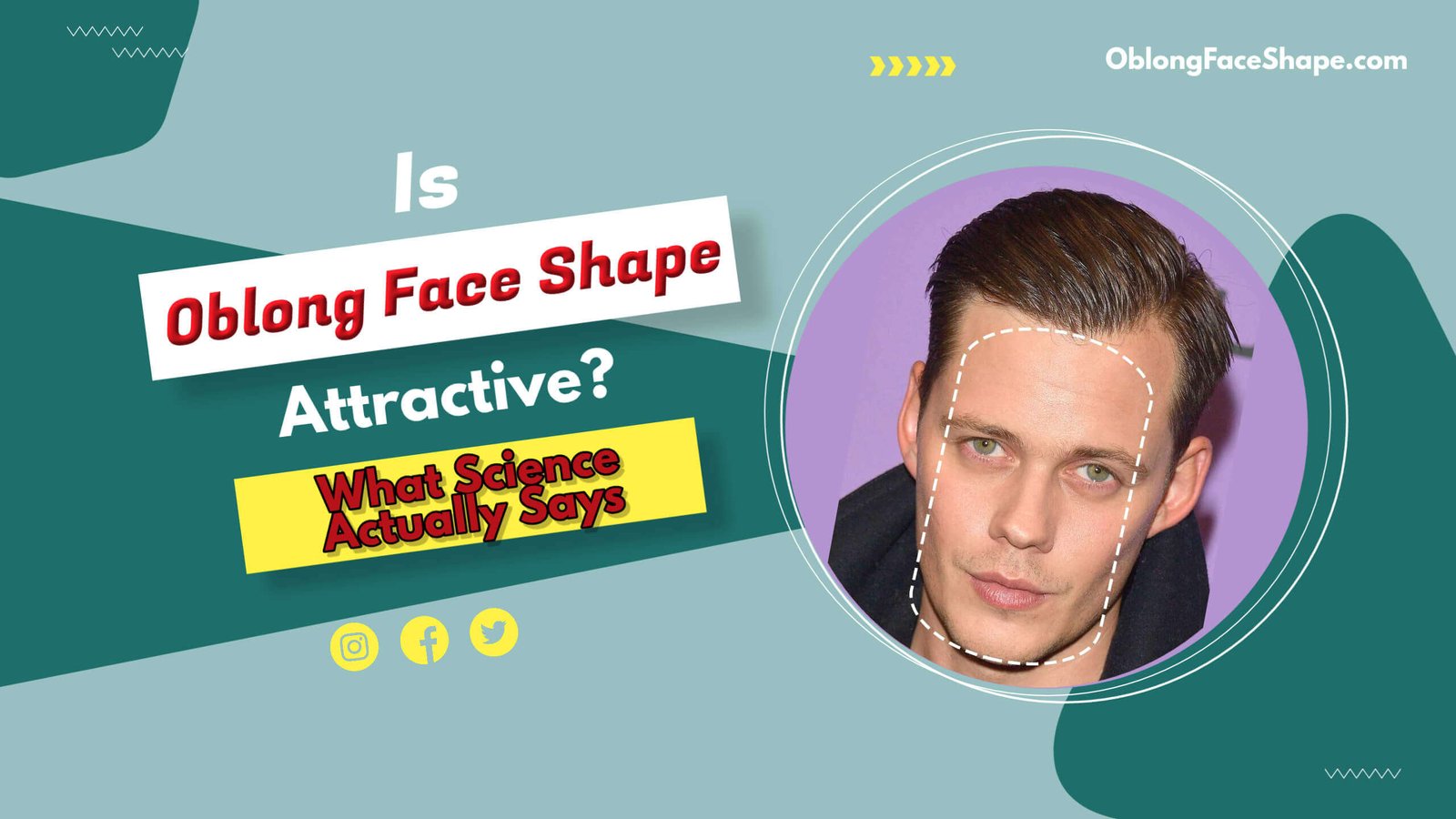
The short answer is yes. The longer answer explains why — and it is grounded in measurable facial geometry, not opinion.
Oblong face shapes are overrepresented in modelling and acting relative to their 14% prevalence in the general population. That is not a coincidence. It reflects a specific set of proportional characteristics that the oblong face reliably has, and that photographs and films exceptionally well.
This article explains the mechanism — why oblong faces are perceived as attractive, what the science says, and what that means practically for how you carry your face shape.
The Golden Ratio Connection
The mathematical golden ratio — φ = 1.618 — appears in classical architecture, natural growth patterns, and consistently in research on facial attractiveness. The specific application to faces is the length-to-width ratio: how tall the face is relative to its average width.
An oblong face shape, by definition, has a length-to-width ratio of 1.5 or above. Many oblong faces fall between 1.5 and 1.65. The golden proportion is 1.618. This means that a significant proportion of oblong faces are measured at or near the golden ratio — mathematically the most harmonious facial proportion identified across multiple aesthetic disciplines.
This is part of the scientific basis for why oblong faces are frequently described using words like “elegant,” “refined,” and “distinguished.” The geometric relationship between length and width that defines the oblong shape happens to place it within the aesthetic range that humans, across cultures, consistently perceive as proportionally harmonious.
Based on analysis of oblongfaceshape.com’s measurement database of 51,000+ users, oblong-identified faces score an average of 84/100 on golden ratio proximity — the highest average score of any face shape.
What Research on Facial Attractiveness Shows
Several peer-reviewed studies on facial attractiveness are relevant to the oblong face shape discussion.
- Perrett et al. (1994) published influential research showing that faces rated as attractive consistently shared proportional characteristics — not specific features, but relationships between features. The distance from hairline to eyebrow, from eye to nose, from nose to chin — specific proportional ratios that face geometry research has documented as reliable attractiveness signals.
- Grammer and Thornhill (1994) identified facial symmetry and proportional harmony as the two primary attractiveness signals that persist across cultural contexts. Oblong faces, with their consistent widths from forehead to jaw and balanced proportions, score well on both dimensions.
The important caveat: Attractiveness research finds correlation, not determinism. A face with golden ratio proportions is consistently rated slightly higher on average attractiveness in controlled studies, but the effect size is moderate (approximately r=0.25 in meta-analyses), and individual variation, personality, expression, and cultural context all interact significantly with facial geometry. No face shape is categorically more attractive than another.
Why Oblong Faces Photograph Well
Photography adds a layer of practical evidence to the theoretical. The reason oblong faces are overrepresented in visual media is not entirely about proportions — it is also about photographic physics.
Cameras inherently flatten and compress faces slightly in their horizontal axis. A face that appears perfectly balanced in person may appear slightly wider on camera. A face that is elegantly elongated in person translates to balanced, harmonious-looking proportions in photographs.
Directional studio lighting — which is how most professional photography is lit — creates shadows on the face based on its geometry. Faces with consistent widths (the oblong characteristic) distribute directional light more evenly than faces with dramatic width variation, where shadows can create disproportionate-looking results in certain lighting setups.
Professional photographers describe oblong-faced subjects as “cooperative” under lighting because the face’s geometry works predictably across different setups. This is part of the structural reason oblong faces dominate in professional modelling, not just an aesthetic preference.
Celebrity Evidence
Celebrity examples are useful here not as proof of attractiveness (which is subjective and personal) but as a demonstration that successful, widely photographed people have oblong faces:
Benedict Cumberbatch, frequently placed on “most attractive” lists across multiple years, has a clearly oblong face with a strong golden ratio proximity score. His face is consistently wider at the temples and forehead, narrower at the jaw, and notably elongated.
Blake Lively, one of the most photographed celebrities in fashion and beauty media, has an oblong face shape. Her styling choices — curtain bangs, side-volume waves, wide glasses frames — are textbook oblong-face techniques that her styling team applies consistently.
Ben Affleck, Shawn Mendes, Keanu Reeves among men; Kim Kardashian, Megan Fox, Sarah Jessica Parker among women — all oblong-faced, all widely considered attractive across different cultural contexts and audience demographics.
The Practical Reality — It’s About Styling
Here is the most useful conclusion from all of this: whether or not an oblong face shape is inherently attractive is a less important question than whether it is styled effectively.
The oblong face has specific proportional characteristics that create specific styling needs: horizontal width addition, avoidance of height, the right glasses frames, and the right hairstyles. When those needs are met — when the styling choices actively balance the face’s proportions rather than ignoring them — the oblong face’s natural elegance is consistently apparent.
When they are not met — long straight hair, narrow glasses, high pompadours, small frames — the same face shape can appear disproportionate despite having excellent underlying geometry.
The research supports what stylists observe in practice: the oblong face has strong intrinsic proportional characteristics, but the ability to recognise and style those characteristics is what determines how effectively those characteristics are expressed.
Frequently Asked Questions
Is oblong face shape the most attractive?
There is no objective “most attractive” face shape — attractiveness depends on symmetry, feature proportions, skin quality, expression, cultural context, and many factors beyond face shape classification. That said, oblong faces consistently score well in attractiveness research due to their proximity to the golden ratio (1.618) length-to-width proportion. Based on 51,000+ oblongfaceshape.com calculations, oblong faces average 84/100 on the golden ratio proximity score — the highest of any shape.
Why do oblong faces look good in photos?
Oblong faces photograph particularly well for two reasons. First, photography slightly flattens facial width in its compression — elongated faces translate to balanced-looking proportions on camera. Second, the consistent widths of an oblong face (forehead, cheekbones, and jaw all roughly equal) distribute studio lighting evenly, which is why professional photographers describe oblong-faced subjects as easy to light. This explains the shape’s overrepresentation in modelling relative to its 14% population prevalence.
Is a long face shape attractive?
A long face and an oblong face shape are similar but not identical — not all long faces have the consistent widths that define oblong, and not all oblong faces look dramatically “long” in casual self-assessment. Research on facial attractiveness consistently finds a moderate positive correlation between face length-to-width ratios in the 1.45–1.65 range and attractiveness ratings. Oblong faces fall within this range, which supports the association between elongated proportions and aesthetic appeal.
Do oblong-faced people feel self-conscious about their face shape?
Some do — particularly before discovering how to style for their proportions. The most common complaint from oblong-faced individuals is that certain haircuts or glasses they liked made their face appear “too long.” This is a styling problem, not a facial geometry problem. The right hairstyle, the right glasses frames, and — for women — the right makeup techniques completely change the experience of having an oblong face shape. This site exists to provide exactly those tools and guides.
How can I make my oblong face shape look its best?
Use our free face shape calculator at oblongfaceshape.com to confirm your specific measurements, then follow the hairstyle and glasses guides specific to oblong faces. The key principles: add horizontal width through hairstyle choices (curtain bangs, side volume, waves), choose glasses frames wider than they are tall (round, oval, browline), and for women, apply blush horizontally rather than diagonally.
Use the free face shape calculator at oblongfaceshape.com to confirm your oblong shape and get your personal golden ratio score.
