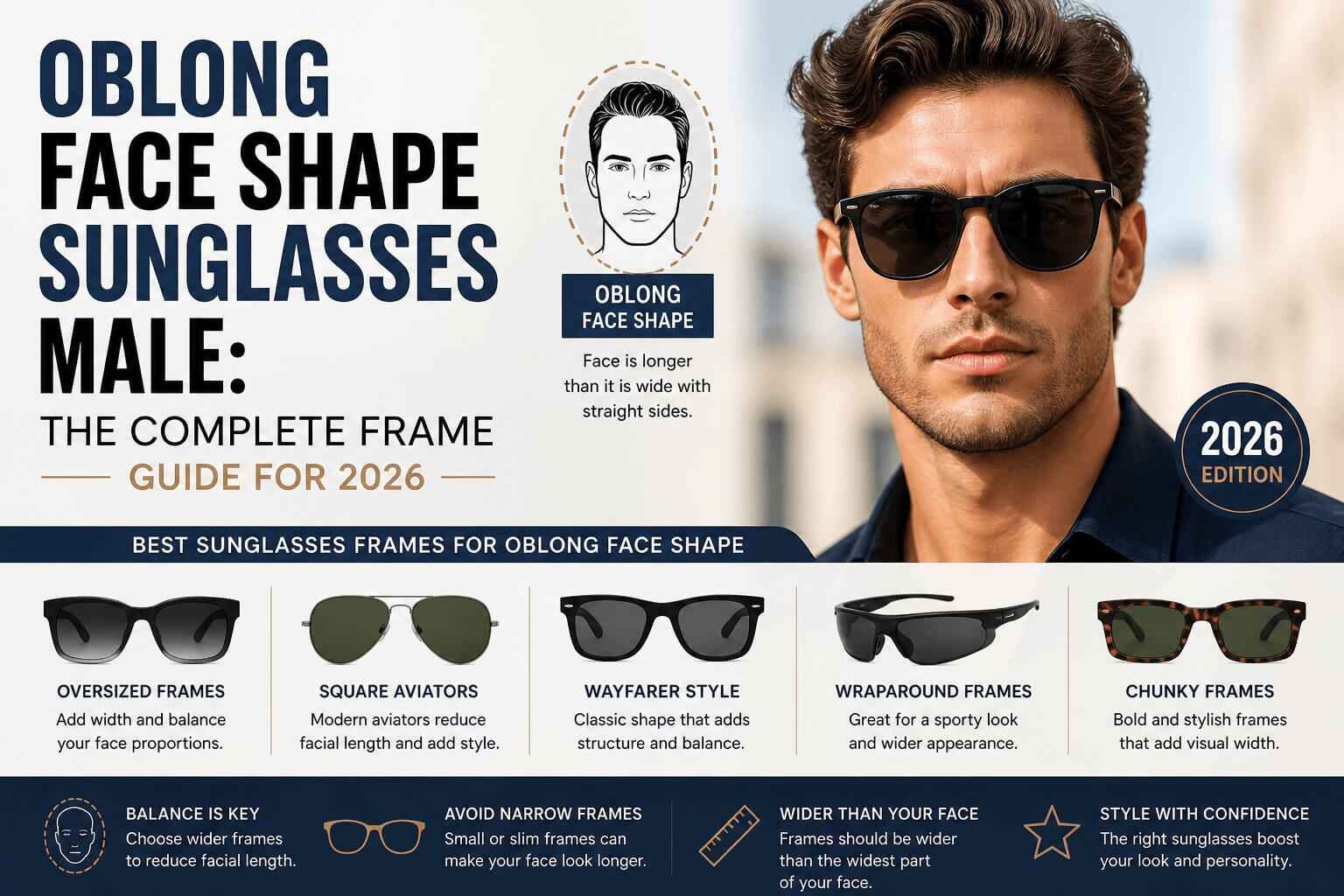
Quick answer:
Men with an oblong face shape need sunglasses that are wider than they are tall. Wide aviators, oversized square frames, and browline styles are the strongest choices. The goal is to add horizontal width — which makes the face look more balanced. Narrow, small, or vertically oriented frames make a long face look even longer. If you want a single recommendation without reading the full guide: wide aviators, 60mm lens width or more.
If you are not certain whether you have an oblong face shape — or a long face, a rectangular face, or something close to oval — use the free face shape calculator to measure your ratio before buying frames. Your exact L/W ratio changes which frame size is most effective.
The One Rule, and Why It Works
An oblong face is notably longer than it is wide. The sides of the face run relatively straight from the temples to the jaw — no single horizontal point (cheekbones, forehead, jaw) is dramatically wider than the others. Stylists also call this shape a long face, a rectangular face, or an elongated face. All four terms describe the same proportional characteristic.
The frame solution follows directly from the problem. A wide sunglasses frame — wider than tall, extending to or past your outer eye corners — adds a strong horizontal line across the face. That horizontal line makes the face read as wider and therefore less elongated. A narrow or small frame adds nothing, or worse, draws a short vertical element that emphasises length.
The practical test when shopping: look at the lens dimensions (listed in mm on most product pages). Lens width should be greater than lens height, ideally by at least 15–20%. A frame with a 58mm lens width and 38mm lens height is well-proportioned for an oblong face. A frame with a 46mm lens width and 42mm lens height works against it.
10 Best Sunglasses for Men with an Oblong Face Shape
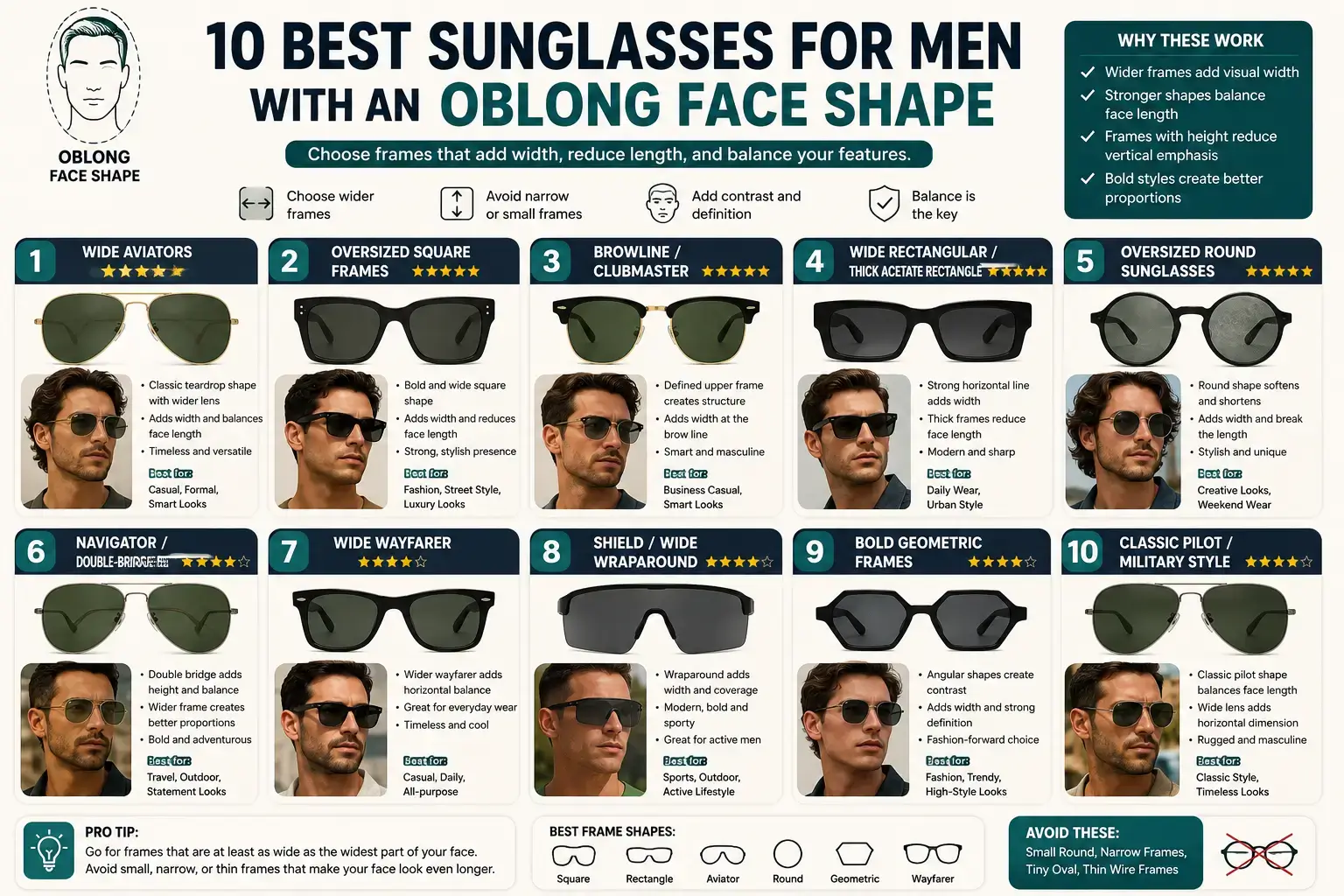
1. Wide Aviators — Rating ★★★★★
Wide aviators are the single most versatile and consistently recommended choice for men with oblong or long faces. The teardrop-shaped lens fans outward from the bridge, adding horizontal emphasis at precisely eye level — the most important place. The double bridge (the two connecting bars across the nose) creates an additional horizontal accent that reinforces the width signal.
The critical detail: Not all aviators suit oblong faces. Standard aviators in sizes 55–57mm are too narrow. For an oblong face, you need the oversized or “large” version — 60mm lens width or above. In that size, wide aviators are excellent. In standard size, they are borderline.
- What to tell the salesperson: “I need wide aviators — 60mm lens width or bigger. Not the standard teardrop.”
- Celebrity reference: Ben Affleck consistently wears wide-frame aviators and browline sunglasses. His face is a confirmed oblong proportion. Look at which specific aviator sizing he gravitates toward — it is always the larger sizing.
- 2026 context: Oversized aviators in gold, silver, and matte black are strong in men’s eyewear this year. All three finishes suit oblong faces well.
- Look for: Lens width 60mm+, double bridge, metal frame in gold or silver.
2. Oversized Square Frames — Rating ★★★★★
Oversized square frames in thick acetate are the most geometrically powerful choice for oblong-faced men. The angular geometry adds structure; the large size adds significant horizontal width; the thick acetate adds visual mass that a metal frame cannot match at the same dimensions.
The combination of all three — angular, large, thick — creates maximum horizontal emphasis. Square frames are particularly useful for men whose oblong face also has softer features, because the geometry of the frame adds the definition that the face lacks.
- What to look for: Lens width 54mm or above, lens height 40–45mm, thick acetate frame in black or tortoiseshell.
- Celebrity reference: Will Smith and Kanye West have both reached for oversized square sunglasses as a consistent choice — both have oblong-adjacent proportions, and both demonstrate how effectively the wide square frame balances a long face.
- 2026 context: Oversized thick acetate squares are at peak popularity in men’s fashion right now. Black and tortoiseshell are timeless; amber and deep navy are the 2026 additions.
3. Browline / Clubmaster — Rating ★★★★★
Browline sunglasses have a thick, prominent bar across the top of the frame — the “brow” — and a lighter, thinner lower rim. This structure creates a strong horizontal line at brow level that immediately draws the eye across the face rather than down it.
For oblong-faced men, the browline style is one of the most effective because the heavy upper bar does almost all of the work. You do not need a particularly wide overall frame — the horizontal emphasis comes from the brow bar itself.
- What to look for: Dark, substantial brow bar — black or tortoiseshell acetate. Classic proportions. Width 52mm+.
- Celebrity reference: Benedict Cumberbatch has been photographed in browline and round frames repeatedly. His face is a textbook oblong shape — notably long with consistent widths at the forehead, cheekbones, and jaw.
4. Wide Rectangular / Thick Acetate Rectangle — Rating ★★★★★
A wide rectangular frame in thick acetate is one of the most reliable daily-wear choices for oblong-faced men. Slightly different from oversized square frames: rectangles tend to be wider relative to their height, creating an even stronger horizontal emphasis, while having a more understated shape than bold oversized squares.
This is the safest, most universally appropriate choice — works for casual, smart-casual, and most professional settings. If you only buy one pair of sunglasses, this is it.
- What to look for: Lens width 55mm+, lens height under 42mm, thick frame in black or tortoiseshell. Avoid thin metal rectangles — they lose the horizontal mass effect.
5. Oversized Round Sunglasses — Rating ★★★★★
Round frames seem counterintuitive for a long face, but oversized round sunglasses work precisely because their width exceeds their height and their curved shape provides maximum contrast against the linear, rectangular oblong face outline.
The key word is “oversized.” Small round frames (under 50mm) look completely wrong on an oblong face — they add a tiny circular element that disappears against the face’s length and provides no horizontal balance. At 52mm or above, round frames become genuinely effective.
- What to look for: Diameter 52mm or above. Acetate or thick metal frame. Small round sunglasses are the wrong choice — go large.
6. Navigator / Double-Bridge Frames — Rating ★★★★☆
Navigator frames — squared at the top with a teardrop lower lens — and frames with a double bridge share a useful property: they create visual interest and horizontal emphasis at multiple levels of the face simultaneously. The flat squared top provides a horizontal line; the double bridge creates a second horizontal accent at nose level.
This style was popularised by military and pilot eyewear and has strong 2026 relevance in men’s fashion through its association with workwear-influenced styling.
- What to look for: Wide lens dimensions (55mm+), flat or squared top rim, pronounced double bridge.
7. Wide Wayfarer — Rating ★★★★☆
Classic wayfarer shapes — angular, slightly trapezoidal, with a bold flat-top rim — work well for men with long or oblong faces when sized large. The flat horizontal top creates a defined width line; the angular shape adds structure.
“Wayfarer sunglasses for oblong face” is a common search precisely because the classic wayfarer shape instinctively reads as flattering to many people with long faces. The instinct is right — but only in the larger sizes.
- What to look for: Large or extra-large Wayfarer sizing. Lens width 53mm or above. Black acetate is the classic choice. Standard-size Wayfarers (50–52mm) are too narrow for strong oblong proportions.
8. Shield / Wide Wraparound — Rating ★★★★☆
Wide shield-style sunglasses that span the full width of the face in a single lens or continuous frame create bold horizontal emphasis. For casual, outdoor, and active settings, they are one of the most effective choices — and one of the most comfortable for extended wear in the sun.
- The distinction that matters: wide shield styles (where the frame extends well past the outer eye corners) suit oblong faces. Narrow wraparounds that hug the face closely do not — they add a tight, narrow element that follows the face’s contour rather than correcting it.
- 2026 context: Shield and wraparound styles are growing in men’s casual and sport eyewear. Several major brands have released fashion-forward wide shield styles that work as lifestyle choices, not just sport accessories.
9. Bold Geometric Frames — Rating ★★★★☆
Hexagonal, octagonal, and other wide angular geometric frames add both horizontal width and visual interest. The sharp angles create structure that contrasts with the oblong face’s softer silhouette, and when the geometric shape is oriented horizontally (wider than tall), it provides the width signal needed.
- What to look for: Horizontal orientation — the frame should be wider than tall. Flat-top geometric styles (hexagonals with a straight top) are particularly effective because they combine a strong horizontal upper line with angular geometry.
- 2026 context: Bold geometric frames are a top men’s eyewear trend. Architectural shapes in both metal and acetate are widely available.
10. Classic Pilot / Military Style — Rating ★★★★☆
Military pilot frames — a squared variation on the classic aviator with flatter, less teardrop-shaped lenses — combine the horizontal brow bar of browline styles with the extended width of aviators. They sit at the intersection of structured geometry and wide proportions.
- What to look for: Flat-top squared versions (not the rounded teardrop). Width 56mm+.
Frame Size Guide: What the Numbers Mean
When shopping online, most sunglasses list three numbers: lens width × lens height × bridge width (in mm). For example: 58 × 38 × 16.
For men with an oblong or long face:
- Lens width: 55mm minimum. 58–62mm is ideal.
- Lens height: Keep below 44mm. This is the height restriction — tall lenses add vertical emphasis.
- Width-to-height ratio: Width should be at least 1.3× the height. A 58×40 lens (1.45 ratio) is good. A 50×46 lens (1.09 ratio) is wrong.
- Total frame width: Should reach or slightly exceed your cheekbone width. Hold the frame up — if it sits noticeably inside your outer eye corners, it is too narrow.
- Frame weight: Thick acetate frames carry more horizontal visual mass than thin metal at the same dimensions. Both can work, but thick acetate is the safer choice when frame size is borderline.
What Not to Buy
- Narrow wrap-around sports styles: That hug the face closely. These create a tight, narrow visual band that follows the face’s length without adding any width.
- Small round frames: The miniature circle trend (sub-48mm) looks disproportionate on any long or oblong face. The small circular element disappears relative to the face’s length and provides no horizontal correction.
- Tall narrow rectangles: Where the lens height approaches or exceeds the lens width. These add a vertical element to a face that is already vertical-dominant.
- Very thin metal frames with small lenses: They simply disappear on an oblong face and provide no horizontal signal at all.
- Standard-size aviators without checking the lens width: Many popular aviator styles run 55–57mm — adequate but not strong. Always check whether you are buying the standard or the large/oversized version.
Frequently Asked Questions
What sunglasses suit men with an oblong face shape?
The best sunglasses for men with an oblong or long face are frames wider than they are tall, in sizes large enough to extend to or past the outer corners of the eyes. The top choices are wide aviators (60mm+ lens width), oversized square frames, browline sunglasses, and wide rectangular frames in thick acetate. The consistent principle across all of them: horizontal width emphasis, generous sizing, substantial frame presence.
Are aviators good for men with an oblong or long face?
Wide or oversized aviators are excellent. Standard aviators (55–57mm) are borderline — they have the right shape but not always enough width. Look specifically for the large or oversized version of any aviator model, with a lens width of 60mm or above. Ben Affleck’s consistent choice of wide-frame aviators is the clearest celebrity demonstration of this.
What is the best frame size for an oblong face?
Lens width 55–62mm, lens height under 44mm. The width-to-height ratio of the lens should be at least 1.3:1 — meaning the lens is at least 30% wider than it is tall. Total frame width should match or slightly exceed your cheekbone width. When in doubt, size up — oblong faces carry large frames without them looking oversized.
Can men with an oblong face wear square sunglasses?
Yes — oversized square sunglasses in thick acetate are one of the strongest choices for oblong-faced men. The angular geometry adds structure; the large size adds horizontal width. Square frames and oblong faces work well together precisely because the square’s horizontal width directly addresses the oblong’s vertical dominance.
What is the difference between an oblong face and a long face for sunglasses selection?
There is no meaningful difference for sunglasses selection. “Oblong face,” “long face,” “rectangular face,” and “elongated face” are all terms that describe the same proportional characteristic: a face that is notably longer than wide. The sunglasses recommendation is identical for all four terms: wider than tall, generously sized, substantial frame presence.
What are the best sunglasses brands for men with oblong faces?
Any brand that offers genuinely wide sizing in the frame styles above. Specific models that consistently suit oblong faces: Ray-Ban RB3025 Aviator in size 62mm (the large version), Ray-Ban RB2132 Wayfarer in size 55, Persol PO3195S (wide rectangular), and Oliver Peoples Cary Grant. Online brands like EyeBuyDirect and Zenni allow filtering by frame width, which makes it easier to find wide options at lower price points.
Before You Buy
If you are between sizes or unsure how extreme your oblong proportions are, measure your face length and average width, then use the face shape calculator to get your exact L/W ratio. A ratio of 1.5 is moderately oblong and has flexibility with frame sizing. A ratio of 1.7 or above benefits strongly from the larger, bolder options above — anything subtle will look disproportionate.
