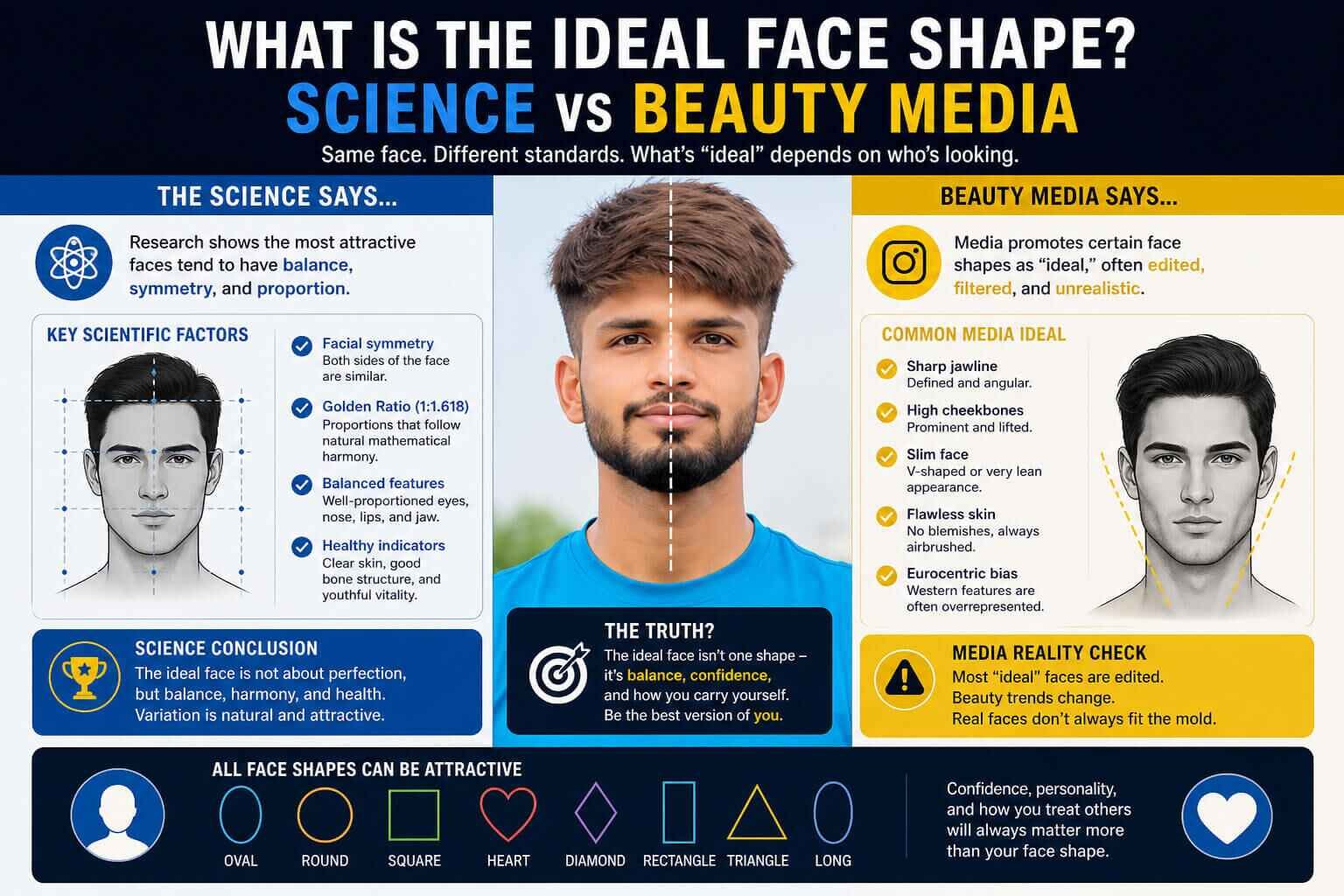
Most beauty sites will tell you that oval is the ideal face shape. Some say, heart. A few say the golden ratio decides.
All three answers are partially right — and incomplete in ways that matter.
“Ideal” in facial aesthetics is not a single answer. It is a question with three variables: what metric you use to define ideal, whose cultural context you’re applying, and whether you are discussing appearance or styling versatility. Get clear on which question you’re actually asking, and the answer becomes genuinely useful rather than aspirationally vague.
What “Ideal” Actually Means in Facial Geometry
Facial attractiveness research uses three distinct frameworks, and they do not always agree:
Framework 1 — The Golden Ratio (1.618)
The golden ratio — φ = 1.618 — applied to faces means the face length divided by its width produces a result near 1.618. Faces approaching this ratio are consistently rated as more attractive across cultural contexts in peer-reviewed studies, including foundational work by Farkas (1994) on facial anthropometry.
Which face shape sits closest to 1.618? Oblong faces — with L/W ratios of 1.5–1.65 — are geometrically nearest. Based on oblongfaceshape.com’s database of 51,000+ calculations, oblong faces average a golden ratio proximity score of 84/100, the highest of any shape category.
Framework 2 — Symmetry and Proportion Balance
The distance from the hairline to the eyebrow, from the eyebrow to the bottom of the nose, and from the bottom of the nose to the chin should all be roughly equal. This vertical thirds rule favours oval faces — their proportions naturally distribute facial height into near-equal thirds more consistently than elongated or wide faces.
Framework 3 — Cultural and Gender Preference
Responses showed that the majority of participants preferred an oval face shape, with a smoothly tapered jawline for both men and women, and a round, pointed chin for both genders. A separate study of Chinese aesthetic practitioners found a preference for heart-shaped and inverted-triangular shapes with a narrower lower face height — the most preferred was a narrow lower face and a pointed chin at 51.9%, followed by oval at 36.5%.
The practical conclusion: there is no single globally agreed ideal face shape. There are preferred proportional relationships, and multiple face shapes can satisfy them.
What Science Actually Identifies as Attractive
The research consensus is clearer on proportional principles than on shape categories:
- Symmetry: Bilateral symmetry — where the left and right halves of the face mirror each other — is the strongest and most cross-culturally consistent predictor of facial attractiveness. This is independent of face shape category; any shape can be highly symmetrical.
- Vertical balance: The three-thirds rule (hairline-to-brow, brow-to-nose, nose-to-chin in roughly equal proportions) applies across shapes. Faces where these proportions are dramatically unequal — extremely long lower thirds, very high foreheads — are consistently rated less attractive in controlled studies.
- Width-to-length ratio: The ideal female face has a length-to-width ratio of approximately 1.44 units, with a regular, smooth jawline and near-perfect facial symmetry — characteristics that research has linked to heart-shaped proportions.
- High cheekbones: High cheekbones are frequently cited in aesthetic research as a marker of facial attractiveness, contributing to why diamond-structured faces photograph distinctively.
The “Oval is Ideal” Claim — Examined Honestly
The claim that oval is the ideal face shape originates primarily from the beauty and hairstyling industry, not from facial attractiveness research specifically. Its basis is practical rather than scientific: oval faces are the most versatile for styling. Almost any hairstyle, glasses frame, and makeup technique is flattering. Stylists reach for “oval” as their default recommendation precisely because it removes the most variables from the equation.
A common narrative in beauty media describes oval as a rare, aspirational ideal — something like winning the genetic lottery. The data doesn’t support that. Oval is the baseline, not the exception. Nearly half the people who run a face shape detector scan get this result.
The scientific reality: oval is the most statistically common face shape (~28% of people), not the rarest. Its “ideal” status in beauty media reflects its styling versatility and its frequency rather than its measurable superiority in attractiveness research.
Ideal by Gender — The Research Differs
Facial attractiveness research consistently finds different proportional preferences for male and female faces:
- For women: Research favours narrower lower face proportions, higher cheekbones relative to face width, and a gentle facial taper. Heart and oval shapes tend to score well on these metrics — the wide-cheekbone, narrow-chin structure of the heart face aligns with what attractiveness research identifies as preferred female facial geometry.
- For men: Research favours a stronger jaw angle, greater lower-face width relative to height, and more facial symmetry. Square and oblong faces tend to score well — the defined angular jaw of the square face and the golden ratio proximity of oblong faces both align with what attracts attention in male facial assessment research. An obtuse jaw angle was preferred for women and a square, well-defined jaw angle for men in major preference studies.
- The practical implication: “ideal face shape” is gender-dependent. A heart face may sit closer to the female attractiveness ideal; a square or oblong face may sit closer to the male equivalent.
How Close Is Your Face to the Ideal?
The most useful version of this question is not “which category is ideal?” but “how close are my specific proportions to the proportional principles research identifies as attractive?”
This is measurable. The face shape calculator at oblongfaceshape.com generates a golden ratio score — a numeric measure of how closely your L/W ratio approaches 1.618 — alongside your shape category. A score of 80 or above indicates proportions close to what the golden ratio framework identifies as harmonious. You can also use the calculator to see your vertical thirds balance from your four measurements.
What this tells you practically: you do not need to be in the “ideal” shape category to have attractive proportional characteristics. An oval face with poor symmetry may score lower than an oblong face with near-golden-ratio proportions and high symmetry. Shape category is one input; proportion quality within that category is another.
Styling Toward Ideal Proportions — Without Surgery
The styling choices recommended throughout oblongfaceshape.com are, in effect, the non-surgical equivalent of moving toward more ideal proportions:
- Oblong faces choosing horizontal-emphasis hairstyles and wide glasses reduce their L/W visual ratio, moving it closer to the oval/heart ideal range
- Round faces choosing height-adding styles and angular glasses increase their apparent L/W ratio, moving toward oval territory
- Square faces, softening the jaw with round frames and layered cuts, reduce the visual angularity that scores lower in the female attractiveness ideal (though it scores higher in the male equivalent)
The right styling choices do not change your bone structure. They change how your proportions read visually — and that is the practical definition of what styling advice for face shapes is designed to achieve.
Frequently Asked Questions
What is the ideal face shape according to science?
No single face shape is the universal scientific ideal. Research identifies proportional principles as attractive — symmetry, vertical thirds balance, and width-to-length ratios approaching the golden ratio (1.618) — and multiple face shapes can satisfy these. Oval is most commonly cited in beauty media for its styling versatility. The heart shape aligns closely with female facial attractiveness research. Oblong has the highest golden ratio proximity of any shape category. Square and oblong shapes are consistently associated with male facial attractiveness research. Use the free face shape calculator at oblongfaceshape.com to get your specific golden ratio score and see how your proportions compare.
Is oval face shape really the ideal?
Oval’s “ideal” status in beauty media comes from its styling versatility, not from its scoring highest in facial attractiveness research. It is the most common face shape — approximately 28% of people, not the rarest or most scientifically exceptional. Research identifies proportional principles (symmetry, vertical thirds, golden ratio proximity) that oval faces often satisfy well, but so do oblong faces and, for female-specific research, heart faces.
What is the ideal face shape for women?
Female facial attractiveness research tends to favour narrower lower-face proportions, high cheekbones, and a gentle taper toward the chin — characteristics most associated with heart and oval face shapes. Mathematical analysis of the “ideal” female face suggests heart-shaped proportions: wider at the cheekbones, tapering to a narrower chin, with a face length approximately 1.44 times its width. Cultural context matters significantly — preferences differ between Western and East Asian aesthetic standards, for example.
What is the ideal face shape for men?
Male facial attractiveness research favours a stronger jaw, greater lower-face definition, and proportions that signal physical maturity. Square faces with defined jaw angles and oblong faces with high golden ratio proximity both score well in male-specific research. A defined jaw angle is consistently cited as a male attractiveness marker across multiple studies and cultural contexts.
Does face shape determine attractiveness?
Shape category alone does not determine attractiveness. Symmetry and proportion quality within your shape are stronger predictors. A highly symmetrical face in any shape category will consistently rate more attractively than an asymmetrical face in the “ideal” category. Focus on symmetry-enhancing styling choices, which work across all face shapes, rather than the shape category itself.
Find your face shape and golden ratio score using the free calculator at oblongfaceshape.com — your score shows exactly how close your proportions are to the 1.618 golden ratio associated with facial harmony.
