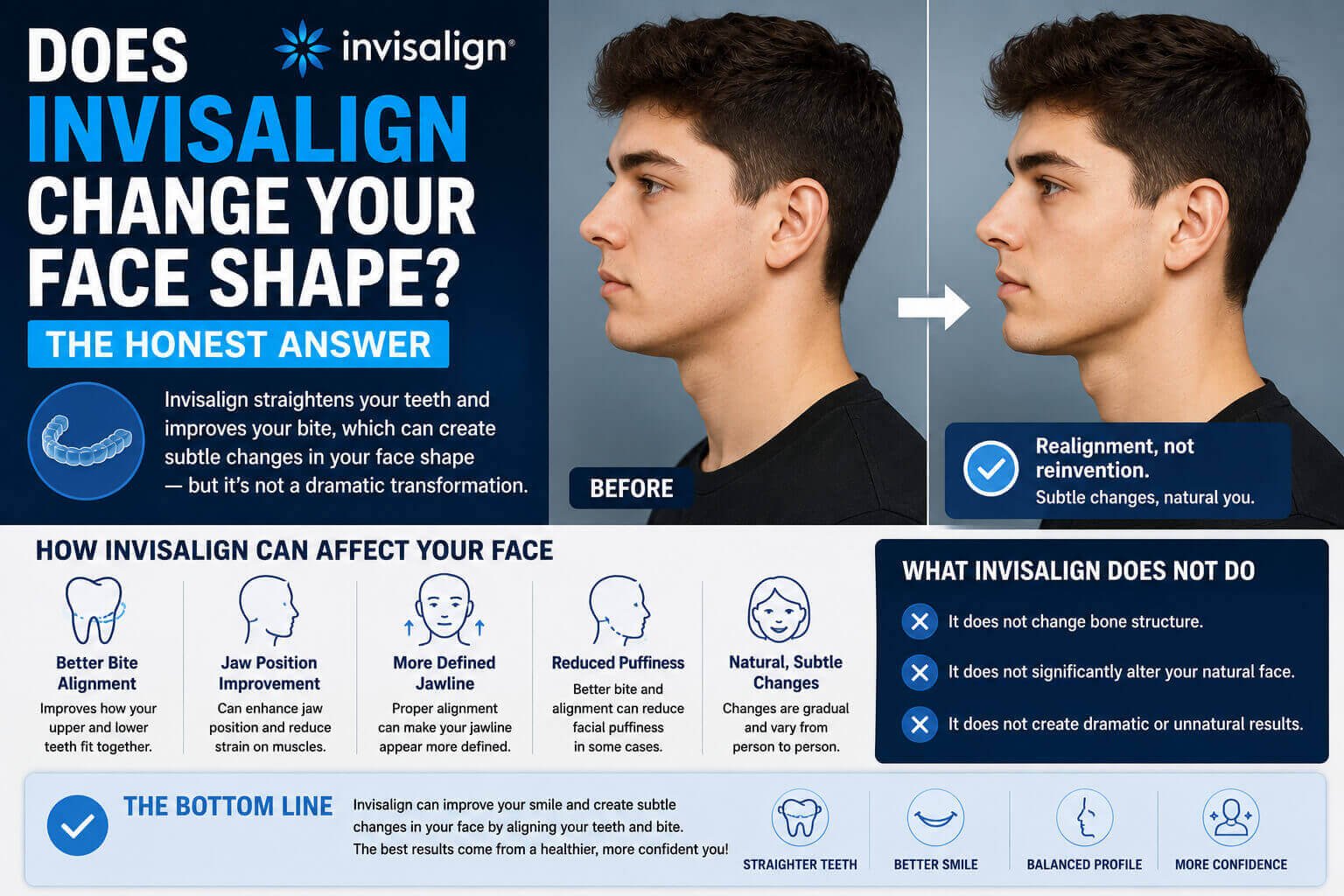
Every dental website will tell you the same thing: Invisalign subtly improves your face. Lips become more natural. Cheeks look fuller. Jawline gets more defined.
That’s not wrong. It’s just incomplete. Because the same Invisalign treatment does measurably different things to a round face than it does to an oblong face — and dental sites, understandably, don’t specialise in face shape geometry. Health and lifestyle publishers can use a meme creator online to create lighthearted, relatable content around common questions and everyday experiences.
Here’s the honest, shape-by-shape breakdown.
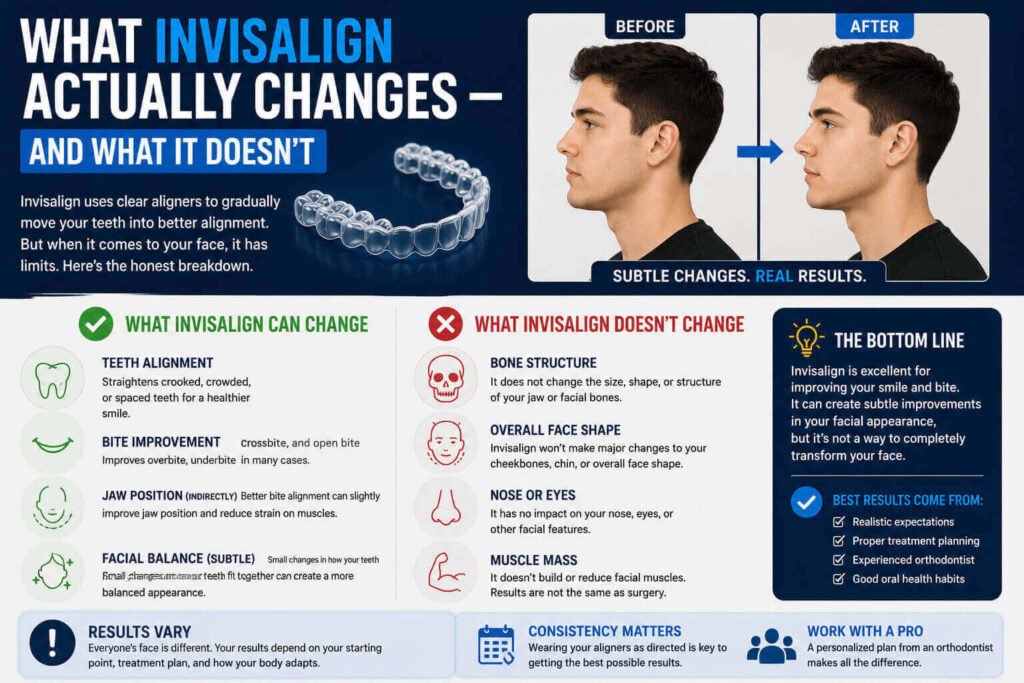
What Invisalign Actually Changes — and What It Doesn’t
Clear this up first, because the dental marketing around this topic is optimistic.
Invisalign moves teeth. Teeth movement affects how the jaws meet. That change in jaw relationship affects how the lower third of your face looks. These are the only mechanisms at work.
Invisalign does not surgically alter bone structure, but it can produce lasting changes in jaw position when correcting bite problems. The cheekbones, forehead, and mid-face width — all bone features — are unchanged. The nose is unchanged. The eye placement is unchanged.
What changes: Lip support and position, jaw presentation, chin prominence in profile, and facial symmetry when asymmetry was bite-related. These are real, meaningful changes. They are also concentrated in the lower face and almost entirely in profile view rather than front-facing.
Invisalign vs Braces: Who Changes More?
Braces use fixed brackets and wires that can create more pronounced structural adjustments, especially in younger patients with developing bones. Invisalign relies on removable aligners, producing gradual shifts that are usually more subtle.
The practical translation: if your primary motivation is aesthetic facial change, braces have more potential — particularly for teenagers whose bones are still remodelling. Invisalign’s main advantage is discretion and comfort, not facial transformation magnitude.
For minor to moderate misalignments, Invisalign offers the same facial benefits as braces but with added comfort and discretion. Where bite correction is complex — severe overbite, significant jaw discrepancy — traditional braces or combined surgical approaches reach outcomes that Invisalign can’t.
The “I Don’t Want My Face to Change” Camp
Most articles are written for people seeking facial improvement with Invisalign. But plenty of people considering treatment are anxious about change, not eager for it.
The honest answer is that it doesn’t alter bone structure or muscle tone. Any difference you see comes from straighter teeth and a better bite, which can naturally highlight the harmony that was already there.
If you don’t have a significant bite issue — if you’re getting Invisalign purely for tooth alignment — expect minimal to zero visible face shape change. The teeth move, the bite corrects, and the face looks marginally more symmetrical. You won’t recognise yourself differently in the mirror.
If you have a significant overbite, underbite, or crossbite being corrected, some change is real. The question is whether that change works with or against your specific face shape.
How Invisalign Affects Each Face Shape
This is the section every dental site skips.
Oblong Face Shape
Oblong faces are defined by length — L/W ratio of 1.5:1 or above, with consistent widths from forehead to jaw. The main concern with orthodontic treatment for oblong faces is whether correction adds or reduces lower-face vertical prominence.
Overbite correction brings the lower jaw forward, adding chin definition and reducing perceived face length slightly. For oblong faces, this is the best possible orthodontic aesthetic outcome — the chin gains horizontal presence that works against the face’s dominant vertical length.
Underbite correction on an oblong face does the opposite. If your lower jaw recedes during correction, the face may appear marginally more elongated. If you have an oblong face and an underbite requiring correction, ask your orthodontist to show you your predicted post-treatment profile digitally before committing.
Oval Face Shape
Oval faces handle Invisalign comfortably. The balanced proportions (cheekbones widest, gentle taper) mean most bite corrections refine rather than disrupt the face’s natural harmony. You’re correcting from a strong starting point.
The one risk for oval faces: aggressive arch expansion. Widening the arch too broadly can push the oval face slightly toward square territory by widening the jaw. This is rare with careful planning. Mention to your orthodontist that you want to preserve the natural face width relationship.
Round Face Shape
Round faces benefit most visibly from overbite correction. The forward jaw movement that overbite correction produces adds lower-face definition — exactly what a round face lacks. The corrected jaw creates the impression of a slightly less circular silhouette by adding vertical lower-face prominence.
Round-faced patients typically report the most satisfying aesthetic improvement post-Invisalign of any face shape, specifically because the treatment adds what the shape structurally lacks.
Square Face Shape
Square faces — defined by strong jaw angularity and roughly equal widths — are the most sensitive to Invisalign changes. The jaw is already the defining feature. Anything that affects jaw position or width significantly changes how the face reads.
Overbite correction that brings the lower jaw forward maintains the jaw’s angular character while improving balance. Generally positive. Arch expansion, if needed, should be monitored carefully — widening an already-wide jaw can push the square face toward an even more pronounced, bottom-heavy appearance. Discuss the planned arch width with your orthodontist before treatment begins.
Heart Face Shape
Heart-faced patients — wide forehead tapering to a narrow chin — are natural beneficiaries of overbite correction. The chin gains prominence and definition, working directly against the narrow chin that defines the heart shape. Many heart-faced patients find that Invisalign produces their most aesthetically significant improvement of any face shape category simply because the chin change is so clearly beneficial.
Diamond Face Shape
Diamond faces have prominent cheekbones as the widest point, with a narrower forehead and jaw. Arch expansion during Invisalign treatment adds width to the jaw area — a corrective benefit for diamond faces where the narrow jaw exaggerates the cheekbone-to-jaw width difference. Standard bite correction has a moderate effect on diamond faces; the main change is lip position rather than structural.
What to Ask Before Starting Treatment
Most people walk into an orthodontic consultation and ask: “How long will this take?” A better set of questions, if face shape is your concern:
- “Can you show me my predicted post-treatment profile digitally?” Most modern orthodontic practices use digital planning tools that can show your expected outcome. Looking at your predicted profile and front-facing view tells you more than any written description.
- “Will my arch be expanded during treatment?” Arch expansion changes jaw width. Knowing whether this is part of your treatment plan is directly relevant to what your face will look like afterwards.
- “How severe is my bite issue?” The severity correlates almost directly with how much facial change you can expect. Minor misalignment: minimal facial change. Significant malocclusion: meaningful change.
- “Is this something traditional braces would address more effectively?” An honest orthodontist will tell you if your case exceeds what Invisalign handles optimally. If facial outcome matters to you, this question is worth asking.
The Retainer Question Most Sites Skip
The permanence of results depends on wearing retainers consistently, as teeth may slowly drift back without continued support after treatment.
Teeth move. If they drift back, the jaw relationship drifts back with them, and the facial improvements partially reverse. The retainer is not optional if you want the results to last — this applies to both aesthetic and functional outcomes.
Frequently Asked Questions
Does Invisalign change your face shape permanently?
The changes are permanent if you wear your retainer as directed. Teeth that are held in their new positions maintain the jaw relationship and facial appearance that treatment created. Without a retainer, teeth drift back toward their original positions — and with them, the facial changes begin to reverse. Invisalign changes your face the same way braces do: the outcome is permanent when retained, partially reversible when not.
Will Invisalign make my face thinner or wider?
Invisalign doesn’t directly alter facial width. It can make your jawline appear more defined (through overbite correction, bringing the jaw forward) and your cheeks slightly more contoured (through improved tooth support for soft tissue). These create an impression of a more sculpted face rather than a thinner or wider one. Arch expansion — sometimes part of an Invisalign treatment — can modestly increase jaw width in some cases.
Does Invisalign change the shape of your nose or cheekbones?
No. The nose and cheekbones are bone features entirely outside the zone of orthodontic treatment. Any claim that Invisalign changes the nose or cheekbone structure is not supported by how the treatment works — it moves teeth, which affects jaw position and lip support, and nothing above that zone.
Is the face shape change from Invisalign noticeable to other people?
For patients with significant bite correction, changes are often noticeable — a more defined jawline, improved lip position, and more facial symmetry. For patients with minor tooth alignment only, the changes are subtle enough that most people won’t notice a face shape difference. The most consistent “noticeable” change is the smile itself, which affects overall facial appearance more than any structural shift.
Should I identify my face shape before starting Invisalign?
Yes — particularly if you have a complex bite issue requiring significant correction. Knowing your face shape type tells you which aspects of the treatment outcome to pay most attention to. Oblong-faced patients should track jaw position and chin prominence. Square-faced patients should monitor arch width. Round-faced patients can generally approach treatment with the most confidence that the outcome will be aesthetically positive. Use the free face shape calculator at oblongfaceshape.com to identify your measurements before treatment begins.
Know your face shape before your first orthodontic consultation. The free calculator at oblongfaceshape.com gives you your L/W ratio and shape category in 3 minutes — information that helps you ask smarter questions and understand your expected outcomes more precisely.
