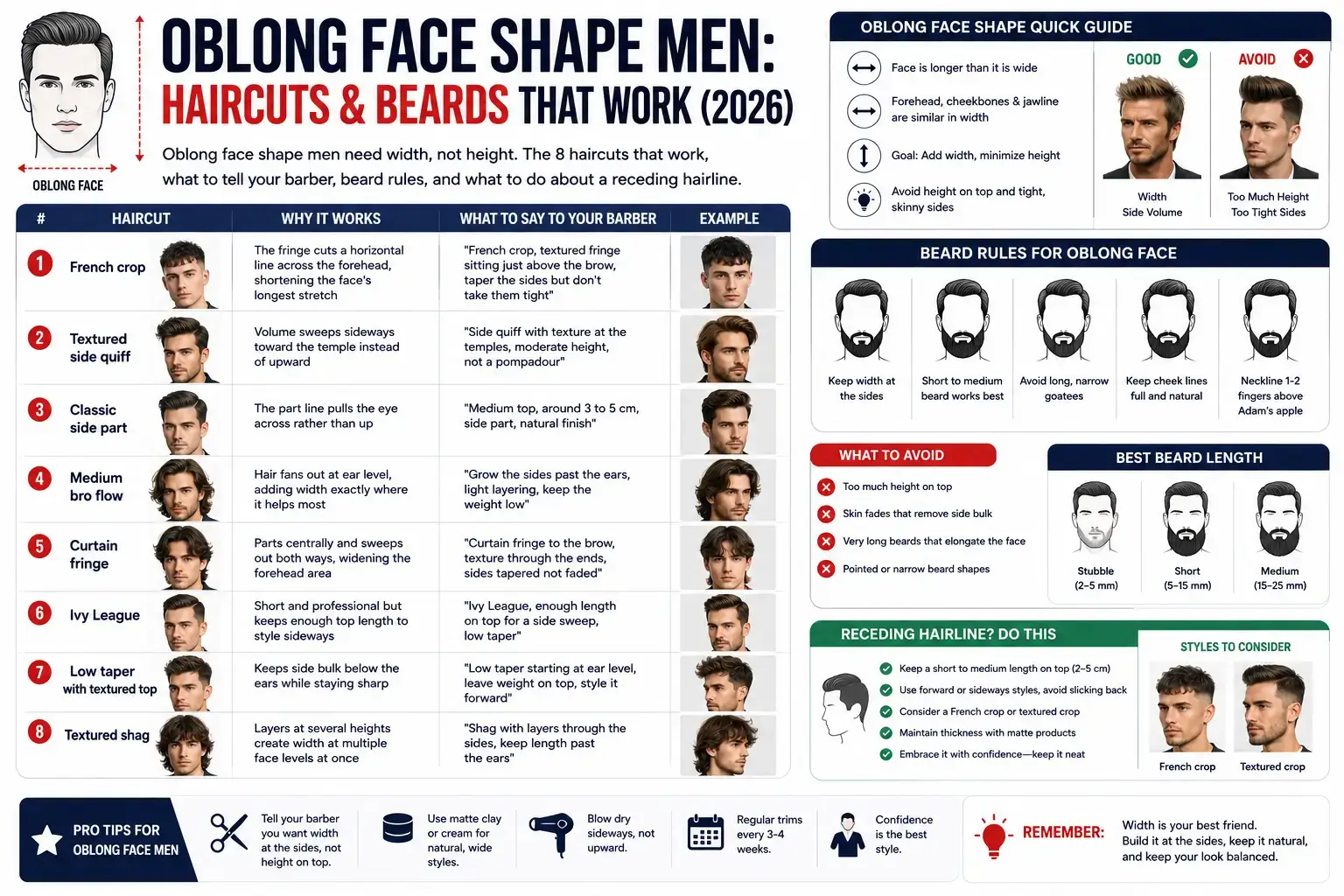
Quick answer:
If you have an oblong face, every styling decision comes down to one rule: add width at the sides, avoid height at the crown. The haircuts that deliver it are the French crop, textured side quiff, classic side part, and medium bro flow. The ones that work against you are pompadours, high skin fades, and man buns. Your beard matters just as much as your hair, and if your hairline is receding, the usual advice needs adjusting. All of that is below, including the exact words to say to your barber.
First, Confirm You Are Actually Oblong
An oblong face is clearly longer than it is wide, with forehead, cheekbones, and jaw all measuring close to the same width. The sides run fairly straight rather than curving in.
The check: divide your face length by your average width (forehead, cheekbones, and jaw added, divided by three). 1.5 or higher means oblong. Two things men specifically get wrong here:
- Measure to your original hairline, not your current one. A receding hairline makes the ratio read higher than your bone structure really is.
- Your beard hides the jaw measurement. Use a photo where the jaw outline is visible, or measure with the beard flattened.
Not sure? The face shape calculator does the maths, or the AI detector reads it from a photo. If the terms confuse you, long face shape and rectangle vs oblong clear that up.
Why Standard Barber Advice Fails Oblong Men
Barbers default to what is trending. Right now that means high skin fades, pompadours, and textured crops with very tight sides. Those cuts genuinely look great on round and square faces.
On an oblong face, they backfire twice over. A pompadour adds crown height, extending the exact dimension you want to reduce. A skin fade strips side bulk, removing the only horizontal mass your face had. Combine both, and you have made a long face look longer.
This is not the barber’s fault. Most cutting education is about technique, not facial proportion. Which is why you need to walk in knowing what to ask for.
The 8 Haircuts That Work
Depth beats a list of 40 near-identical fades. These eight cover every hair length and lifestyle, and each one includes the sentence to say at the chair.
| Haircut | Why it works | What to say to your barber |
|---|---|---|
| French crop | The fringe cuts a horizontal line across the forehead, shortening the face’s longest stretch | “French crop, textured fringe sitting just above the brow, taper the sides but don’t take them tight” |
| Textured side quiff | Volume sweeps sideways toward the temple instead of upward | “Side quiff with texture at the temples, moderate height, not a pompadour” |
| Classic side part | The part line pulls the eye across rather than up | “Medium top, around 3 to 5 cm, side part, natural finish” |
| Medium bro flow | Hair fans out at ear level, adding width exactly where it helps most | “Grow the sides past the ears, light layering, keep the weight low” |
| Curtain fringe | Parts centrally and sweeps out both ways, widening the forehead area | “Curtain fringe to the brow, texture through the ends, sides tapered not faded” |
| Ivy League | Short and professional but keeps enough top length to style sideways | “Ivy League, enough length on top for a side sweep, low taper” |
| Low taper with textured top | Keeps side bulk below the ears while staying sharp | “Low taper starting at ear level, leave weight on top, style it forward” |
| Textured shag | Layers at several heights create width at multiple face levels at once | “Shag with layers through the sides, keep length past the ears” |
The pattern in all eight: length or texture stays at the sides, and nothing builds upward at the crown.
For styling steps, hair texture specifics, and how each cut ages between barber visits, see the oblong face shape hairstyles for men by length.
Match It to Your Hair Texture
Most guides skip this, and it is why the same haircut looks great on one man and flat on another.
- Straight and fine hair does not hold width on its own. You need the cut to do the work. Choose the French crop or curtain fringe, where the fringe creates the horizontal line structurally. Use a matte clay, not pomade, and dry the sides outward with your fingers.
- Wavy or thick hair is the easiest case. The texture already pushes sideways. Grow it to medium length and let it do the job. The bro flow and shag are made for this. Barely any product needed.
- Coily and afro-textured hair naturally builds outward, which is exactly what an oblong face wants. A medium-length afro or a shaped sponge twist adds real width at the sides. Avoid high-top styles, which add the vertical height you are trying to avoid.
If Your Hairline Is Receding
This is the biggest men-specific factor, and almost no styling guide addresses it. A receding hairline adds visible length to the forehead, which makes an oblong face read even longer. Standard advice needs three adjustments:
- Fringes become more valuable, not less. A French crop or forward-styled fringe covers recession and shortens the face at the same time. It solves two problems with one cut.
- Skip anything swept back. Slicked-back and pompadour styles expose the full forehead. On an oblong face with recession, that is the worst possible combination.
- Consider going shorter overall. Once recession is advanced, a very short cut paired with a full beard shifts visual weight downward, which balances proportions better than thin hair styled forward.
If recession is progressing quickly, that is a conversation for a doctor rather than a barber. Pattern hair loss is common and treatable, and the earlier it is addressed, the more options exist.
Beards: Your Most Powerful Tool
Here is what makes styling an oblong face different for men. A beard is an adjustable jawline. Hair changes the top of your face’s frame. A beard changes the bottom, and you have far more control over it.
| Beard style | Effect on an oblong face |
|---|---|
| Full beard, fuller at the sides | The single most effective option. Adds real horizontal mass at jaw level |
| Short boxed beard | Clean and professional. Defined horizontal lines at the jaw |
| Stubble with fuller cheeks | Subtle width, almost no maintenance |
| Long pointed goatee | Avoid. Extends the chin downward and lengthens the face |
| Chinstrap | Avoid. Traces the jaw’s length without adding any width |
The rule is simple: width at the sides, never length at the chin.
Where Styling Guides Contradict Each Other
Two honest disagreements worth knowing about, because you will run into both.
- Buzz cuts: One 2026 barber guide states flatly that buzz cuts are not recommended for oblong faces because ultra-short hair removes everything that could add width. Another guide lists the buzz cut among its recommended short cuts for the same face shape. Both are published as fact.
The nuanced answer: A buzz cut works on an oblong face when the jaw is strong and angular, because the jaw then supplies its own horizontal emphasis. With a softer jaw, it leaves nothing balancing the length. Pair it with a full beard, and it works for almost anyone.
- Fades: Some guides recommend skin fades for oblong faces as a modern sharp option. Most recommend avoiding them. The measurable difference is where the fade starts: a low taper at ear level preserves side bulk, a high skin fade removes it. If you want a fade, ask for a low one.
Nobody is enforcing standards here, so treat all styling rules as starting points rather than laws.
What to Avoid
- Pompadours and high quiffs that build crown height
- High skin fades that strip side bulk entirely
- Man buns and top knots, which add height and remove side volume simultaneously
- Long, flat, straight hair hanging down, which reads as a vertical column
- Long pointed goatees, the single most counterproductive beard shape
Glasses and the Rest of the Look
Frames follow the same principle: wide beats narrow, and horizontal beats tall. Rectangular, browline, and round frames all add a horizontal line across the middle of the face. Narrow or very tall frames extend it. Full detail in the glasses guide.
For the broader picture across every face shape, see face shapes for men.
FAQs
What is the best hairstyle for an oblong face shape male?
The French crop with a fringe is the strongest single option, because the fringe cuts a horizontal line across the forehead and shortens the face’s longest dimension. The textured side quiff, classic side part, and medium bro flow are all similarly effective. Avoid anything that adds crown height.
Does a fade suit an oblong face shape?
A low taper fade does. A high or skin fade does not. The difference is side bulk: a low taper starting at ear level keeps horizontal mass, while a high skin fade removes it and exposes the full length of the face.
What beard style suits an oblong face shape?
A full beard kept wider at the sides than at the chin. It adds horizontal mass exactly where an oblong face needs it. Short boxed beards and fuller stubble work as lighter alternatives. Avoid long pointed goatees and chinstraps.
Is a buzz cut good for an oblong face shape male?
Only with a strong angular jaw, which supplies its own horizontal emphasis. With a softer jaw, a buzz cut leaves nothing to balance the length. Adding a full beard makes it work for most men either way.
Should I get a fringe if my hairline is receding?
Usually yes. A forward-styled fringe covers recession and shortens the visible face length at the same time. Swept-back styles do the opposite by exposing the whole forehead.
Which male celebrities have oblong faces?
Benedict Cumberbatch, Ben Affleck, Will Smith, and Shawn Mendes are commonly cited examples. The pattern in how they style it is consistent: side-swept volume, fringes, full beards, and no crown height.
