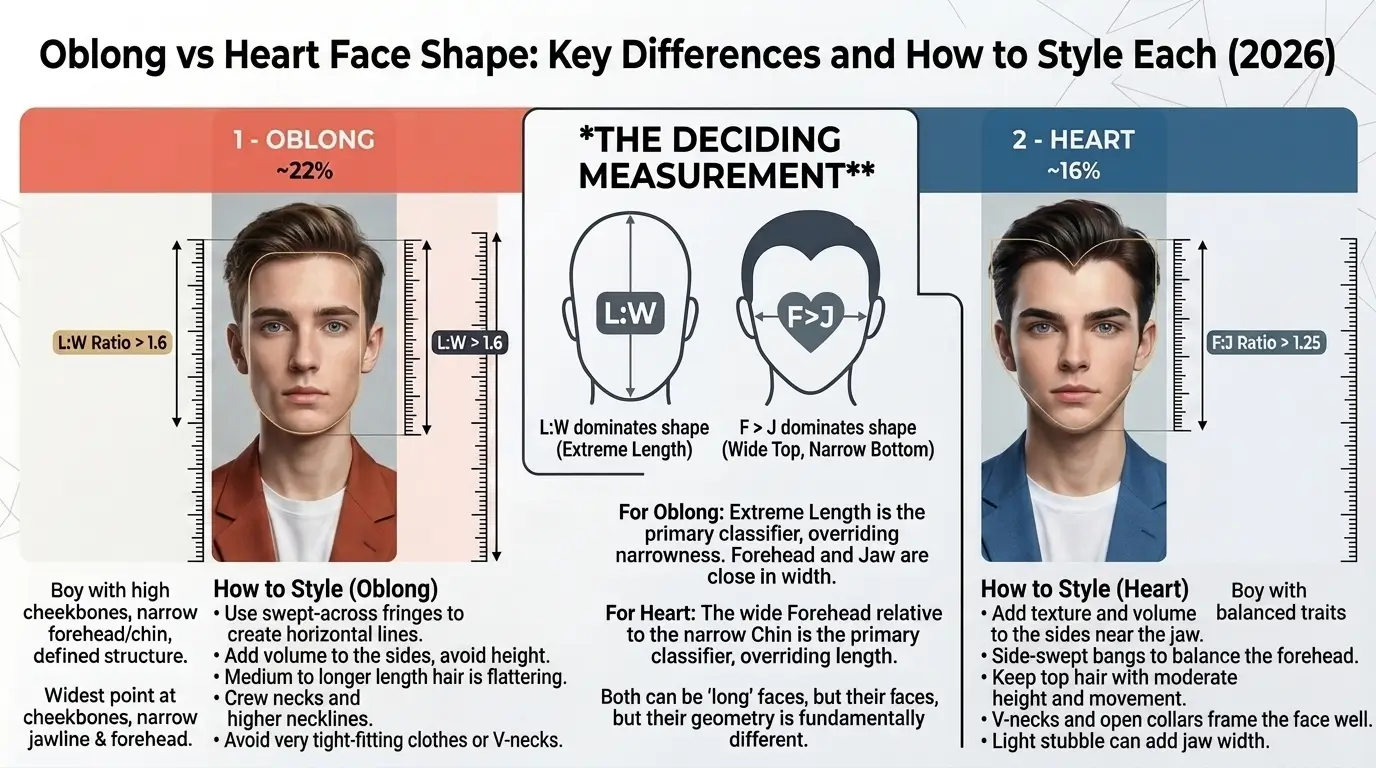
Quick answer:
The difference between an oblong and heart face shape comes down to one measurement — your forehead width versus your jaw width. An oblong face has even widths from top to bottom (all three widths within 15% of each other) and is clearly long. A heart face shape has a forehead at least 15% wider than the jaw, tapering to a pointed chin. One tape measurement settles it in 60 seconds.
These two shapes confuse people for a simple reason: both can look elongated. But their structures are opposite where it matters — and so are their styling rules. A hairstyle that flatters a heart face can actively work against an oblong face, and vice versa. So getting the answer right is worth two minutes of measuring.
The One Measurement That Decides It
Grab a soft tape and measure two things: your forehead at its widest (about one finger above the brows) and your jaw straight across the corners. Now divide forehead by jaw.
- Below 1.08 — your widths are consistent. If your face is also clearly long, you are oblong.
- 1.08 to 1.15 — blended zone. You have a little of both; see the blended section below.
- 1.15 or above — your forehead is at least 15% wider than your jaw. That is the heart signal, no matter how long your face looks.
In the full measurement formula used across this site: oblong = width consistency of 85% or more (all three widths within 15% of each other) plus a length-to-width ratio of 1.5+, while heart = forehead ÷ jaw ≥ 1.15. A face cannot be both at once — the forehead-to-jaw relationship always breaks the tie. The measurement points follow facial anthropometry standards (Farkas, 1994).
Want the math done for you? The free face shape calculator takes your four measurements and shows confidence scores for all 7 face shapes — so blended results are visible too, with 92%+ accuracy.
Side-by-Side Comparison
| Feature | Oblong | Heart |
|---|---|---|
| Length-to-width ratio | 1.5 or more | 1.15–1.40 (varies more) |
| Forehead | Similar to cheekbones and jaw | Widest point of the face |
| Cheekbones | Similar to forehead and jaw | Second widest, behind forehead |
| Jaw | Similar to forehead | Narrow — face tapers to the chin |
| Chin | Slightly rounded or mildly pointed | Distinctly pointed or very narrow |
| Silhouette | Tall rectangle with soft corners | Upside-down triangle: wide top, narrow bottom |
| How common | 21.7% — 2nd most common | 14.1% — 4th most common |
Celebrity Examples of Each
Seeing confirmed examples side by side is the fastest visual check.
- Oblong: Benedict Cumberbatch, Blake Lively, Ben Affleck. Notice the steady width from forehead to jaw — no dramatic narrowing at the chin.
- Heart: Reese Witherspoon, Taylor Swift, Ryan Gosling. Notice the clearly wider forehead tapering to a narrow chin — the widest point sits at the top of the face.
If your outline matches the first group, follow oblong styling rules. If it matches the second, follow heart rules.
Hairstyles: Where the Two Shapes Collide
Here is the practical reason this comparison matters. The two shapes need opposite things from a fringe.
- Oblong goal: add horizontal width everywhere: A full fringe is excellent — it shortens the visible face and adds width up top. Curtain bangs, waves, wolf cuts with side volume all work. Avoid height at the crown, which makes a long face longer. Full guide: oblong hairstyles for women.
- Heart goal: add width low, keep the forehead calm: A full fringe is the trap here — it emphasises the already-dominant forehead and makes the face top-heavy. Instead: chin-length bobs, waves that start below the chin, and side-swept bangs.
The two safe overlaps when you are still unsure: the chin-length bob (adds jaw-level width, which helps both shapes) and side-swept bangs (breaks up the forehead without fully widening it). These two are your no-regret picks.
Glasses: Opposite Rules Again
- Oblong: Wide frames, round frames, browline styles — horizontal emphasis everywhere is the goal.
- Heart: Bottom-heavy frames, aviators, rimless and light-rim styles — visual weight goes to the lower face, never to the brow line. A bold browline frame that suits an oblong face doubles down on a heart face’s widest zone.
Can You Be Both? The Blended Zone, Honestly
Yes — blends are common, and any guide that pretends everyone fits one clean box is oversimplifying. If your face is clearly long (ratio 1.45+) and your forehead leads the jaw by 8–15%, you have a “long heart” blend. The practical fix: figure out which trait is stronger — the length or the forehead dominance — and follow that shape’s rules first, borrowing the safe overlaps (chin-length bob, side-swept bangs) from the shared list. The AI face shape detector shows your percentage match for every shape, which makes the dominant trait obvious in one scan.
Frequently Asked Questions
What is the difference between oblong and heart face shapes?
Width consistency. Oblong faces have roughly equal widths across forehead, cheekbones, and jaw — within 15% of each other — plus clear length. Heart faces have a forehead at least 15% wider than the jaw, tapering to a pointed chin. Both can look long, but their structures and styling needs are opposite.
How do I know if I have a heart or oblong face shape?
Divide your forehead width by your jaw width. Above 1.15 means heart. Below 1.08 with a long face means oblong. Between the two is a blend. The free 60-second quiz can also sort it without any measuring.
Can I have both heart and oblong characteristics?
Yes. A long face (1.45+) with mild forehead dominance (8–15%) is a “long heart” blend. Follow the rules of whichever trait is stronger, and lean on the styles that work for both: chin-length bobs and side-swept bangs.
What hairstyle works for both heart and oblong face shapes?
The chin-length bob is the clearest overlap — it adds width at jaw level, which flatters both shapes. Side-swept bangs are the second safe pick, softening the forehead without widening it.
Is heart face shape rare?
Not especially. Heart is the 4th most common shape at about 14.1% of people — more common than square (9.5%), triangle (8.6%), and diamond (~5%), but less common than oblong at 21.7%. See all 7 face shapes ranked for the full data from 51,247+ analyses.
