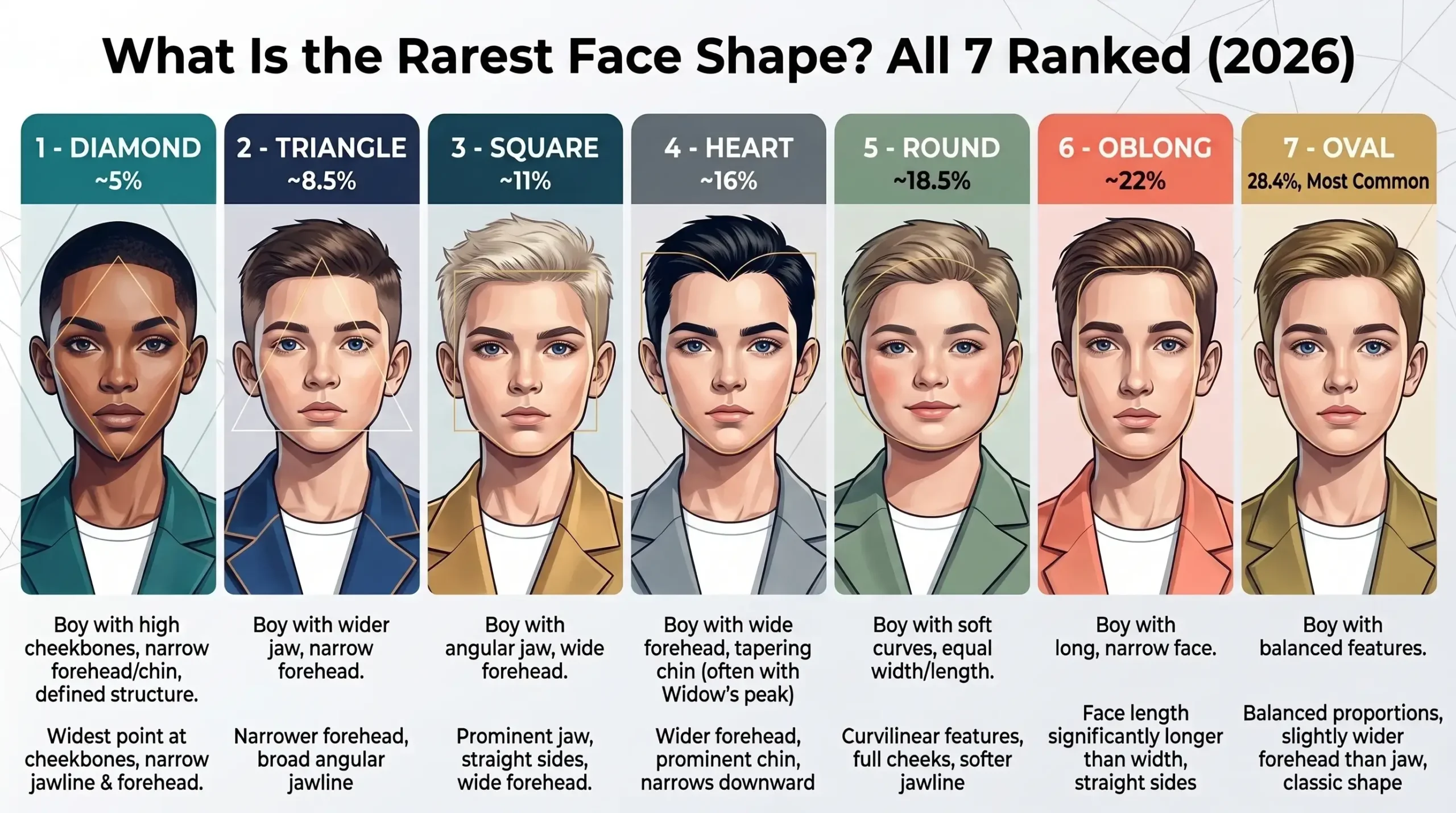
Diamond is the rarest face shape, found in about 5% of people. It needs a narrow forehead, cheekbones that are clearly the widest point of the face, and a narrow, pointed chin — and all three things rarely happen together. The second rarest is triangle at 8.6%, and the most common is oval at 28.4%. This guide ranks all 7 face shapes from rarest to most common, using data from 51,247+ analyses on this site’s free tools.
All 7 Face Shapes Ranked: Rarest to Most Common
| Rank | Face Shape | % of People | Why It Is Rare (or Common) |
|---|---|---|---|
| 1 — Rarest | Diamond | ~5% | Needs 3 strict conditions at once: dominant cheekbones, narrow forehead, narrow chin |
| 2 | Triangle | 8.6% | A jaw wider than the cheekbones needs an unusual bone pattern |
| 3 | Square | 9.5% | All three widths must be nearly equal AND the jaw must be sharply angular |
| 4 | Heart | 14.1% | Needs a forehead clearly wider than the jaw, plus a pointed chin |
| 5 | Round | 17.3% | Equal length and width with soft curves — a fairly common pattern |
| 6 | Oblong | 21.7% | Long face with even widths — very common, but often mislabeled as oval |
| 7 — Most common | Oval | 28.4% | The most “balanced” geometry, so most faces land closest to it |
Percentages are rounded, and many real faces blend two shapes, so the totals may not add up to exactly 100%. Data: 51,247+ analyses on this site’s tools, consistent with facial anthropometry research (Farkas, 1994; Rhee et al., 2004).
Want to know where you fall? The free AI face shape detector tells you in 3 seconds from a photo.
Why Is Diamond the Rarest Face Shape?
Think of it like rolling three dice and needing all three to land on six. A diamond face shape needs three things to be true at the same time: the cheekbones must be the widest part of the face by a clear margin, the forehead must be noticeably narrower than the cheekbones, and the chin must taper to a narrow point.
Most human skulls grow with fairly even width from forehead to cheekbones. For the cheekbones to stick out dramatically past both the forehead and the jaw, a specific genetic bone pattern is needed — and it simply does not happen often. That is the whole secret of rarity: it is not magic, it is math. The more conditions a shape needs, the fewer people have it.
Famous diamond faces include Rihanna, Robert Pattinson, and Jennifer Lopez. Notice how stylists give them side-swept fringes and chin-level volume — width added exactly where the diamond face is narrow.
The Second Rarest: Triangle (And Why Nobody Talks About It)
The triangle face shape — jaw wider than the cheekbones, forehead narrowest — sits at 8.6%. It gets far less attention than diamond, but it is nearly as uncommon, because a jaw that outgrows the cheekbones needs its own unusual skeletal setup.
Triangle is also the most under-diagnosed shape. People with triangle faces often call themselves “square” in the mirror, because both shapes share a strong jaw. The difference is simple: square = jaw and forehead nearly equal; triangle = jaw clearly wider than the forehead.
Square Is Rarer Than You Think
Here is the surprise of the list. Square is everywhere in beauty media — “strong jaw” tutorials, men’s grooming ads, contouring guides. But a true geometric square face is only 9.5% of people. It needs all three widths (forehead, cheekbones, jaw) to be nearly equal, plus hard, angular jaw corners. Most faces people casually call “square” are actually ovals with a slightly wider jaw. If you are not sure which you are, four quick measurements in the face shape calculator settle it with 92%+ accuracy.
Why Do Different Websites Give Different Numbers?
You may see other sites claim different percentages — some even rank the shapes in a different order. Three honest reasons:
- Different datasets: Population research averages (like Farkas, 1994) measure broad groups of people. Tool datasets measure only the people who used that one tool — and small datasets of a few thousand scans can swing wildly. Our numbers come from 51,247+ analyses, one of the larger public datasets available.
- Different strictness: How much wider must cheekbones be to count as “diamond” — 10%? 15%? Stricter rules make rare shapes look rarer. Our thresholds are published openly on the calculator page, so every result is explainable.
- Real differences between populations: Rarity shifts by ethnicity and sex. Diamond appears more often in some East and Central Asian populations. Heart is more common in women, because women’s faces statistically trend toward wider foreheads relative to the jaw. Triangle is more common in men. So “rarest” is an average — your own community’s mix may differ slightly.
Any site that gives you one hard number with no source and no method is guessing. That is the honest truth of this topic.
Is a Rare Face Shape More Attractive?
No — and this is the clarification every rarity list needs. Rarity measures geometric probability, not beauty. Research on facial attractiveness (Perrett et al., 1994; Grammer & Thornhill, 1994) shows that symmetry and proportional harmony predict attractiveness — and both can exist in any face shape.
An oblong face close to the golden ratio of 1.618 can easily be rated more attractive than a diamond face with poor symmetry. You can check your own harmony score with the free golden ratio face calculator. The useful question is never “how rare is my shape?” — it is “am I styling my shape well?”
How to Find Out If You Have a Rare Face Shape
- Fastest: the AI face shape detector — upload a photo or take a selfie, result in 3 seconds, all analysis in your browser.
- Most accurate: the face shape calculator — enter 4 measurements in cm or inches and see match scores for all 7 shapes.
- No tools at all: the 60-second face shape quiz — 7 simple questions.
If two methods agree, that is your shape — and the table above tells you exactly how rare it is.
FAQs
What is the rarest face shape?
Diamond, at about 5% of people. It requires cheekbones clearly wider than both the forehead and jaw, plus a narrow pointed chin — three strict conditions that rarely occur together.
What is the second rarest face shape?
Triangle, at 8.6%. A jaw wider than the cheekbones needs an uncommon bone structure. Square follows closely at 9.5%.
What is the most common face shape?
Oval, at about 28.4% of people. Oblong is second at 21.7%, then round at 17.3%.
What is the rarest face shape for females?
Diamond remains the rarest for women too. Heart is notably more common in women than men, and triangle is more common in men — so a triangle face is extra rare in women.
Is a rare face shape better or more attractive?
No. Attractiveness research points to symmetry and proportion, not rarity. Every shape can look striking when styled for its geometry.
Are there 6 or 7 face shapes?
Seven: oval, oblong, round, heart, square, triangle, and diamond. Older guides list six and leave out triangle, but that classification is outdated.
Can my face shape change over time?
Bone structure does not change in adulthood, but weight changes and age-related volume loss can shift how your face measures — a borderline result can move between neighbouring shapes.
