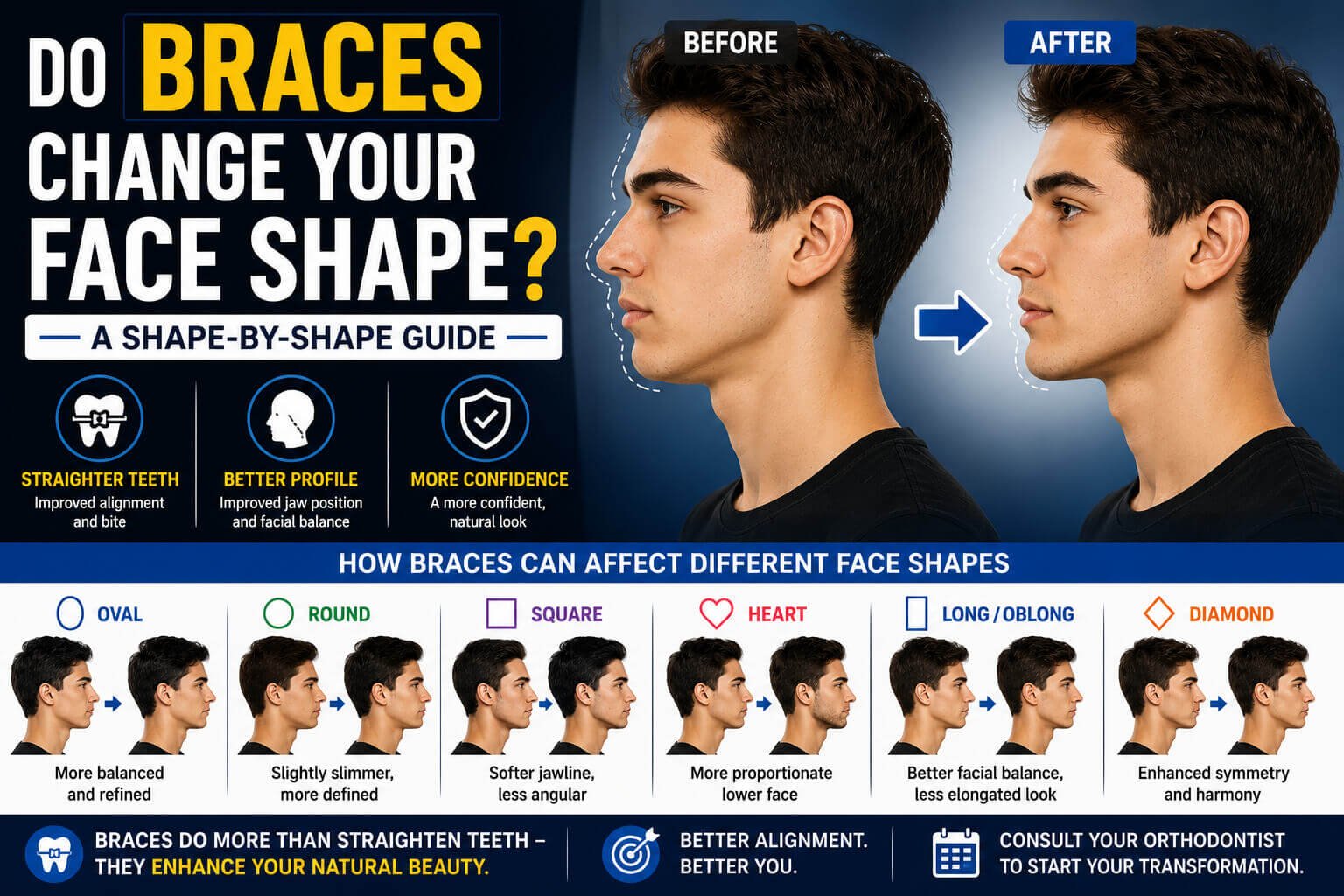
Key Takeaways
- Braces change your face shape primarily by correcting jaw alignment, not bone structure itself.
- The effect on your appearance depends heavily on your starting face shape — the same orthodontic correction produces different visual results on a round face versus an oblong face.
- For most adults, changes are subtle and positive. For teens under 18, bone remodelling means more significant results are possible.
- Changes concentrate in the lower third of the face — jaw, lip position, and chin prominence.
- Your face shape type can shift one category after significant bite correction (e.g., from square to slightly oval if jaw width narrows during correction).
Do Braces Change Your Face Shape?
Yes — but probably not the way you are imagining. Braces do not sculpt your bone like surgery. What they do is shift where your teeth sit, which changes where your jaw sits, which changes how your lower face looks. Those three layers of change produce results that are real and measurable but consistently described by patients as “subtle improvement” rather than transformation.
The more useful question is not whether braces change your face shape — they often do — but how much the change matters for your specific face shape. A round face and an oblong face respond to the same orthodontic correction in completely different ways.
How Braces Physically Affect the Face
Braces apply continuous, calibrated pressure to teeth. That pressure triggers a biological process called bone remodelling: the periodontal ligament (the connective tissue anchoring each tooth) activates bone-dissolving cells on the pressure side and bone-building cells on the tension side, allowing the tooth to migrate through the jaw over months.
This process changes three things visible in the face:
- Jaw position: When an overbite, underbite, or crossbite is corrected, the mandible (lower jaw) sits in a different position. A corrected overbite typically brings the lower jaw forward, increasing jaw prominence. A corrected underbite does the opposite.
- Lip position: Your lips drape over your teeth. When protruding upper teeth are moved back, the upper lip naturally rests further back, too, creating a less prominent profile. When a recessed lower jaw is brought forward, the lower lip gains definition.
- Facial thirds balance: Orthodontists divide the face into thirds: forehead to brow, brow to nose base, nose to chin. Braces specifically affect the lower third. Correcting jaw relationship brings this third into better proportion with the upper two, which is the main source of the “more symmetrical” effect patients report.
How Each Face Shape Is Affected Differently
This is the section no orthodontist’s website will tell you — because orthodontists think about bite, not about face shape categories. Here is what actually happens:
Oblong Face Shape
An oblong face is defined by a length-to-width ratio of 1.5:1 or above, with consistent widths from forehead to jaw. For oblong-faced patients:
Overbite correction brings the lower jaw forward, increasing chin prominence. This reduces the perceived length of the face — the lower jaw takes up more visual space, proportionally shortening the overall silhouette. For oblong faces, this is often the most flattering orthodontic outcome possible: it adds horizontal structure at the chin, working against the face’s dominant vertical length.
Underbite correction does the opposite: it recedes the lower jaw, potentially increasing the perceived face length. If you have an oblong face and an underbite, discuss with your orthodontist how to minimise additional elongation.
Crossbite or arch expansion adds width at the upper arch, which on an oblong face adds horizontal width signal — again, flattering. The face gains a slightly wider smile zone, which works against elongation.
Oval Face Shape
An oval face (L/W ratio 1.25–1.45, cheekbones widest) is the most versatile starting point for orthodontics.
Because the oval face already has good proportional balance, most bite corrections produce improvements without risking imbalance. The consistent risk for oval-faced patients is over-expansion: widening the arch too aggressively can push the face toward square, losing some of the oval’s natural taper. This is rare with careful planning.
Overbite correction on an oval face brings the lower third into tighter balance with the upper — patients typically describe the result as a “stronger chin” without changing what makes the face oval. Most of the aesthetic improvement comes from lip position normalising rather than any structural shift.
Round Face Shape
A round face has an L/W ratio near 1.0 with soft jaw edges and consistent full cheeks.
For round-faced patients, overbite correction that brings the lower jaw forward is particularly beneficial: it adds lower-face prominence that the face naturally lacks. The corrected bite creates a more defined jaw angle, which, together with the chin moving forward, gives the impression of a slightly less circular silhouette. This is one of the stronger aesthetic benefits orthodontics offers, specifically for round faces.
Note: Round-faced patients with significant arch expansion may temporarily experience a rounder appearance while teeth settle. This resolves as the bite stabilises.
Square Face Shape
A square face has strong, angular jaw corners with an L/W ratio of 1.05–1.20 and roughly equal widths.
For square-faced patients, the aesthetic impact of braces depends almost entirely on bite type. Overbite correction that brings the lower jaw slightly forward maintains the jaw’s angular character while improving balance — generally a positive outcome. The jaw angle becomes more refined rather than more prominent.
Underbite correction that recedes the lower jaw on a square face requires more careful management. Pulling an already-prominent jaw back can create an imbalance where the mid-face appears to dominate. Discuss jaw elastics positioning with your orthodontist if you have both a square face and an underbite.
Palate expanders, sometimes used before braces on square-faced teens, can modestly widen the arch. On a square face, this generally has minimal visual effect since the jaw is already wide, but it provides important functional improvement.
Heart Face Shape
A heart face is wide at the forehead, tapering to a narrow, pointed chin. Orthodontic changes concentrate on the lower face, which means for heart-faced patients, most interventions are automatically beneficial.
Overbite correction that brings the chin forward adds width and definition to the narrow chin — the single most useful styling intervention for heart faces. Orthodontics effectively does the same thing. Patients with heart faces often report the most noticeable and flattering aesthetic improvement post-braces, precisely because the chin gains prominence that the face structurally lacked.
Underbite correction is less commonly needed in heart-faced patients (the narrow jaw makes underbite geometrically unusual), but when required, the treatment reduces what little chin prominence exists — discuss expected chin position carefully.
Diamond Face Shape
A diamond face has dramatically prominent cheekbones as the widest point, with a narrower forehead and jaw.
For diamond-faced patients, arch expansion is the most consequential orthodontic intervention. Expanding the upper arch adds width to the jaw area, which, for diamond faces, is actually a corrective benefit, working against the extreme width differential between cheekbones and jaw. Patients with diamond faces often notice their faces look more proportionally balanced after arch expansion.
Standard overbite correction has a moderate effect on diamond faces — the main change is lip position rather than any structural shift in the cheekbone-to-jaw relationship, which braces cannot directly address.
Does the Change Depend on Age?
Yes, substantially. This is not marketing — it is bone biology.
Teenagers under 18 have bones that are still remodelling naturally through growth. Orthodontic force works with this natural process. A 15-year-old with an overbite can experience genuine mandibular repositioning that changes the resting jaw position permanently. The results are more pronounced and appear more quickly.
Adults have fully mineralised bone. Movement still occurs through the same periodontal ligament mechanism, but without the assistance of natural growth. The changes are real but consistently described as “subtle” — improved lip position, marginally changed jaw presentation, and better facial symmetry from bite correction. Dramatic structural shifts require surgical intervention (orthognathic surgery) in adults, not braces alone.
The practical takeaway: if you are an adult hoping braces will significantly alter your face shape, recalibrate expectations. The changes will be genuine and positive. They will not be dramatic. If you are a parent of a teenager, orthodontic timing matters more than often presented — early treatment during the growth window produces better facial outcomes.
What Braces Cannot Change
Understanding the ceiling of orthodontic treatment is as important as understanding its benefits.
Braces cannot change: your cheekbone width or position (determined entirely by bone structure); your forehead width (set by cranial bone); the overall L/W ratio of your face (except at the margins through jaw position changes); your nose shape; your eye placement; or any feature outside the jaw, teeth, and immediate lip/chin area.
Any site or provider claiming braces significantly reshape cheekbones, forehead, or mid-face is overstating what the evidence supports. Orthodontic effects are real and valuable, and they are specific to the lower facial third.
How to Check Your Face Shape Before and After
If you are in orthodontic treatment or considering it, use our free face shape calculator before you start. Record your four measurements (forehead width, cheekbone width, jaw width, face length) and your L/W ratio. Use the same measurements again twelve months into treatment and after completion.
For most patients, the L/W ratio changes by less than 0.05 — a barely perceptible structural shift. What changes more visibly is jaw presentation and lower face balance. Having baseline measurements makes the change quantifiable rather than a matter of subjective impression.
The face shape detector at oblongfaceshape.com works with photos — take a front-facing photo now and again at the end of treatment. The comparison is often striking even when the mathematical shift is small, because lip position and jaw presentation affect perceived face shape significantly.
Braces vs Invisalign — Different Effects on Face Shape?
The mechanism is the same — both move teeth through periodontal ligament pressure — but with key practical differences.
Invisalign and clear aligners produce equivalent bite correction for mild to moderate cases. For complex bite issues (severe overbites, significant jaw discrepancy), traditional braces with elastics remain more powerful because the elastic forces can influence jaw position directly, whereas aligners primarily move individual teeth.
If jaw position change is your goal for facial aesthetic reasons, discuss this explicitly with your orthodontist. Clear aligners alone are not always sufficient for meaningful jaw repositioning, particularly for adults.
For face shape purposes: if your main bite issue is tooth alignment rather than jaw position, expect equivalent aesthetic outcomes from Invisalign and traditional braces. If jaw repositioning is involved, discuss with your provider whether clear aligners provide the force needed for your specific case.
Frequently Asked Questions
Do braces change your face shape permanently?
The changes braces make to jaw position and lip support are permanent once treatment is complete and you wear your retainer as directed. The teeth have physically moved to new positions in the jawbone, and the bone has remodelled around those new positions. Without a retainer, teeth drift back toward their original positions, and with them, the facial changes begin to reverse. The short answer: permanent when retained, reversible when not.
How long does it take for braces to change your face shape?
Most patients notice lip position changes within 3–6 months as the bite begins to correct. Jaw position changes become visible at 6–12 months for patients with significant bite issues being corrected. The full extent of change is typically visible 3–6 months after braces are removed, once soft tissues have settled into their new positions. Do not compare your appearance during treatment to your expected final result — the swelling and adjustment period during treatment can temporarily make the face look different from what the outcome will be.
Can braces change your face shape as an adult?
Yes, but the scope is narrower than for teenagers. Adult bone is fully mineralised and does not have the remodelling flexibility of growing bone. Orthodontic treatment in adults produces the same tooth movement but less jaw repositioning without surgical assistance. The realistic changes for adults: improved lip support, better facial symmetry from bite correction, and a more harmonious lower-face profile. The unrealistic expectation: significant jaw repositioning or structural face shape change without orthognathic surgery.
Do braces make your face thinner or rounder?
Neither directly. Braces do not alter facial volume — they do not affect fat distribution, muscle mass, or bone width outside the jaw. Some patients lose weight during treatment due to dietary changes (softer foods, discomfort reducing appetite), which can make the face look thinner — but that is weight loss, not an orthodontic effect. What braces actually change is jaw presentation and lip position, not fat distribution or bone width.
What is the best face shape to have after braces?
There is no universally “best” outcome — the goal is a face that matches your natural proportional potential. However, for most patients, orthodontic correction moves the face toward more balanced proportions within their existing shape type. Oblong-faced patients with overbites often find that their face looks closer to oval post-correction. Round-faced patients with an overbite find that their lower face gains definition. The target is harmonious proportion, not a specific shape category.
Does wisdom teeth removal change face shape?
This is a separate process from braces. Wisdom teeth removal does not significantly change face shape in most cases — the removed teeth are at the back of the arch, far from the visible facial structure. Temporary post-surgical swelling affects appearance for 1–2 weeks. Some patients report subtle changes in jaw feel, but these are not measurable face shape changes. The face shape category you are in after wisdom teeth removal is the same as before.
Use the free face shape calculator at oblongfaceshape.com before starting orthodontic treatment to record your baseline measurements. Use it again when treatment ends to see your exact before-and-after face shape data.
