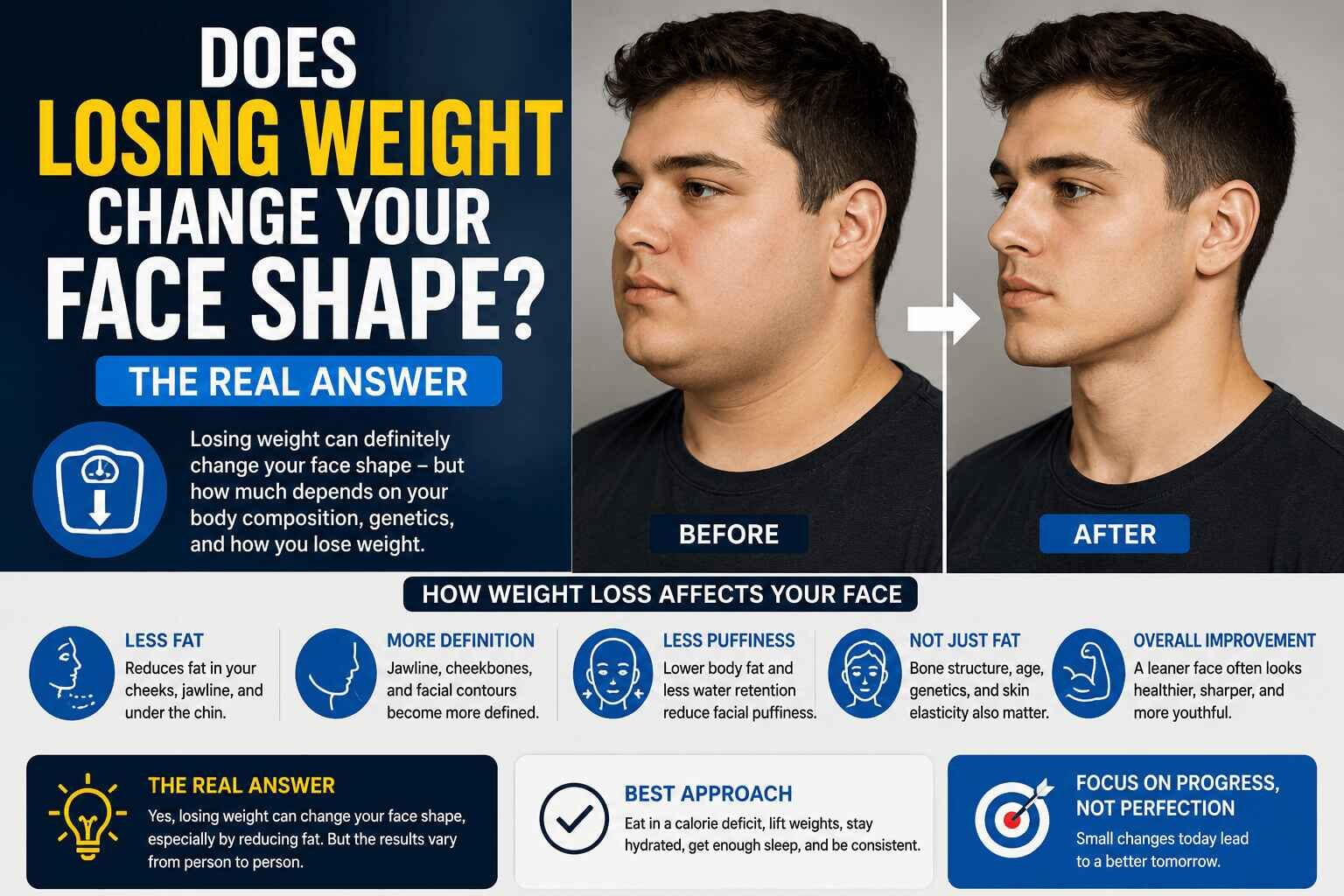
Key Takeaways
- Losing weight changes how your face looks — it does not change your underlying bone structure.
- For most people, weight loss moves the face toward its “true” bone-structure shape by removing fat that was masking it.
- A round face caused mostly by fat may reveal oval or heart proportions after significant weight loss.
- A truly round bone structure remains round after weight loss, but with more defined features.
- The face shape category someone identifies as at a higher weight is often not their “real” bone-based shape — weight loss is a reveal, not a transformation.
- People start seeing a visible difference in someone’s face when they lose at least 8–9 pounds, approximately 4 kg.
Does Losing Weight Change Your Face Shape?
The direct answer is yes and no — and the distinction matters.
Losing weight does not change your bone structure. Your skull’s width, your jaw angle, your cheekbone height, and position — these are set by genetics and bone development and are not altered by fat loss. What losing weight changes is the soft tissue layer over that bone structure. As facial fat reduces, the bones become more visible, more defined, and more dominant in shaping the face’s appearance.
For most people, this means weight loss is a reveal. The face shape they have at their lower weight is closer to their actual bone-based face shape. The face shape they had at higher weight was partially or significantly shaped by fat volume rather than bone.
This has a practical consequence: many people identify themselves as one face shape while carrying extra weight, then discover a different shape — or a cleaner version of their existing shape — once that weight comes off. A face that reads as round at higher weight may reveal oval or oblong bone structure after significant loss. A face that reads as full and balanced may reveal more heart or diamond characteristics.
How Weight Loss Actually Affects the Face
When you lose weight, the distribution of fat in your face changes, which can lead to a more balanced, proportional look. Features that were once hidden or less noticeable become more prominent.
Specifically, fat loss affects:
- Cheek volume: The buccal fat pads in the cheeks are often the most visible site of facial fat. When these reduce, the cheekbones become more visually prominent. Many people who lose a lot of weight will notice that their jawline and cheekbones are sharper and more angular.
- Jaw definition: Subcutaneous fat along the jaw and under the chin — the submental area — often reduces significantly with weight loss. This reveals the jaw angle definition that was previously hidden. A person who believed they had a round or oval face may find a square or oblong jaw structure underneath.
- Temporal hollowing: Fat at the temples reduces with significant weight loss, sometimes creating a slight hollow appearance at the temples. This narrows the upper face’s apparent width, which can shift the perceived L/W ratio.
- Lower eyelid and mid-face volume: Facial fat volume decreases in the superficial fat compartment around the eyes and mid-face, which makes the under-eye and mid-cheek area appear more angular and less full.
What Happens to Each Face Shape Category
This section does not exist anywhere in existing weight loss content — because it has only been written by medical and wellness sites, not face shape specialists.
If you identified as Round at higher weight:
A round face shape at a higher weight is the most likely to reveal a different category after weight loss. The round shape’s defining characteristic — L/W ratio near 1.0 with soft, full cheeks — is highly dependent on fat volume. Many people with round faces at higher weights find oval or oblong bone structure underneath.
After weight loss, your L/W ratio effectively increases as the face becomes less padded and bone structure dominates. A face that measured 1.0:1 at higher weight may settle at 1.3:1 or above at goal weight. This is not unusual — it is a structural reveal. Measure your face shape again at your goal weight using the free face shape calculator at oblongfaceshape.com. Your category may genuinely change.
If you identified as Square at higher weight:
The square face shape has significant structural dependency — the jaw angle required to be classified as square is bone-based. Weight loss typically sharpens and clarifies a square face rather than changing its category. The jaw angle becomes more defined, and the jaw corners become more prominent. The face may look more angular and structured, but it remains square.
The exception: if your “square” classification at higher weight was influenced by fat-widened cheeks creating apparent consistent widths, you may find the actual bone structure is more oblong (longer face with less consistent widths) or even oval.
If you identified as Oval at higher weight:
Oval is largely maintained through weight loss since its proportions are structurally defined by cheekbones being the widest point, a bone feature. Weight loss typically refines an oval face: the cheekbones appear more prominent, the jaw slightly more tapered. The result is often a cleaner, more clearly defined oval.
However, significant weight loss can shift an oval toward diamond territory if the cheekbones become dramatically more prominent relative to a now-leaner jaw and forehead. This is a positive change for most — diamond is considered one of the most striking face shapes.
If you identified as Heart at higher weight:
Heart face shape depends significantly on bone structure — the wider forehead relative to jaw is a cranial bone feature, not primarily fat-dependent. Weight loss maintains the heart shape while making the proportions more dramatic: the forehead-to-jaw width difference becomes more pronounced as jaw fat reduces. The chin appears narrower and more pointed.
If you identified as Oblong at higher weight:
Oblong faces are bone-structure dependent — the L/W ratio above 1.5 with consistent widths reflects skull proportions, not fat distribution. Weight loss typically sharpens and clarifies an oblong face: the jaw angle becomes more defined, the cheekbones more visible, the overall silhouette more refined. The oblong category is usually preserved through weight loss.
If you identified as Diamond at higher weight:
Diamond face shapes become more dramatically defined with weight loss. The cheekbones — already the widest point — become even more visually dominant as surrounding fat reduces. This often creates the most striking facial transformation of any face shape category. Diamond faces tend to photograph very distinctively after significant weight loss, precisely because the cheekbone prominence increases.
How Much Weight Loss Changes Face Shape
You may notice a change in your face after losing 2–5 kg. Bigger changes usually appear after 8–10 kg of weight loss.
The practical thresholds:
- 5–10 lbs / 2–4 kg: Visible reduction in puffiness. Slight jaw definition increase. L/W ratio may shift marginally. Face shape category unlikely to change.
- 10–20 lbs / 4–9 kg: Cheekbones become noticeably more prominent. Jaw definition increases meaningfully. Round face classifications may begin shifting toward oval. L/W ratio change is measurable with careful measurement.
- 20+ lbs / 9+ kg: Structural face shape can measurably change category. Significant cheekbone exposure. Jaw angle is clearly visible. This is the threshold where re-measuring with the face shape calculator is genuinely useful — your category may now differ from your original classification.
- 50+ lbs / 22+ kg: Major structural reveal. Significant skin laxity may become a factor. Rapid fat loss allows less time for the skin and underlying structures to adapt, making facial volume loss appear more pronounced.
Why Your Face Shape At Higher Weight May Not Be Your Real Shape
This is the most practically useful insight for anyone using face-shape tools: the category you calculate at higher body weight has lower diagnostic accuracy because fat volume partially determines the result, not just bone structure.
The face shape calculator measures your actual face widths at the time of measurement. If those widths are influenced by fat volume, the result reflects your current proportions — not your permanent bone structure. Both are useful for styling purposes (you want to style the face you have today, not an imagined future face), but if you are actively losing weight, plan to re-measure at a stable goal weight for your definitive face shape category.
The practical recommendation: if you are currently more than 20 lbs above your goal weight, take a baseline measurement today, use it for current styling, and then re-measure at goal weight. The shift — or lack of shift — in your category will tell you how much of your current face shape is bone versus fat.
Does Rapid Weight Loss Change Your Face Shape Differently?
When weight is lost quickly, these fat pads can also reduce in volume abruptly. This can create noticeable changes in facial appearance, including hollowing around the temples and under the eyes.
Rapid weight loss — through GLP-1 medications (Ozempic, Mounjaro), bariatric surgery, or aggressive caloric restriction — produces the same structural reveals as gradual weight loss but with less time for skin adaptation. The bone structure reveal is the same. What differs is:
- Skin laxity: Gradual weight loss gives skin time to contract as the underlying volume reduces. Rapid loss does not. Quick weight loss doesn’t give your body time to readjust to living with less fat. Your skin may take longer to regain its shape.
- Temporal hollowing: Often more pronounced with rapid loss because superficial fat at the temples depletes quickly. This creates a more angular upper face appearance than a gradual loss produces.
- Face shape measurement accuracy: Interestingly, rapid weight loss may actually reveal bone structure faster — giving you a more accurate face shape measurement sooner, at the cost of potentially more dramatic skin texture changes during the process.
Frequently Asked Questions
Does losing weight change your face shape?
Yes and no. Weight loss changes how your face looks by reducing facial fat and revealing more of your bone structure. It does not change your actual bone structure. For many people, weight loss reveals a different face shape category than what was apparent at a higher weight, particularly for round faces, where fat volume contributes significantly to the circular appearance. Measure your face shape before and after significant weight loss using the free calculator at oblongfaceshape.com to track the actual change.
How much weight do you need to lose to change your face shape?
Visible facial differences appear after losing approximately 8–9 pounds (4 kg). Face shape category changes typically require more, approximately 20+ lbs / 9+ kg. At that level, the L/W ratio may measurably shift, and cheekbone prominence increases enough to move from one category to an adjacent one (e.g., round to oval, oval to diamond).
Does losing weight make your face more oval?
It can. Oval is the most common “base” face shape in bone structure. When fat volume masking bone structure is reduced, many people who are classified as round discover oval proportions underneath. Whether your weight loss reveals oval depends on your actual bone structure, which the face shape calculator measures most accurately at or near your stable goal weight.
Can losing weight change a round face to an oval?
Yes, this is one of the most common face shape category transitions with weight loss. Round face shape is significantly fat-dependent — the L/W ratio is near 1.0, and soft jaw characteristics are partly determined by fat volume. As this reduces, a longer, more tapered bone structure may emerge. If your skull is longer than your face appears at a higher weight, weight loss will reveal this, producing a face that measures closer to oval.
Does “Ozempic face” change your face shape?
Ozempic face refers to the rapid facial volume loss associated with GLP-1 weight loss medications. It does not create a new face shape — it rapidly reveals the bone structure underneath by rapidly reducing facial fat. The bone-based face shape is the same before and after. What changes is how quickly and dramatically the reveal happens compared to gradual weight loss, and potentially greater skin laxity due to the speed of fat reduction.
Re-measure your face shape at your goal weight using the free calculator at oblongfaceshape.com. The change in your L/W ratio and width measurements will show exactly how your face shape category has shifted — or confirm your original shape with more definition.
