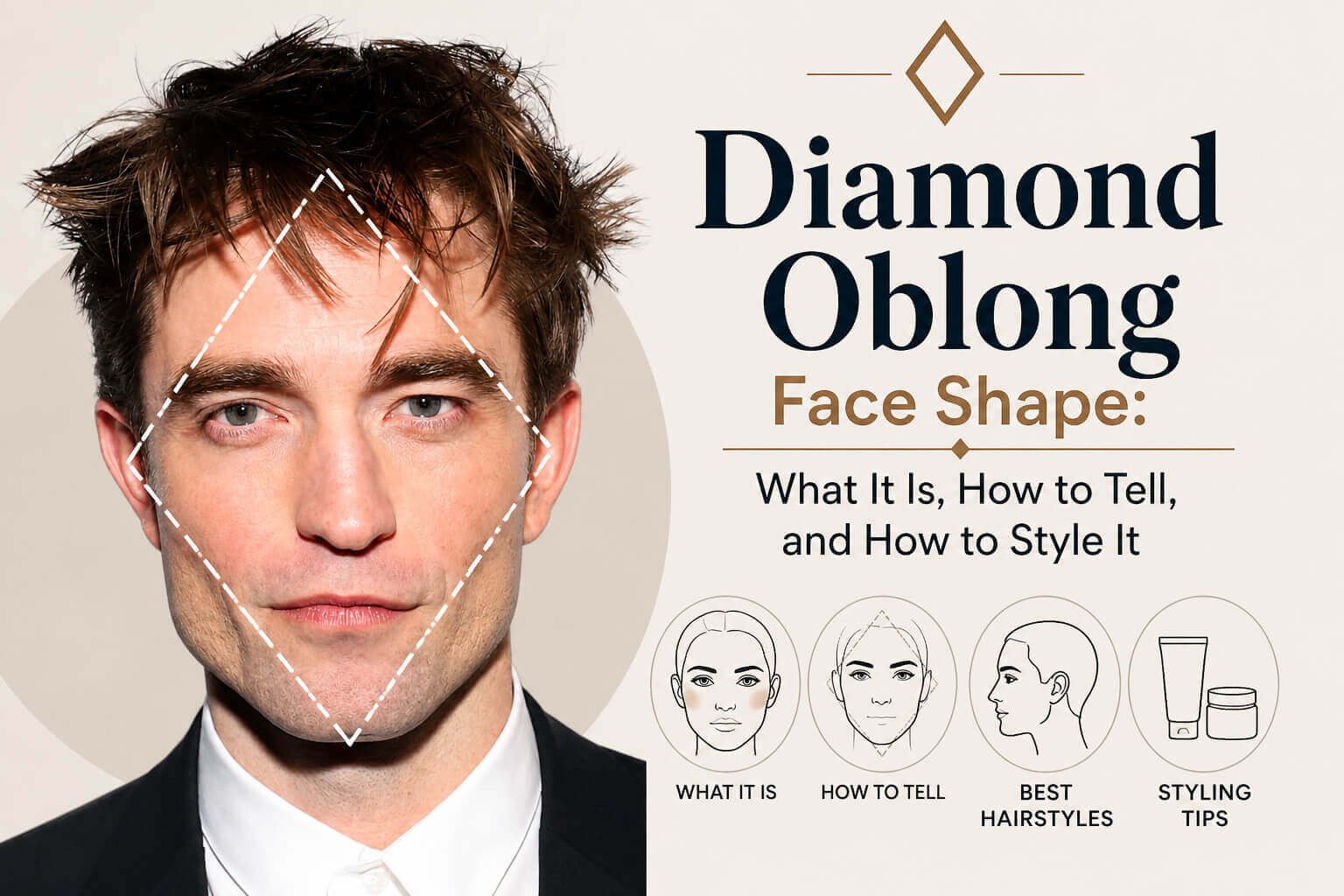
The diamond oblong face shape is a blended face shape that sits between two of the most distinctive categories: the diamond (defined by prominent cheekbones as the widest point) and the oblong (defined by consistent width and significant elongation).
It is one of the most commonly misidentified blends. Men and women with this combination often identify themselves as “just oblong” because they notice their face’s length, without registering the degree to which their cheekbones project beyond their forehead and jaw. Or they identify as “diamond” because their cheekbones are prominent, without noticing the degree of overall elongation.
Getting the distinction right matters because the hairstyle rules for diamond and oblong face shapes differ in specific areas — and the blend requires a particular approach that neither set of rules alone addresses.
What Makes a Diamond Oblong Face?
- A pure diamond face has these characteristics: L/W ratio of 1.20–1.45, with cheekbones that are clearly wider than both the forehead and jaw by 15% or more. The face narrows both above and below the cheekbones, creating a pointed-top, wide-middle, pointed-bottom silhouette.
- A pure oblong face has: L/W ratio of 1.5 or above, with forehead, cheekbones, and jaw all measuring within 12% of each other. The face is long with consistent widths throughout.
- A diamond-oblong blend has: L/W ratio of 1.40–1.58, with cheekbones prominent (wider than forehead and jaw) but not dramatically so (10–18% wider rather than 20%+). The face is elongated, but the cheekbones create a visible widening at mid-face that prevents it from reading as a pure oblong.
- To test for this blend: Measure your forehead width and divide by your cheekbone width. A ratio of 0.82–0.91 (cheekbones 10–18% wider than forehead) combined with an L/W ratio above 1.40 indicates a diamond-oblong blend.
The Styling Challenge
The diamond-oblong blend creates a specific styling challenge that neither shape’s guide addresses on its own.
Oblong face styling adds horizontal width everywhere — including at the forehead. The standard oblong technique of curtain bangs and fringe works by adding a horizontal element at the forehead, which is appropriate when the forehead is narrow relative to the cheekbones.
But on a diamond-oblong face, adding width at the forehead risks creating top-heaviness — because the cheekbones are already the widest point, adding forehead width narrows the visual gap between forehead and cheekbones, which can make the upper face appear disproportionately wide.
At the same time, the oblong’s elongation needs addressing — so simply following diamond-face guidelines (which focus on forehead-level width addition) without any oblong correction would leave the face’s length unaddressed.
The solution is a layered approach: add width at the forehead and jaw simultaneously to balance the cheekbone prominence, while using texture and movement (rather than height) to manage the elongation.
Best Hairstyles for Diamond Oblong Face Men
The French Crop — Best Overall Choice
The French crop addresses both components simultaneously. The fringe adds forehead-level width (addressing the diamond’s narrow forehead); the short, textured sides don’t add cheekbone-level bulk (which is already present); and the overall shape avoids crown height (addressing the oblong elongation).
Request: “French crop with a fringe at brow level, textured top, tapered sides that keep some length — not a skin fade.”
Curtain Bangs with Side Texture
Curtain bangs that sweep outward toward the temples add forehead width specifically — ideal for the diamond component. Combined with textured, side-volume styling at the lower crown level, this handles the elongation without adding height. This is the strongest option for men comfortable with curtain-bang length.
Medium-Length Waves with Volume at Forehead and Crown
Medium-length wavy hair that builds volume at the forehead (addressing the diamond’s narrow top) while maintaining wave texture throughout (addressing the oblong’s elongation) is an effective approach. The waves create horizontal movement at multiple levels simultaneously.
Textured Quiff with Forward-Swept Direction
A quiff that sweeps forward toward the forehead rather than straight up or backwards — this adds forehead-level visual volume rather than crown height. The forward sweep is a specific modification of the standard quiff that suits diamond-oblong faces where a backward or upward quiff would fail.
Side Part with Volume at the Temple
A side part with deliberate volume built at the temple on the high side creates width specifically at forehead level. Styling the temple section outward rather than downward amplifies this effect.
Best Hairstyles for Diamond Oblong Face — Boys and Younger Men
The same principles apply, but with age-appropriate styles:
The textured fringe (a shorter version of the curtain bang, sitting at brow level with a centre or near-centre part) is the strongest choice for younger males with diamond-oblong faces. It handles both the forehead narrowness and the face’s elongation simultaneously.
The two-block cut (popular in Korean barbershops) — longer top with clean-cut sides — works for diamond-oblong boys because the longer top can be styled with fringe or side sweep (adding forehead width) while the clean sides don’t emphasise the cheekbone width.
The short textured crop with defined fringe is another strong option — the fringe adds forehead width; the textured, slightly messy finish adds visual interest across the top rather than directing the eye upward.
Glasses for Diamond Oblong Face Shape
Diamond faces need frames with a strong upper-frame presence to add forehead-level width. Oblong faces need wide frames for horizontal emphasis. The diamond-oblong combination needs both simultaneously:
- Best frames: Browline/clubmaster frames are the single strongest choice — the thick upper bar adds forehead-level width (diamond need) and the wide format adds horizontal emphasis (oblong need). Oval frames with a prominent upper rim work similarly.
- Good choices: Wide round frames (add forehead width through their shape); wide rectangular frames with thick upper rim; rimless oval with prominent brow bar.
- Avoid: Narrow frames that add no width; frames with thick lower rims (add visual weight below the cheekbones, which accentuates the narrowing); very small frames.
Beard Styles for Diamond Oblong Men
Beard styling for diamond-oblong faces should add width at the jaw level (addressing both the diamond’s narrow jaw and the oblong’s need for horizontal balance):
A full beard with volume at the sides of the jaw is the strongest choice. The fullness at jaw level widens the visual bottom of the face, which simultaneously narrows the perceived width gap between the cheekbones and jaw (reducing diamond prominence) and adds horizontal width at the face’s lower section (addressing oblong elongation).
Avoid long, narrow goatees — they draw attention to the narrow chin without adding jaw width, which worsens both the diamond and oblong proportional challenges simultaneously.
Frequently Asked Questions
What is a diamond oblong face shape?
A diamond oblong face shape is a blended shape where measurements fall between the diamond and oblong categories. The face is elongated (L/W ratio 1.40–1.58) with cheekbones that are the widest point, but not dramatically so (10–18% wider than the forehead). The face is longer than wide and has a subtle diamond-like mid-face widening. It is distinct from both a pure diamond (more extreme cheekbone prominence) and a pure oblong (more consistent widths throughout).
What is the difference between a diamond and an oblong face shape?
A diamond face has dramatic cheekbone dominance — cheekbones are the clear widest point, significantly wider than both the narrow forehead and jaw. An oblong face has consistent widths throughout — forehead, cheekbones, and jaw all roughly equal. A diamond face creates a distinct diamond-shaped silhouette; an oblong face creates a tall, relatively straight-sided silhouette. The key measurement: forehead ÷ cheekbone width. Diamond: ratio below 0.82. Oblong: ratio above 0.90. Diamond-oblong blend: 0.82–0.90.
What hairstyle suits a diamond oblong face shape male?
The French crop with brow-level fringe is the strongest single choice — it adds forehead-level width (addressing the diamond’s narrow forehead) while avoiding crown height (addressing the oblong’s elongation). Curtain bangs with side texture are the second-best choice. Both options target the specific dual challenge of the diamond-oblong blend: a narrow forehead that needs width, combined with overall face length that needs balancing.
Are diamond and oblong face shapes common together?
Yes — the diamond-oblong blend is one of the more frequently occurring combined results on the oblongfaceshape.com calculator. Many people who perceive themselves as “having high cheekbones” and “a long face” simultaneously are measured as a diamond-oblong blend. The cheekbones are prominent enough to create visible mid-face widening, but the overall face is elongated rather than having the dramatic narrowing at the top and bottom that a true diamond shape shows.
Use the face shape calculator at oblongfaceshape.com to measure your specific forehead-to-cheekbone ratio and L/W ratio. These two numbers precisely place you on the diamond-oblong spectrum and determine how much each set of styling rules applies.
