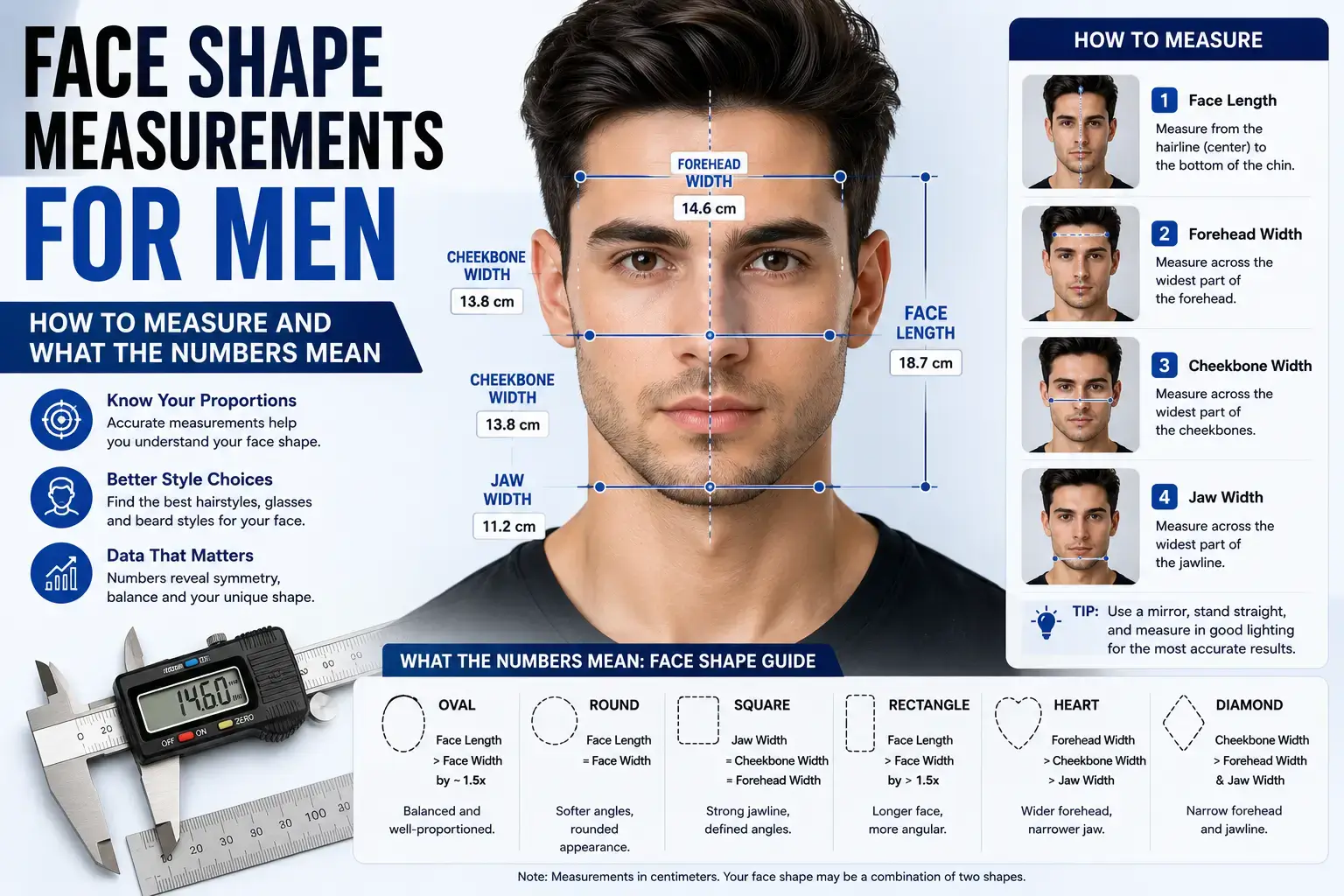
Direct answer:
To measure your face shape as a man, take four measurements with a flexible tape: Face length (hairline to chin), forehead width (above the brows), cheekbone width (below the eyes), and jawline width (corner to corner across the jaw). Divide face length by average width to get your ratio. Above 1.5 is oblong. Near 1.0–1.2 with angular jaw corners is square. Cheekbones clearly widest with a ratio of 1.25–1.45 is oval. The jawline measurement is the most important single data point for men specifically — here’s why.
Why Measurement Matters More for Men Than Most Guides Admit
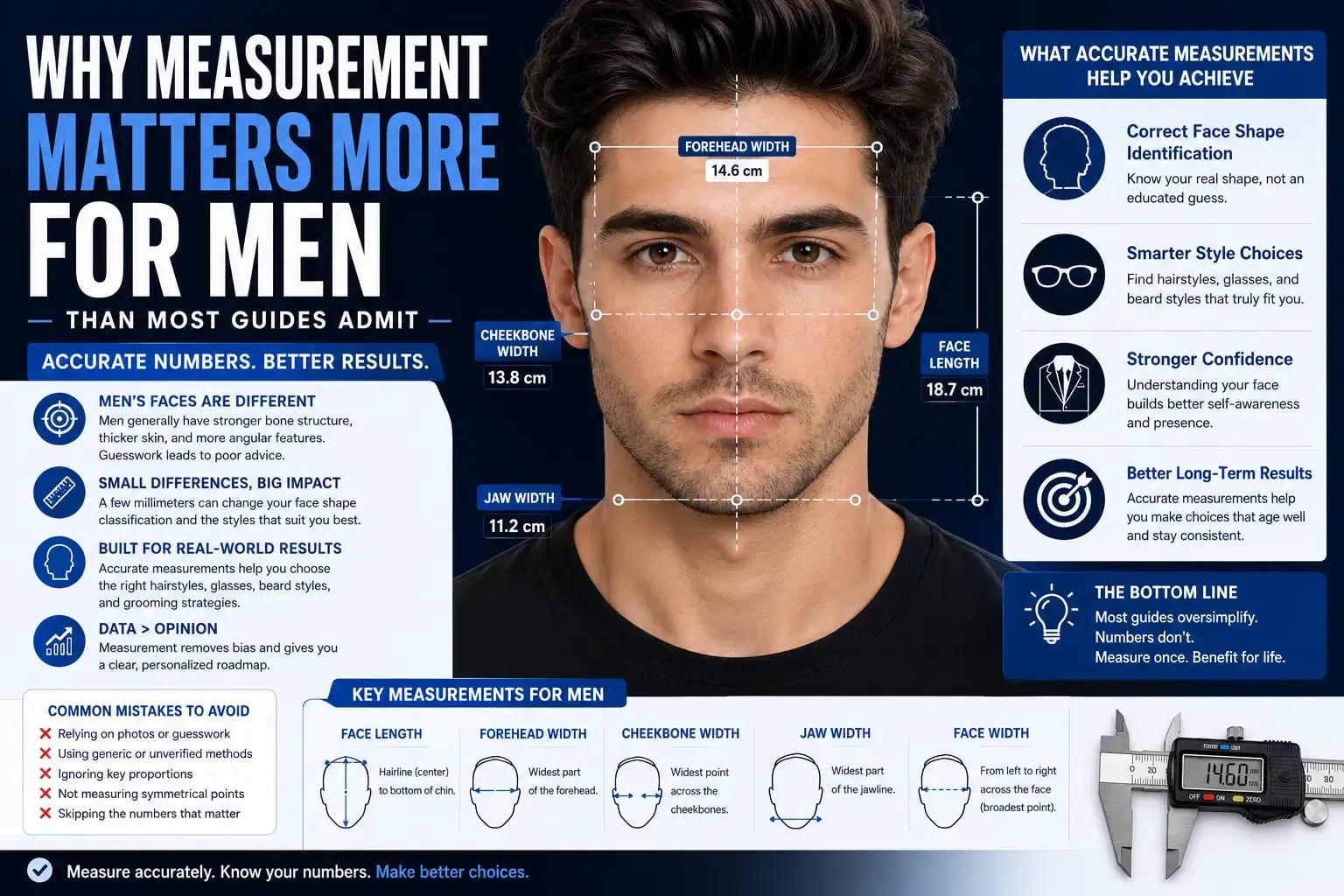
Men’s face shape guides are dominated by visual approximation — “look in a mirror and see if your face looks round or square.” That approach is unreliable for two reasons.
First, men typically have more pronounced bone structure than women, which means the visual impression of angular features (a defined jaw, prominent brow ridge) can mislead the self-assessment. A man with a strong, angular jaw and an oval face will consistently misidentify himself as square if he judges by jaw definition alone. Jaw definition is about bone prominence, not face width.
Second, hairstyle and beard choice mask the face’s natural proportions. A man who has been cutting his hair with a tight fade for years and keeping a shaped beard has been visually modifying his face shape for so long that he cannot easily see his underlying geometry without actively measuring it.
Measurement removes both of these biases. The ratio does not care about bone definition or current styling choices.
The 4 Measurements — What, Where, and Why Each Matters
1. Face Length
- What it is: The vertical distance from the center of your hairline to the tip of your chin.
- Where exactly: Hold the tape at the center of your hairline — the point directly above the middle of your nose. Pull it straight down to the very tip of your chin.
- Why it matters: Face length is your vertical dimension. All face shape decisions are ultimately about the relationship between this number and your widths. Without this measurement, the other three are meaningless.
- For men specifically: If you have a receding hairline, measure from your natural hairline if you can estimate it, not from the current hairline edge. A receding hairline changes your visual impression significantly but does not change your underlying face shape — your bone structure did not change.
2. Forehead Width
- What it is: The horizontal distance across the widest point of your forehead.
- Where exactly: Place the tape one finger’s width above your eyebrows and pull it edge to edge — from the point where the forehead meets the temple on each side.
- Why it matters: For men, the forehead width is the measurement most likely to reveal a heart face shape (forehead clearly wider than jaw) or a triangle face shape (forehead clearly narrower than jaw). It is also the measurement most obscured by hairstyle — if you have significant hair falling over your temples, you need to pull it back completely before measuring.
3. Cheekbone Width
- What it is: The horizontal distance across the widest point below the eyes.
- Where exactly: Find the outer corner of each eye and follow the bone diagonally downward — you will feel the zygomatic arch, the prominent cheekbone. The widest point is typically 1–2 cm below and slightly outward from the outer eye corner. Pull the tape across from the widest point on each side.
- Why it matters for men: The cheekbone measurement distinguishes oval from diamond and from square. On many men, the cheekbone measurement is visually less obvious than on women because facial hair and beard growth at the jaw level can draw the eye away from mid-face width. Measure directly — do not estimate.
4. Jawline Width
- What it is: The horizontal distance across the jaw, corner to corner.
- Where exactly: Feel along your jaw until you find the angle point — the corner where the jaw turns downward toward the chin. Place the tape from the left jaw corner to the right jaw corner across the front of the face. This is not across the chin tip — it is the widest horizontal point of the lower jaw.
Why this measurement matters most for men:
The jawline is the most gender-differentiated measurement in facial anthropometry. Men on average have a wider, more angular jaw relative to face width than women. This means that for men, the jawline measurement is both the most informative and the most commonly misread.
Here is what the jawline test tells you:
- Jaw width roughly equals forehead width (within 10%), ratio near 1.0–1.2, angular jaw corners → Square face
- Jaw width roughly equals forehead width (within 10%), ratio 1.5+, less angular corners → Oblong face
- Jaw width clearly narrower than forehead → Heart face
- Jaw width clearly wider than forehead → Triangle face
- Jaw width clearly narrower than cheekbones → Diamond face (if forehead also narrow) or Oval (if forehead slightly wider than jaw)
The Jawline Check: What Your Jaw Reveals
The jaw corner angle — the angle formed where the jaw turns toward the chin — tells you information beyond face width.
- Sharp, defined jaw corners (close to 90 degrees): This is the characteristic feature of a square face shape. The jaw maintains its width almost to the chin and then angles sharply. If your jaw corners are visible in photos and feel clearly angular under your fingers, add this as a confirming signal for square if your other measurements align.
- Soft, gradual jaw corners: The jaw tapers more gently toward the chin without a sharp turn. This is characteristic of oval, oblong, heart, and diamond faces — all of which have some degree of chin taper.
- Wide jaw corners with outward-set angle: The jaw flares outward, with the jaw width at the corners clearly wider than anything above it. This is the triangle face signal — the characteristic bottom-heavy proportion.
To check your jaw corners without measuring: run two fingers from your earlobe along the underside of your jaw toward your chin. Feel where the bone turns. The sharpness and outward-set of that turn is your jawline check.
Calculating Your Face Shape: Step-by-Step
Once you have your four measurements, here is the exact process:
- Step 1 — Calculate your ratio: Face Length ÷ ((Forehead + Cheekbones + Jaw) ÷ 3) = Your ratio
- Step 2 — Identify which width is largest: Compare your forehead, cheekbone, and jaw measurements directly.
- Step 3 — Cross-reference the table:
| Ratio | Widest Point | Jaw Character | Face Shape |
|---|---|---|---|
| 1.0–1.2 | All roughly equal | Angular, sharp corners | Square |
| 1.0–1.15 | Cheekbones | Soft, curved | Round |
| 1.25–1.45 | Cheekbones | Tapered, soft | Oval |
| 1.5+ | All roughly equal | Moderate, less angular | Oblong |
| Any | Forehead (10%+ wider than jaw) | Narrow, tapered | Heart |
| Any | Cheekbones (10%+ wider than both) | Narrow chin | Diamond |
| Any | Jawline (10%+ wider than forehead) | Wide, angular | Triangle |
Example calculation — Male: Face length: 24 cm Forehead: 15.5 cm Cheekbones: 16 cm Jaw: 15 cm Average width: (15.5 + 16 + 15) ÷ 3 = 15.5 cm Ratio: 24 ÷ 15.5 = 1.55 → Oblong range Widest point: cheekbones (just slightly) — but all three widths within 7% of each other Jaw: moderate angularity
Result: Oblong face shape (mild — close to oval-oblong border)
What Face Shape Is Most Common in Men?
Research on facial geometry suggests that square and oblong face shapes are proportionally more common in men than in the general population, while oval and heart are more common in women. The overall distribution across all adults is approximately:
| Shape | Adults Overall | Notes |
|---|---|---|
| Oval | ~28% | Most common overall |
| Round | ~23% | Slightly less common in men |
| Square | ~19% | Higher proportion in men |
| Heart | ~11% | More common in women |
| Oblong | ~10% | Slightly higher in men |
| Triangle | ~8–10% | — |
| Diamond | ~5% | Rarest overall |
These are estimates from facial geometry classification research, not population census data.
Once You Know Your Shape: What It Changes
The measurement is the input. The output is specific:
- Hairstyle: Which cuts add the perception of width (oblong needs), height (round needs), or softness (square needs).
- Beard shape: The most impactful styling variable for men. A beard on an oblong face should add width at the jaw. A beard on a round face should add chin length. A beard on a heart face should add jaw width at the corners.
- Glasses and sunglasses: Frame width relative to face width. The correct frame for your face shape and the correct frame size for your specific measurements are both determined by your ratio.
Use the face shape calculator to enter your measurements and get a confirmed result with the full styling guide for your shape.
Frequently Asked Questions
How do I measure my face shape as a man?
Four measurements with a flexible tape: face length (hairline center to chin tip), forehead width (above the brows), cheekbone width (below the outer eye corners), and jawline width (corner to corner). Divide face length by average width for your ratio. Above 1.5 is oblong. Near 1.0–1.2 with an angular jaw = square. Cheekbones clearly widest at 1.25–1.45 = oval.
What is the jawline test for face shape?
The jawline test checks two things: the width of your jaw relative to your forehead and cheekbones, and the angle of your jaw corners. Jaw wider than forehead = triangle face. Jaw much narrower than forehead = heart face. Angular, sharp jaw corners with width near forehead width = square face. The test is done with a flexible tape across the jaw or by running fingers along the jaw to feel the corner angle.
How do I know if I have a square or oblong face as a man?
Measure both. The key difference is the length-to-width ratio. Square faces have a ratio of 1.0–1.2 — roughly as wide as they are tall. Oblong faces have a ratio of 1.5 or above — clearly longer than wide. Both shapes have similar widths at the forehead, cheekbones, and jaw. The ratio separates them. If you are between 1.2 and 1.5, you are in an intermediate zone.
What does a face shape meter or face shape calculator do?
A face shape meter or calculator takes your four measurements, calculates your length-to-width ratio, identifies which horizontal measurement is widest, and maps those two data points to the closest face shape category. Some tools also score all seven shapes simultaneously, showing you how closely your measurements fit each one. Use the face shape quiz for a precise measurement-based result.
What is the best face shape for men?
No face shape is objectively best. Square faces are frequently associated with masculine definition in Western cultural aesthetics, oblong faces are associated with the “model” proportion (close to the golden ratio in many cases), and oval is considered the most balanced shape proportionally. All seven shapes appear across conventionally attractive men. The styling choices matter far more than the shape itself.
Confirm Your Measurements
If you would rather do this with a photo instead of a tape measure, the face shape detector lets you upload a photo, place four markers at the measurement points, and get your ratio calculated automatically.
