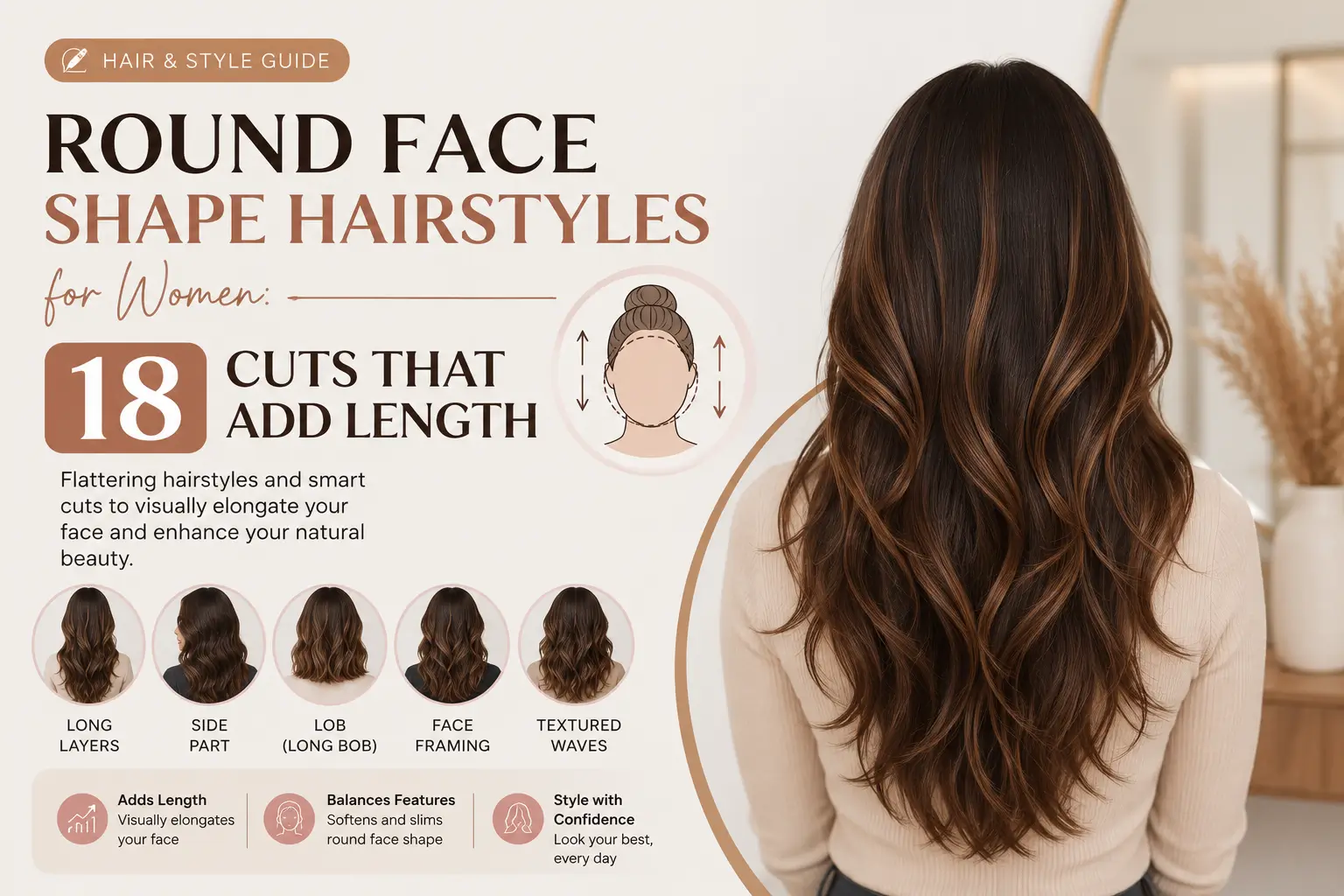
Most round face guides give you the same 5 styles and call it done. They don’t tell you why those cuts work, what happens with different hair textures, or how the same round face at 5’2″ needs a different approach than at 5’8″. This guide covers all of it.
Round face shape accounts for 17.3% of all faces in our dataset of 51,247 analyses — making it the third most common shape, and more prevalent in women (22%) than men (12%). If you have a round face, you are not alone. And you have more options than most guides suggest.
Not sure if your face is round? Use the free face shape detector — upload a photo or enter four measurements and get your result in under 30 seconds.
What Is a Round Face Shape?
A round face shape is defined by equal (or near-equal) face length and width, with full cheeks, a soft rounded jawline, and no strong angular features. The L/W ratio is typically 1.0 to 1.2:1. The forehead and jaw are similar in width, and the sides of the face curve outward rather than tapering inward.
The 4 defining characteristics:
- Face length and width are roughly equal
- Cheeks are the widest part of the face
- Jawline is soft and rounded with no sharp angles
- Forehead is full with no strong taper
What this means for hair: The styling goal for round faces is to create the illusion of length, making the face appear more oval. The two tools for this are vertical volume (height at the crown) and length that draws the eye downward, combined with a reduction in width at the sides.
The 18 Best Hairstyles for Round Face Shape Women
1. Long Layers — The Most Reliable Length Creator ★★★★★
Long hair with face-framing layers pulled downward is the single most effective style for adding perceived length to a round face. The key is that the layers must frame inward, not expand outward at the sides.
- Why it works: Vertical lines formed by the layers draw the eye from forehead to chin, creating the elongation effect the round face needs.
- Best for: Fine to medium hair. Works with straight or wavy hair.
- Length: Collarbone to mid-back. Below the chin is the minimum — chin-length without layers can actually widen the face.
- Avoid: Heavy blunt layers that flare outward at cheek level.
What to tell your stylist: “Long layers with face-framing pieces that fall inward toward my chin. I want the layers to draw the eye down, not flare out at the sides. Keep the bulk of the volume toward the crown rather than the cheeks.”
2. Side-Swept Bangs — Breaks Symmetry, Adds Length ★★★★★
Side-swept bangs are one of the most effective single techniques for round faces. They create an asymmetrical line across the forehead that interrupts the face’s circular outline and visually stretches the proportions.
- Why it works: The diagonal sweep creates a line that draws the eye across and downward — breaking the round symmetry without removing length.
- Best for: All hair types. Works with any overall length from lob to long.
- Key detail: The sweep direction should go from the higher side (where the part is) toward the lower side, creating a downward diagonal across the forehead.
- Avoid: Blunt straight-across bangs — these widen the forehead and emphasise the circular shape.
What to tell your stylist: “Side-swept fringe, parted on my stronger side. I want the fringe to angle diagonally across the forehead — asymmetric rather than straight across. Keep the length at or below brow level on the shorter side.”
3. Long Bob (Lob) with Texture — The Best Bob Option ★★★★★
A lob (long bob) sitting below the jawline — not at it — is the only bob that consistently flatters round faces. The critical detail is length: the ends must sit below the widest part of the face (the cheeks) to avoid cutting a horizontal line across the fullest point.
- Why it works: The chin-plus length carries the eye past the cheeks to a lower focal point, creating elongation. Added texture prevents the ends from flaring outward.
- Best for: Medium to thick hair. Fine hair needs a texture product to prevent the ends from sitting flat and wide.
- Optimal length: 1–2 inches below the chin.
- Avoid: A blunt lob cut straight across — this creates a shelf at cheek level that widens the face significantly.
What to tell your stylist: “Long bob sitting about an inch or two below my chin — not at the jaw. I want point-cut ends for texture, not a blunt line. Some face-framing layers that fall inward.”
4. Curtain Bangs — 2026’s Best Fringe Option for Round Faces ★★★★★
Curtain bangs — parted at the centre or slightly off-centre, falling outward toward the temples — work particularly well for round faces because the outward sweep creates width at forehead level while the centre part creates a vertical line that elongates.
- Why it works: The centre part creates a visual dividing line that makes the face appear narrower and longer. The outward sweep frames without adding bulk at the cheeks.
- Best for: All hair types. Works at any length from lob to long.
- 2026 context: Curtain bangs are the dominant fringe trend and suit round faces better than the alternatives (blunt or heavy fringe).
- Avoid: Curtain bangs that are so full they cover most of the forehead — this reduces the elongating effect of the centre part.
What to tell your stylist: “Curtain bangs with a slightly off-centre part. I want them to frame my face outward toward the temples — soft and wispy rather than heavy. Long enough to tuck behind the ears.”
5. Layered Wolf Cut — The #1 Trending 2026 Style ★★★★☆
The wolf cut — layered shag with choppy ends, face-framing pieces, and volume at the crown — suits round faces well when executed correctly. The crown volume adds height, the face-framing layers pull inward, and the choppy texture prevents the ends from sitting wide.
- Why it works: The crown height adds vertical length. The shaggy layers create texture rather than width. The face-framing pieces direct the eye inward and downward.
- Best for: Wavy to curly hair gets the most out of the wolf cut’s texture. Works on straight hair with styling.
- Critical detail: The wolf cut for round faces must have more crown volume than side volume — the stylist should build height upward, not outward.
- Avoid: Wolf cuts with heavy curtain layers at cheek level — these add width at the widest point.
What to tell your stylist: “Wolf cut but I want the volume built upward at the crown, not at the sides. Face-framing layers falling inward. Keep the sides relatively flat — the height should come from the top.”
6. Pixie Cut with Volume at Crown ★★★★☆
A pixie cut works for round faces only when it has clear volume at the crown. A flat, cropped-all-over pixie removes all length and leaves the circular shape fully exposed. A pixie with a lifted, textured crown creates vertical emphasis that balances the roundness.
- Why it works: Crown volume creates height that visually stretches the face. Textured ends add character rather than width.
- Best for: Thick to medium hair. Fine hair can work if the stylist uses a layering technique to create lift.
- The rule: The more hair you remove in length, the more you need to add in height. A very short pixie needs maximum crown volume to compensate.
- Avoid: Cropped-close pixies with no crown definition — the round face needs something to work against its natural geometry.
What to tell your stylist: “Pixie with clear crown volume and texture — I don’t want it lying flat. Keep the sides and back short and close, but build the crown. Add texture to the top so it lifts rather than lies down.”
7. High Ponytail ★★★★☆
A high ponytail is one of the most immediately flattering styles for round faces — it lifts the hair away from the face, creates vertical height, and reveals the neck, all of which elongate the facial silhouette.
- Why it works: The upward pull of a high pony creates length above the face. The exposed neck adds perceived vertical space below.
- Best for: Any hair type and length (from medium-long upward).
- Improvement: A sleek ponytail exposes the face cleanly and maximises the elongating effect. A slightly bouffant crown before the tie adds extra height.
- Avoid: Low ponytails — these add width at the nape level and reduce the length benefit entirely.
8. Half-Up, Half-Down with Crown Lift ★★★★☆
The half-up style achieves a similar effect to the high ponytail — lifting the crown — while keeping the lower layers long to create a face-framing vertical line.
- Why it works: The crown lift adds vertical height. The lower layers frame the face downward.
- Best for: All hair types. Works with straight or wavy lower layers.
- Key detail: The half-up section should be positioned at the crown, not the sides. Pulling from the sides creates width; pulling from the crown creates height.
9. Textured Shag / 70s Shag ★★★★☆
The shag haircut — layers throughout from root to ends, curtain fringe, and choppy textured ends — is having a significant moment in 2026 and suits round faces well for the same reasons as the wolf cut: crown volume, inward face-framing, and texture over width.
- Why it works: The layering throughout the head adds vertical movement. The curtain fringe creates a centre-part elongating line.
- Best for: Wavy to curly hair. Straight hair needs styling.
- Best length for round faces: Mid-length (collarbone to shoulder) — long enough to create vertical lines, short enough to maintain the shag’s volume.
10. Asymmetric Bob ★★★★☆
An asymmetric (A-line) bob — shorter at the back, longer toward the front — creates a diagonal line that breaks the round face’s symmetry and draws the eye forward and downward.
- Why it works: The angle creates direction across the face. The longer front pieces frame the face below cheek level.
- Best for: Straight to wavy hair, medium to thick density.
- Length requirement: The longer side must sit below the chin — at or above the jaw defeats the purpose.
11. Braids and Updos with Height ★★★★☆
Any style that pulls hair upward and creates crown height works in favour of round faces. French braids, Dutch braids, and topknots all create vertical lines and reduce side width simultaneously.
- French braid: The narrow braid running from forehead to nape creates a strong vertical line. Very flattering.
- High bun: Creates maximum height. Best when the bun is positioned at the very top of the crown, not at the middle of the head.
- Fishtail braid: The texture adds interest; the long braid creates a vertical line down the back.
12. Slicked-Back / Wet Look ★★★☆☆
Slicked-back styles push all hair away from the face, revealing the facial structure and creating a clean, elongated silhouette. Works well on round faces with good symmetry and strong features.
- Why it works: No side width, all vertical lines. The face length is fully revealed.
- Caution: This style works best when the round face has some jaw definition. Very full, soft faces may prefer styles with some framing.
13. Long Straight Hair with Centre Part ★★★☆☆
Long straight hair with a centre part is often listed as flattering for round faces. It can work — but only with length past the shoulders and some face-framing layers. Without those, straight, flat hair simply hangs down without creating any elongating line.
- The requirement: Must be shoulder-length or longer. Must have some inward face-framing layering. A blunt centre-parted style with no layers adds width rather than length.
- Works best: With natural wave or texture. Completely flat, straight hair can look limp and wide at the same time.
14. Side Part Blowout ★★★☆☆
A side part with volume at the crown and smooth blowout finish creates an asymmetric line and height simultaneously. More formal than casual styles, but very flattering.
- Why it works: The diagonal part interrupts the circular symmetry. The crown volume adds height.
- Best for: Professional or formal settings. Straight to wavy hair.
15–18: Styles That Work With Conditions
- 15. Beachy Waves (medium to long) — Works when waves are vertical rather than horizontal. Avoid wide, outward-breaking waves at cheek level. Long, loose waves that fall downward add length.
- 16. Box braids / protective styles — Work well when worn high or pulled upward. Long box braids create strong vertical lines. Avoid wide protective styles that add significant width at the sides.
- 17. Space buns — Generally not flattering for round faces (adds width high up). Exception: space buns positioned at the very top of the crown (not at the sides) can create height without width.
- 18. Layered curls — Natural curls with vertical spring rather than wide horizontal volume suit round faces. Key: keep sides tighter, build volume upward. A diffused crown with a tighter side gives the right proportions.
What to Avoid — and Why Each One Hurts
| Style | Why it hurts round faces |
|---|---|
| Chin-length blunt bob | Cuts a horizontal line directly across the widest part of the face |
| Straight blunt fringe | Shortens the face and adds horizontal width at the forehead |
| Low ponytail/bun | Adds width at the nape with no upward elongation |
| Very short flat pixie | Removes all length with no compensating height |
| Side volume styles | Adds width at exactly the point the round face doesn’t need it |
| Heavily layered ends that flare outward | Creates a wide base that emphasises fullness |
| Very tight, small updos | Leaves all the face visible with nothing creating height |
Round Face Celebrities — and What Their Stylists Actually Do
These four celebrities have confirmed round face proportions. Study what they consistently do — and don’t do.
- Adele — The defining example. Her signature look is volume at the crown with tight sides. The beehive-influenced styles she became known for are geometrically ideal for her face shape: maximum vertical height, minimal side width. When she wears her hair down, it is always long with face-framing layers that fall inward.
- Selena Gomez — Consistently wears face-framing long layers or side-swept styles. Her bob phases always feature asymmetric cuts below the chin rather than at it. Notably avoids blunt fringes in public appearances. Her stylists regularly use the side sweep and crown lift.
- Chrissy Teigen — Favours long, wavy styles with centre or side parts. The length and wave create vertical movement. Uses curtain bangs effectively — the light fringe creates a centre line without adding heaviness.
- Ginnifer Goodwin — One of the few celebrities who makes the pixie work on a round face. Her pixie cuts always feature significant crown volume and texture — the height compensates for the removal of length.
From our data: Round-faced users in our 51,247-analysis dataset most commonly report hairstyle success with long layers (62% positive feedback) and side-swept styles (58%), and the lowest satisfaction with chin-length blunt bobs (28% positive feedback).
By Hair Type — What Works Best
- Fine, straight hair: Best: Side-swept lob with texture product, layered styles below collarbone. Avoid: Very long straight styles without layers — fine hair lying flat and long widens the face. Key: Use lightweight volumising products at the crown. Fine hair needs product help to maintain the height that round faces benefit from.
- Thick, straight hair: Best: Almost all the cuts above. Thick straight hair holds shape well. Particular strength: the blowout side part, the sleek ponytail, and the asymmetric bob all work beautifully.
- Wavy hair: Best: Wolf cut, shag, long layered styles, curtain bangs. Natural wave creates vertical movement naturally — use it. Caution: Wide, horizontal waves at cheek level add width. Keep the wave direction falling downward rather than outward.
- Curly and coily hair: Best: Vertical curl definition with tighter sides and more crown height. The elongated curl shape creates natural length. Key: Avoid styles that build maximum volume at the sides. Ask your stylist for a cut that builds volume upward rather than outward.
What to Tell Your Stylist
“I have a round face shape — equal width and length, soft jaw, full cheeks. The goal with my hair is to add vertical length and avoid adding width. I need: volume at the crown rather than the sides, styles that draw the eye downward rather than outward, and anything that creates a vertical line. Specifically, I want [choose your style from above]. Please avoid anything that adds bulk at cheek level.”
Frequently Asked Questions
What hairstyle suits round face shape women best?
Long layers with face-framing pieces, side-swept bangs, and a lob below the chin are the three consistently strongest choices for round-faced women. All three create vertical lines that add to the perceived length the round face benefits from. The specific best choice depends on your hair type and preferred length — use the guide above to match your texture to the right style.
Does a bob suit a round face shape?
Yes — with one critical condition. The bob must sit below the jawline, not at it. A long bob (lob) ending 1–2 inches below the chin is flattering for round faces. A chin-length bob ending at or above the jaw cuts a horizontal line across the widest point of the face and makes it appear rounder. The length distinction is more important than the cut style itself.
Do bangs suit round face shape women?
Side-swept bangs and curtain bangs both suit round faces well. Straight blunt bangs cut directly across the forehead do not — they shorten the face and add width simultaneously. The asymmetry of a side sweep or the centre-part vertical line of curtain bangs creates elongation rather than width.
What length hair suits a round face shape?
Longer is generally better for round faces because length creates vertical lines that add perceived face length. The minimum flattering length is 1–2 inches below the chin. Medium to long styles from the collarbone to mid-back work best. Very short styles require maximum crown volume to compensate for the removed length.
Does a pixie cut suit a round face shape?
It can — but only when executed with significant crown volume. A flat, cropped-all-over pixie leaves the round shape fully exposed. A pixie with a lifted, textured crown adds the vertical emphasis the round face needs. If you want a pixie, specifically ask for a crown lift and texture rather than an even all-over crop.
What celebrities have round face shapes?
Confirmed round-faced female celebrities include Adele, Selena Gomez, Chrissy Teigen, Ginnifer Goodwin, Cameron Diaz, and Kirsten Dunst. Study their styling choices — particularly what they do at the crown and what they avoid at the cheek level.
How do I know if I have a round or oval face shape?
Oval faces are slightly longer than wide (L/W ratio 1.25–1.45) with cheekbones as the widest point and a gentle inward taper at both forehead and jaw. Round faces are approximately equal in length and width (L/W ratio 1.0–1.2) with a softer jaw and fuller cheeks. The clearest test is measurement: take your face length (hairline to chin) and your cheekbone width. If they are close to equal, your face is round. Use the free face shape calculator for your exact ratio.
Does losing weight change a round face shape?
Losing weight can reduce facial fat in the cheeks and jaw, which may shift a full, round face toward a softer oval. However, the underlying bone structure — cheekbone position, jaw angle, skull width — is set by genetics and does not change with weight. If the rounded appearance is primarily from bone structure, weight loss will not change the face shape category.
