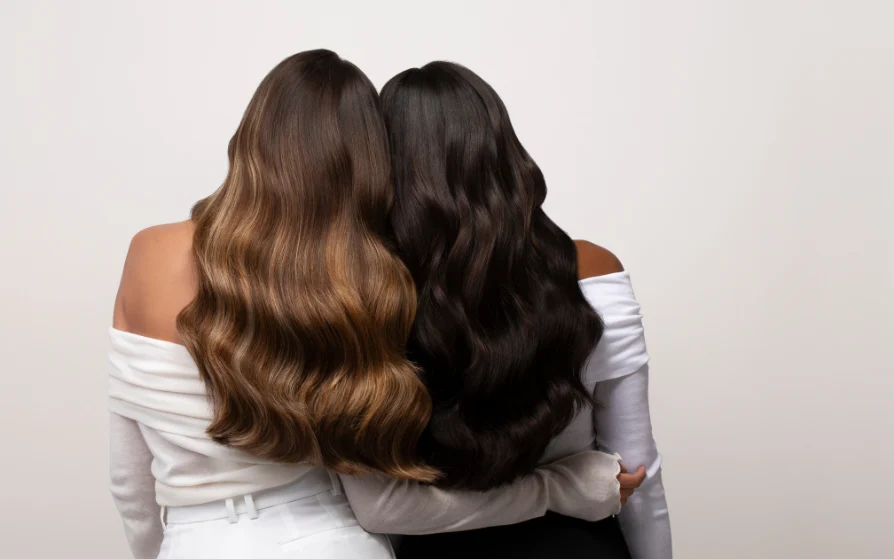
If you have an oblong or long face shape, hair extensions can absolutely work for you – but the approach matters more than it does for some other face shapes. The instinct a lot of women have is to add length, but for oblong faces, that’s usually the wrong direction. What actually flatters a longer face is volume at the sides, body through the mid-lengths, and a silhouette that reads wider rather than taller.
Getting that result with extensions comes down to choosing the right method and understanding how each type of extension moves and sits on the head.
Understanding the Oblong Face Shape
An oblong face is longer than it is wide, with fairly uniform width through the forehead, cheekbones, and jaw. It’s a balanced shape in many ways – no dramatic angles, no heavy jawline – but the vertical length can make certain hairstyles feel like they’re pulling the face further downward.
Long, straight extensions that fall below the collarbone without much volume can do exactly that. They emphasize the vertical drop rather than breaking it up. The goal with extensions on an oblong face is to create width at the sides, particularly through the cheekbone area, and to avoid adding so much length that the face looks even more elongated.
Waves and curls help naturally because they create width as they move outward. Straight extensions can work too, but layering is important – a flat, blunt extension look tends to frame the face narrowly, while layers that move and break at the sides create more of the width that flatters this face shape.
Which Extension Methods Add Volume vs. Length
Not all extensions are designed to do the same thing, and this distinction matters significantly for oblong faces.
Weft extensions for volume and body
Weft extensions are your best friend if you’re working with an oblong face shape. They’re installed in horizontal rows and, when done well, create fullness through the sides and mid-lengths of the hair rather than just adding weight at the bottom. Genius Weft extensions built on a flat, thin construction – like Genius Weft – sit particularly close to the scalp without a bulky track at the root. That flat placement means the hair can fan outward naturally from the sides, creating the width and volume that works best for longer face shapes.
Because wefts can be placed strategically throughout the head, a good stylist can position them to maximize side volume – concentrating the fullness where it does the most work visually. For oblong faces, that usually means rows placed at and just below the occipital bone, where the hair naturally swings out as it falls.
Keratin bond extensions for precision and movement
Keratin hair extensions attach strand by strand at the root using a small keratin tip. Because they’re installed individually rather than in horizontal rows, a stylist has very precise control over placement. This works particularly well for oblong faces because extensions can be concentrated specifically at the sides and temples, adding volume exactly where it’s needed without adding unnecessary weight at the back center, which would pull the silhouette downward.
K-tip extensions also move very naturally because each strand is free to move independently. That natural movement creates a softer, more organic look than some weft methods, which is helpful for creating the kind of relaxed width that flatters longer face shapes. They’re also less visible at the root than wefts when installed well, which matters if you want to wear your hair up occasionally.
The tradeoff is that keratin bonds require professional installation and are more time-intensive to apply and remove. They’re an investment in both time and money, but for the right hair type and face shape, the result is genuinely difficult to achieve any other way.
Color Matching for Oblong Faces: Why Bulk Hair Matters
One of the less-discussed parts of extension success for longer face shapes is color matching. Extensions that don’t blend well with your natural hair create a visible line between your hair and the extension, which tends to draw the eye vertically – the opposite of what you want on an oblong face.
Custom color matching is where wholesale bulk hair becomes relevant. Stylists who specialize in extensions often prefer to work with raw bulk hair because it can be colored to match a client’s exact hair color before being made into wefts or bonds. Rather than choosing from a fixed color chart and hoping for a close match, a stylist can start with quality source hair and achieve a precise result.
Hair By Russians, a European hair supplier with direct sourcing operations since 2011, offers bulk hair specifically for this purpose. The consistent quality of the source material means the color takes evenly and predictably, which is important when you’re trying to achieve a seamless blend. A well-matched set of extensions on an oblong face reads as natural fullness rather than an obvious add-on, which is exactly what flatters this face shape most.
Length Recommendations for Oblong Faces
If you’re working with an oblong or long face shape, the generally flattering extension lengths are:
12 to 16 inches: This length typically falls at or just below the shoulder, which is a sweet spot for oblong faces. The hair has enough weight to swing with movement – creating side volume – without being long enough to visually drag the face downward.
18 inches with layers: This can work well if the extensions are layered and styled with waves or curls. The layers break up the straight vertical fall and create width at the sides. A straight blunt 18-inch set without layers tends to be less flattering.
20 inches and beyond: These lengths require careful styling on oblong faces. Long, straight extensions without volume at the sides can make the face look more elongated. If you prefer longer lengths, waves, curls, or heavy layering become more important, not optional.
Styling Tips That Work With Your Extensions
Extensions do the structural work, but styling keeps them working for your face shape. A few things that consistently help on oblong faces: curling or waving the ends outward rather than under, using a round brush when blowing out to encourage volume at the sides rather than height at the crown, and avoiding sleek center-parted styles that emphasize the vertical line of the face.
A soft side part is almost always more flattering than a center part for oblong faces – it breaks the symmetry and draws the eye horizontally. Loose waves starting at the cheekbone are particularly effective with weft extensions because the natural fullness of the weft structure amplifies the movement outward.
FAQ
Should women with oblong faces avoid long hair extensions?
Not necessarily, but length without volume can make an oblong face appear more elongated. The key is adding width and body at the sides through volume and movement, not just length at the bottom. Layered extensions styled with waves or curls tend to work much better than straight, blunt-cut long extensions for this face shape.
Which extension method is better for oblong faces – wefts or keratin bonds?
Both can work well, but for different reasons. Weft extensions create natural volume through the sides when placed strategically, which is ideal for adding the width that flatters oblong faces. Keratin bond extensions allow precise strand-by-strand placement, so a stylist can concentrate volume exactly at the temples and sides. Your stylist can recommend which is better suited to your specific hair density and texture.
How important is color matching for extensions on a long face shape?
Very important. Extensions that don’t blend at the attachment point create a horizontal contrast line that draws the eye, but more subtly, poorly matched color can also create a visual separation between your natural hair and the extension that emphasizes the vertical length of the face. Seamless color matching, ideally with custom-colored bulk hair, creates the most natural result.
Can I get extensions that add volume without adding much length?
Yes – this is actually one of the best uses of weft extensions for oblong faces. By choosing a length close to your current natural length or just slightly longer, and focusing the installation on adding density and side volume rather than length, you get the fullness and width that flatters the face shape without elongating it further.
How do I find a stylist who understands face-shape-specific extension placement?
Ask specifically whether the stylist considers face shape when planning extension placement. A stylist who does will ask about your face shape, your styling habits, and what result you’re trying to achieve before recommending a method or placement strategy. Extension specialists with experience in face framing and balayage work tend to think about placement this way more naturally than general stylists.
