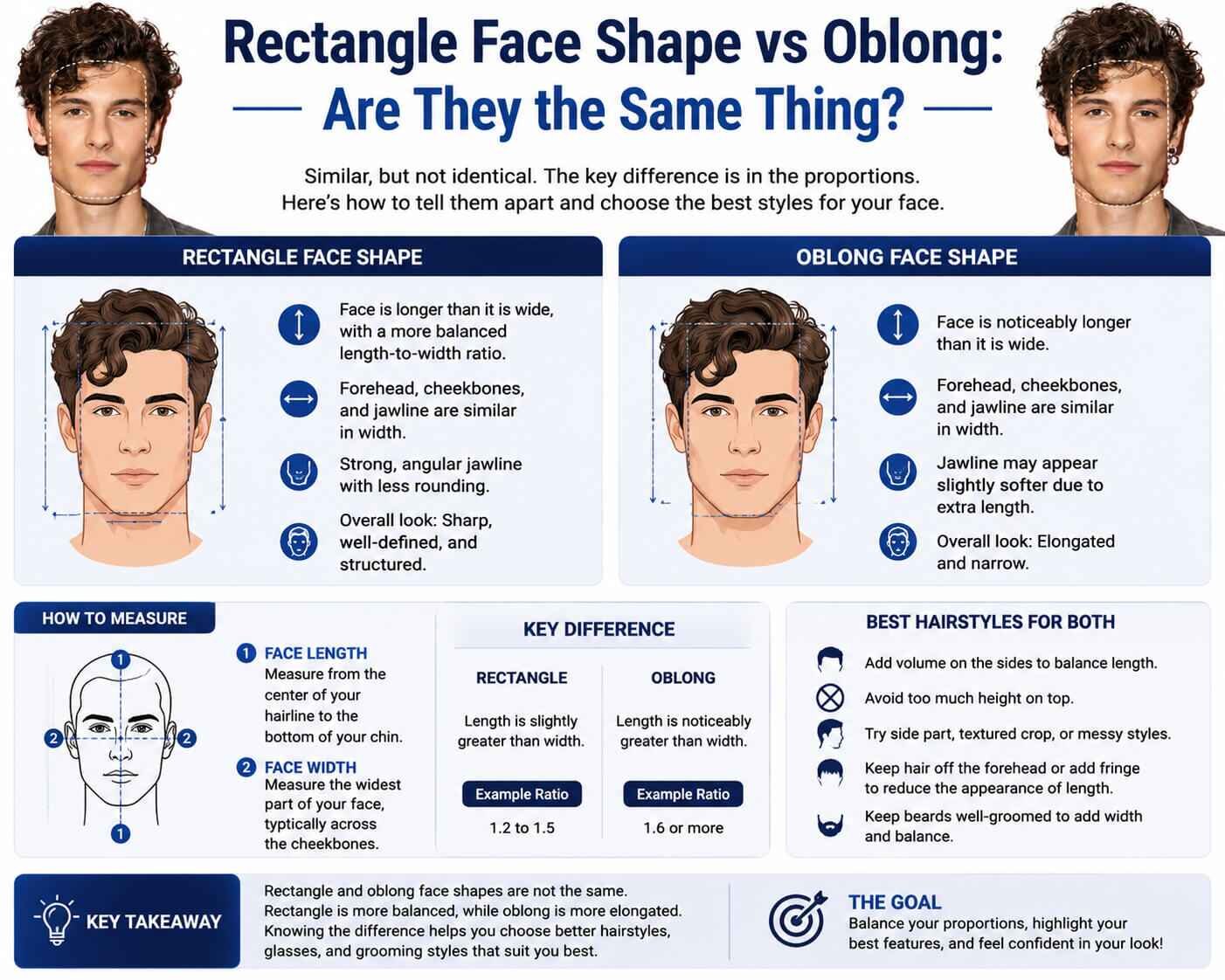
Quick answer:
Rectangle and oblong describe the same proportions with one difference: the jawline. A rectangle face has a squared, angular jaw with visible corners. An oblong face has the same length and the same consistent widths, but with a softer, more rounded jaw. That is the whole distinction. For haircuts, glasses, and beards, the advice is nearly identical, so if you cannot tell which you are, it will not cost you anything.
The Difference in One Table
| Rectangle | Oblong | |
|---|---|---|
| Face length vs width | Clearly longer than wide | Clearly longer than wide |
| Widths across the face | Stay consistent top to bottom | Stay consistent top to bottom |
| Jawline | Angular, visible corners | Softer, rounded |
| Chin | Squarer, flatter | More rounded |
| Sides of the face | Straighter, more parallel | Straight-ish with slight curve |
Everything except the bottom three rows is shared. That is why so many guides simply use the two words interchangeably.
What Actually Separates Them
The jaw is the only reliable difference, and you look at it two ways.
- Corners: Run a finger along your jawline from your ear toward your chin. On a rectangle face, you feel a clear turn, almost a corner, where the jaw changes direction; on an oblong face, that turn is a curve with no obvious corner. The angle of the mandible at that point is what you are feeling, and it varies naturally between people.
- Chin shape: Rectangle chins tend to read flat or squared across the bottom. Oblong chins tend to read rounded.
That is it. There is no separate ratio, no different measurement, and no threshold that flips you from one to the other. Anyone giving you a precise percentage cutoff for this is inventing it.
Why Different Guides Disagree
You will find three different positions on the web, and it helps to know why.
- Position 1: they are different, split by jaw angle: The most common view, and the one this page uses. Classic styling and colour-analysis guides have separated them this way for decades.
- Position 2: they are identical, use either word: Many modern face shape tools take this line because the styling output is the same either way. They are not wrong, just prioritising practicality.
- Position 3: split by something else entirely: A few guides invent their own rule based on cheekbone or jaw width comparisons. These rules are not shared between sites and cannot be checked against anything.
The reason all three exist is simple: face shape naming is a styling convention, not a measurement standard. No professional body defines these categories, so nobody can be formally correct. Both terms are useful shorthand, and the jaw distinction is the version most people already recognise.
How to Tell Which One You Have
Step 1. Confirm you are in the long face family at all. Pull your hair fully back and measure. Face length divided by your average width (forehead, cheekbones, and jaw added together, divided by three). If the result is 1.5 or above and your three widths sit close to each other, you are in the rectangle and oblong family. If not, you are a different shape entirely, and the face shape calculator will tell you which.
Step 2. Look at your jaw in a straight-on photo. Neutral expression, hair back, chin level. Trace the outline of your jaw with your eyes.
- Visible corner where the jaw turns toward the chin, flat chin base, rectangle
- Smooth curve with no corner, rounded chin base, oblong
Step 3. If you genuinely cannot tell, stop worrying. Plenty of jaws sit between the two. The AI face shape detector reads your outline from a photo, and if it puts you on the border, the practical answer is that either label works for you.
Does the Difference Change Your Styling?
Mostly no. Both shapes need the same core correction: add horizontal width, avoid vertical height. A long face reads longer when you add height at the crown and shorter when you break the vertical line.
Where it makes a small difference:
| Element | Rectangle (angular jaw) | Oblong (soft jaw) |
|---|---|---|
| Glasses | Round and oval frames contrast nicely with the jaw corners | Wide rectangular and browline frames add definition |
| Beards | Keep edges softer, avoid sharp lines that double the angles | Sharper trimmed lines add welcome structure |
| Hair | Identical advice: width at the sides, no crown height | Identical advice |
| Makeup | Soften the jaw corners if you want, or lean into them | Contour along the jaw if you want more definition |
Notice the pattern. The adjustments are about whether you want to emphasise or soften your jaw, which is a preference, not a rule. Neither is a mistake.
For the full styling depth: hairstyles for women, men’s hair and beards, and the glasses section.
Where “Long Face Shape” Fits In
There is a third name in circulation, and it is the loosest of the three. Long face shape is the everyday term that covers both rectangle and oblong without distinguishing them. If someone says they have a long face, they mean the proportions, not the jaw.
Full terminology breakdown and the measurement method: long face shape explained.
Rectangle vs Square: A More Useful Distinction
If you are unsure between rectangle and square, that difference actually matters for styling, unlike rectangle versus oblong.
- Square: angular jaw, but the face is roughly as wide as it is long. Styling adds softness and a little length.
- Rectangle: the same angular jaw, but the face is clearly longer than wide. Styling adds width and avoids length.
Same jaw, opposite instructions. This is the mix-up worth getting right.
FAQs
Is rectangle face shape the same as oblong?
Almost. They share the same proportions, longer than wide with consistent widths from forehead to jaw. The difference is the jawline: rectangle is angular with visible corners, oblong is softer and rounded. Styling advice is close to identical.
How do I know if I have a rectangle face shape?
First, confirm your face is clearly longer than wide, a ratio of 1.5 or above using average width. Then look at your jaw in a straight-on photo. A visible corner where the jaw turns toward the chin, plus a flatter chin base, points to rectangle rather than oblong.
What is the difference between rectangle and square face shapes?
The jaw is angular on both. The difference is proportion. A square face is roughly as wide as it is long, while a rectangle face is clearly longer than wide. That reverses the styling goal: square faces add length, rectangle faces add width.
Does it matter whether I am rectangle or oblong?
Not much. The core styling rule is the same for both. The only real choice is whether you want to soften your jaw or emphasise it, and both options are valid.
Is long face shape the same as rectangle?
Long face shape is a broader everyday term covering both rectangle and oblong. If a guide calls you long-faced, it is describing your proportions and not making a claim about your jaw.
Why do different websites give me different labels?
Because face shape categories are a styling convention rather than a measured standard. Different guides split rectangle and oblong differently, and some do not split them at all. None of them is officially correct.
