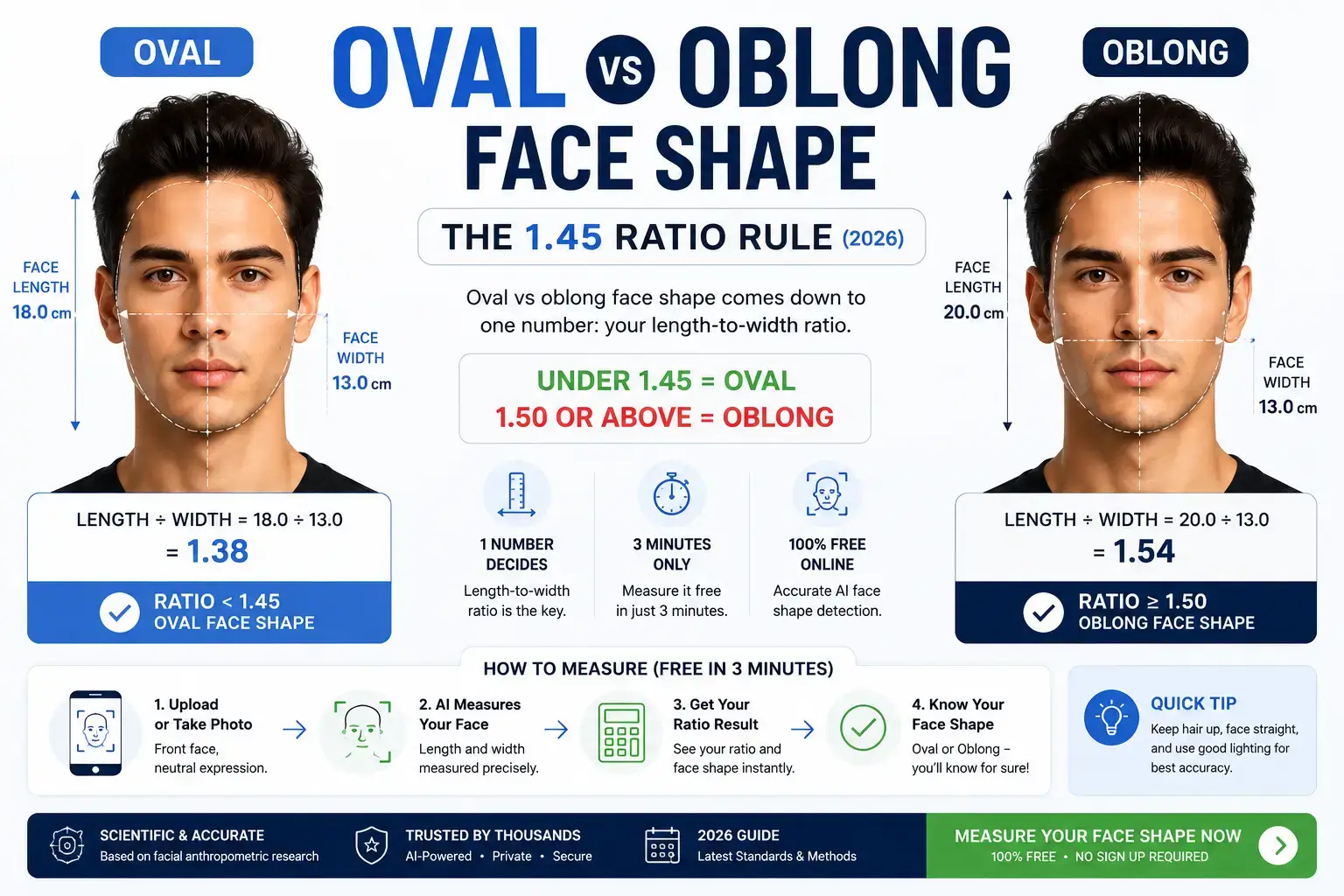
Quick answer:
The difference between an oval and oblong face shape is length. Both shapes have fairly even widths, but an oval face has a length-to-width ratio of roughly 1.25–1.45, while an oblong face measures 1.5 or higher. Divide your face length by your average face width — that one number decides it. Between 1.45 and 1.5? You are on the border, and this guide covers that too.
This is the most common face shape mix-up on the internet, and it matters: about 28.4% of people are oval and 21.7% are oblong — together, half of everyone (full statistics here). Most oblong people call themselves oval, because guides lead with oval and mirrors are bad at judging length. The fix costs three minutes and a tape measure.
The Ratio Test: 3 Minutes, One Answer
- Measure four things with a soft tape: face length (hairline centre to chin tip), forehead width, cheekbone width, and jaw width.
- Average the three widths — add them, divide by 3.
- Divide length by average width. That’s your ratio.
| Your Ratio | Your Shape |
|---|---|
| 1.25 – 1.45 | Oval |
| 1.45 – 1.5 | Borderline — read the blend section |
| 1.5 or higher | Oblong |
Worked example: length 22 cm, widths 14 + 15 + 13 = 42 ÷ 3 = 14. Ratio = 22 ÷ 14 = 1.57 → oblong. Don’t want to do the math? The free face shape calculator computes it with 92%+ accuracy, or the AI detector reads it from a photo in 3 seconds.
Beyond the Ratio: Three Smaller Differences
- Cheekbones: Oval faces have cheekbones as the slightly widest point, with a gentle taper. Oblong faces have nearly equal widths from forehead to jaw — no single point clearly leads (all three within 15% of each other).
- Chin: Oval chins are softly rounded. Oblong chins can be rounded or mildly squared, but the lower face stays as wide as the upper face for longer before tapering.
- Overall impression: Oval reads “balanced.” Oblong reads “elegant and long” — the geometry closest to the golden ratio of 1.618, which is why oblong faces average the highest scores on the golden ratio face calculator.
Celebrity Examples
- Oval: George Clooney and Jessica Alba — balanced proportions, cheekbones gently widest, rounded chin.
- Oblong: Benedict Cumberbatch, Blake Lively, and Ben Affleck — clearly long faces with steady width top to bottom.
Compare your mirror outline to each pair; the length difference is usually obvious once you know to look for it.
Why It Matters: The Styling Rules Are Opposite
Here is the practical stake. Oval styling is permissive — nearly every haircut, glasses frame, and beard works, because the face is already balanced. Oblong styling has one strict rule: add width, never height. Crown volume, tall pompadours, and long straight hair make an oblong face look longer. Fringes, waves, side volume, and wide glasses frames balance it. So if you’re actually oblong but styling as oval, you may be picking looks that stretch your face — the full fixes are in the women’s oblong hairstyle guide and men’s guide.
Borderline (1.45–1.5): The Long Oval
If your ratio sits in the gap, you have a “long oval” blend — genuinely common, and honestly, the luckiest position. You keep most of oval’s styling freedom, with one borrowed oblong rule: skip extreme crown height. When in doubt, run two methods — if the tape and the AI detector agree, that’s your answer. And if your forehead turns out to be your widest point instead, you’re in different territory: see oblong vs heart.
FAQs
Is my face oval or oblong?
Divide face length by average width. 1.25–1.45 is oval; 1.5+ is oblong. Oblong faces are clearly longer than they are wide; oval faces are only slightly longer.
Can a face be both oval and oblong?
Yes — ratios between 1.45 and 1.5 blend both. Style it as an oval but avoid strong crown height.
Which is more common, oval or oblong?
Oval, at 28.4% of people versus oblong at 21.7%. They are the two most common shapes, based on 51,247+ analyses — see the full face shape statistics.
Is an oblong face attractive?
Yes — its proportions sit closest to the golden ratio (1.618) of all 7 shapes. Read the full breakdown: is the oblong face shape attractive?
Do oval and oblong faces suit the same hairstyles?
Mostly no. Oval suits nearly everything; oblong needs width-adding styles and should avoid height. Getting the diagnosis right comes first.
