Quick answer:
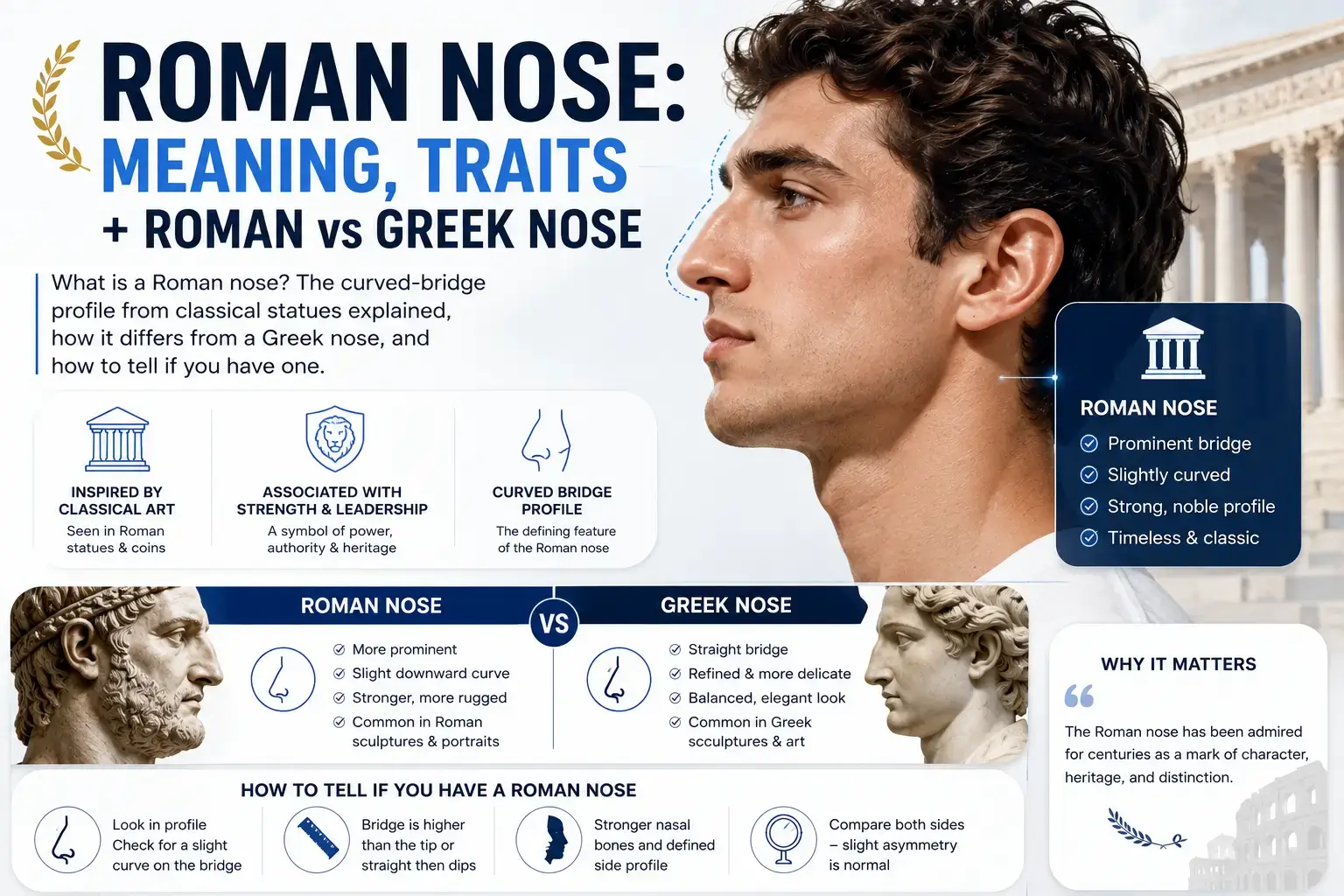
A Roman nose has a prominent, outward-curved bridge, the profile seen across ancient Roman statues and coins, which is where the name comes from. It is anatomically the same shape as an aquiline nose: Roman is the cultural name, aquiline the anatomical one. Its classic contrast is the Greek nose, which runs perfectly straight from brow to tip. Check your profile in a mirror: an outward curve or bump on the bridge means Roman; a ruler-straight line means Greek.
Where the Name Comes From
The term comes from classical art. Busts and coins of Roman figures, most famously Julius Caesar, repeatedly show a strong, convex-bridged profile, and the shape became culturally attached to ideas of authority and leadership. That association is art history, not biology: the same shape appears in populations worldwide and carries no proven link to character or ability, as the evidence summarized on Wikipedia makes clear.
Roman Nose Characteristics
- A high, prominent bridge that projects clearly in profile
- An outward (convex) curve or visible bump along the bridge line
- A tip that sits level or dips slightly downward
- Best identified from the side; from the front it often just reads as a defined bridge
Roman vs Greek Nose: The Classic Pairing
This is the comparison people actually search for, and it is refreshingly simple:
| Feature | Roman Nose | Greek Nose |
|---|---|---|
| Bridge line | Curved outward, may have a bump | Perfectly straight, root to tip |
| Profile impression | Strong, projecting | Smooth, even |
| Classical association | Roman statues and emperors | Greek sculpture ideals |
Both names come from classical art traditions rather than anatomy textbooks, which is why the categories feel more cultural than clinical. They are.
Roman vs Aquiline: One Shape, Two Names
If you have read about the aquiline nose and wondered how it differs, the honest answer is that it does not, in any meaningful physical way. Aquiline is the anatomical descriptor (from the Latin for eagle-like); Roman is the historical nickname. A few sites manufacture subtle distinctions between them, but the mainstream position is that the difference is vocabulary, not structure.
Is a Roman Nose Something to Change?
Most pages on this topic are written by rhinoplasty clinics, so the framing quietly leans toward correction. Here is the neutral version: a Roman nose is a common structural variant, historically depicted as distinguished, and it needs attention only if a structural issue inside the nose affects breathing, which is a medical question for a doctor. For styling, your overall face shape drives decisions like glasses and hairstyles far more than your nose profile does.
FAQs
What is a Roman nose?
A nose with a prominent bridge that curves outward, named after the profile commonly depicted in ancient Roman statues and coins.
What is the difference between a Roman nose and a Greek nose?
The bridge line. A Roman nose curves outward or has a bump; a Greek nose is perfectly straight from the brow to the tip.
Is a Roman nose the same as an aquiline nose?
Yes. They describe the same convex-bridge shape; aquiline is the anatomical term, and Roman is the cultural one.
Who has a Roman nose?
The shape appears in every population worldwide. Historically, it is associated with figures like Julius Caesar through classical art, but it is not tied to any ethnicity or personality type.
