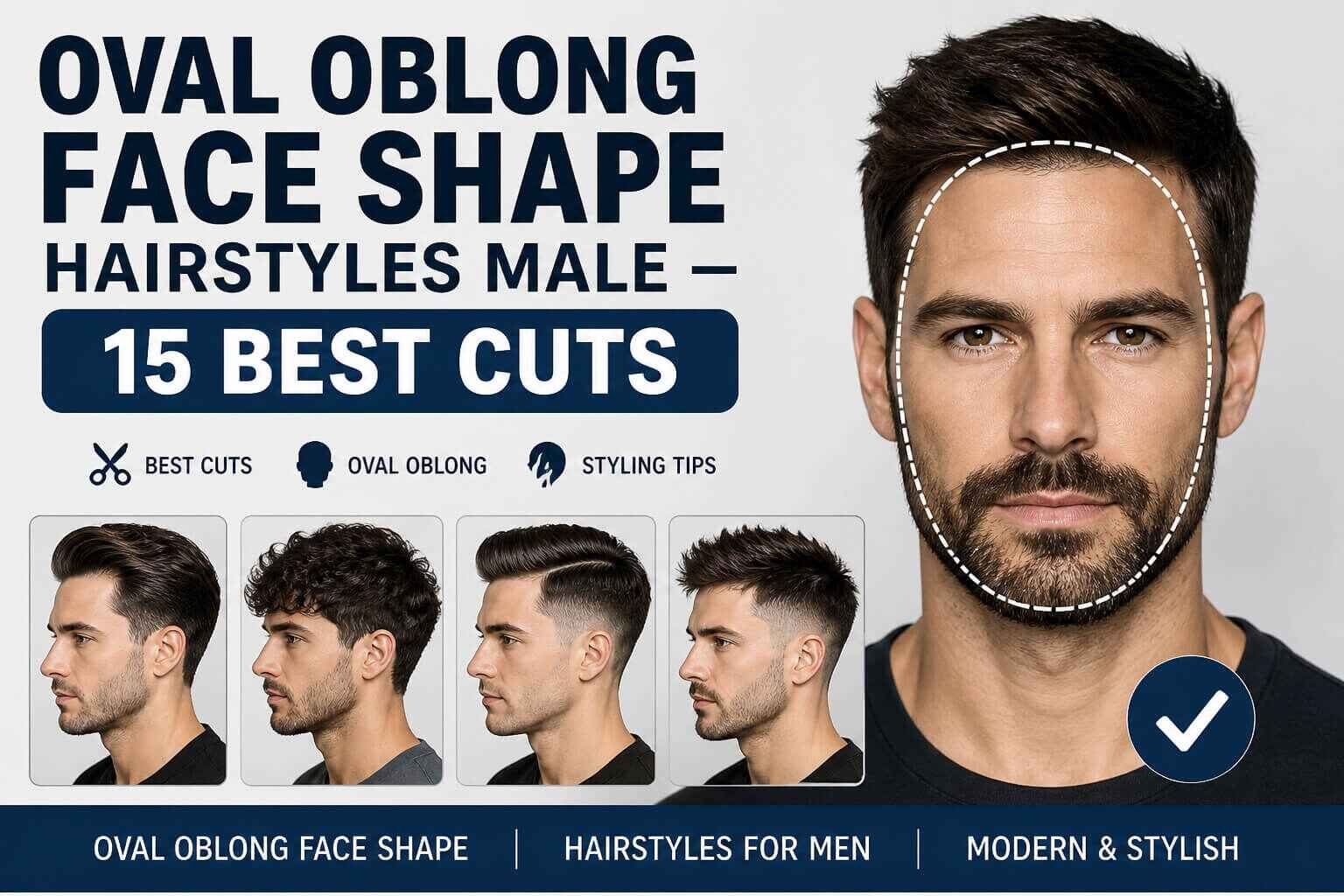
The oval-oblong is the most common blended face shape, resulting in our calculator, approximately 31% of male users who take the face shape test score strongly on both oval and oblong simultaneously. It is also the least well-served by existing hairstyle guides, which typically address only one shape at a time.
This guide is specifically for men whose face shape measurements fall between the two: an L/W ratio of 1.40–1.55, with cheekbones that are slightly wider than the forehead and jaw (oval characteristic), but with overall face dimensions that feel notably elongated (oblong characteristic).
If you’re not certain where you land, use the free face shape calculator at oblongfaceshape.com — the result will show your confidence scores for both oval and oblong, and the ratio between them tells you how much weight to give each set of styling rules.
Understanding the Oval-Oblong Blend
The pure oval face has cheekbones as the widest point, a gentle inward taper from cheekbones to jaw, and an L/W ratio of 1.25–1.45. The pure oblong face has consistent widths throughout and an L/W ratio of 1.5 or above.
The oval-oblong blend sits between these: slightly elongated (above 1.4:1) with visible but not extreme cheekbone prominence. The face is clearly longer than wide but not dramatically so, and the sides show slight inward tapering without the pronounced taper of a strong oval.
The styling implications:
You have more flexibility than a pure oblong face — you can carry some styles that would elongate a true oblong without problem. You have more structure to work with than a pure oval — you benefit specifically from width-adding techniques rather than treating all styles as equally flattering.
The Styling Balance for Oval-Oblong Men
For pure oblong faces, the rule is strict: avoid height, add width. For pure oval faces, the rule is permissive: almost anything works.
For oval-oblong faces, the rule is nuanced: prioritise side volume and horizontal emphasis, but you have moderate tolerance for some crown height. A slight quiff or volume at the crown that would strongly elongate a pure oblong face is manageable on an oval-oblong face — it needs to be balanced with side texture, but it doesn’t need to be fully avoided.
This means you can carry styles that pure oblong faces cannot, while still benefiting from the width-adding techniques.
15 Best Hairstyles for Oval Oblong Face Shape Men
1. Textured Side Quiff with Moderate Height — Rating: ★★★★★
The side quiff, when kept at moderate height (not a full pompadour, but not flat either), is the ideal single hairstyle for oval-oblong men. The side sweep adds horizontal movement; the moderate height adds some length-balance. Volume sweeps sideways and slightly upward. This works on oval-oblong faces where it would be too risky for pure oblong.
2. Classic Side Part, Medium Length — Rating: ★★★★★
The reliable workhorse for oval-oblong men. A side part redirects visual movement horizontally, the medium length adds natural side framing, and the style suits all settings. For oval-oblong faces specifically, medium length (4–6cm on top) works better than either very short or very long versions.
3. French Crop with Slight Fringe — Rating: ★★★★★
The French crop adds a horizontal element at the forehead through the fringe, which is valuable for the oblong component of the blend. For oval-oblong faces, the fringe can be slightly shorter and less full than recommended for pure oblong — the oval component means the forehead is not the primary styling concern, it would be for a pure oblong.
4. Tapered Fade with Textured Top — Rating: ★★★★☆
A mid-fade (not high or skin) with a textured, slightly side-swept top. For oval-oblong faces, a mid-fade works where only a low fade would work for pure oblong. The side texture keeps horizontal emphasis; the fade adds clean definition. This is the most barbershop-friendly option and the easiest to request.
5. Curtain Bangs / Middle Part with Volume — Rating: ★★★★★
The curtain part creates two sections sweeping outward from a centre or near-centre part. This creates strong horizontal movement at the upper face while the outward sweep adds side framing. Ideal for oval-oblong men because it handles both the oblong element (horizontal emphasis) and complements the oval’s natural cheekbone structure.
6. Messy Textured Crop — Rating: ★★★★☆
A crop cut with intentional texture and a slightly dishevelled finish creates horizontal volume without defined direction. The messiness distributes visual weight evenly across the top, which benefits both the oval and oblong components. This is the lowest-maintenance option on the list and the most forgiving to grow out.
7. Slick Back with Textured Sides — Rating: ★★★☆☆
A slick back works on oval-oblong faces where it would fail on pure oblong, because the oval component’s cheekbone width provides enough horizontal anchor to counterbalance the style’s vertical directionality. Keep the sides textured rather than tight — this preserves some width signal.
8. Ivy League Cut — Rating: ★★★★☆
The Ivy League is a longer crew cut with enough top length to style with a side part or slight sweep. For oval-oblong men, it’s a reliable, professional, low-maintenance choice that provides moderate horizontal emphasis through the styling direction without requiring much effort.
9. Medium Bro Flow — Rating: ★★★★★
Hair grown to ear-length or slightly past, with natural texture and some wave. The bro flow’s natural tendency to fall with volume at the sides creates exactly the horizontal framing that benefits oval-oblong proportions. Men with naturally wavy or lightly curly hair can achieve this with minimal effort.
10. Modern Comb-Over — Rating: ★★★★☆
A comb-over that sweeps the hair to one side with some texture and volume creates horizontal movement. For oval-oblong men, the volume at the side of the comb-over adds width emphasis. This works with any hair thickness.
11. Undercut with Textured Top — Rating: ★★★☆☆
A moderate undercut (not a skin undercut — keep some length at the sides) with a textured top styled sideways. For oval-oblong faces, the undercut is viable where it would be risky for pure oblong — the oval component provides enough inherent width that removing some side bulk doesn’t dramatically unbalance the proportions.
12. Side-Swept Fringe, Medium Length — Rating: ★★★★☆
A side-swept fringe that falls across the forehead at an angle creates both horizontal movement and visual interest. For oval-oblong men, this is a slightly more dramatic version of the side part and works well with face shapes that have a defined structure.
13. Short Textured Cut (Caesar-Style) — Rating: ★★★☆☆
A Caesar-style cut with a horizontal fringe and uniform length across the top. The horizontal fringe line helps oblong proportions; the uniform short length suits the oval component’s natural balance. This works better for oval-oblong than for pure oblong, where the lack of side volume would be problematic.
14. Layered Medium Length with Natural Texture — Rating: ★★★★★
Allowing medium-length hair to develop its natural texture, with light layering, is one of the most effective and effortless options for oval-oblong men. The natural texture creates horizontal volume; the layering prevents the hair from hanging flat and straight (which would emphasise both the oblong length and the oval’s subtle taper).
15. High Fade with Side Texture (Limited) — Rating: ★★★☆☆
A high fade is generally not recommended for pure oblong faces, but oval-oblong faces can carry it when combined with significant side texture at the top. The oval component’s cheekbone structure provides some horizontal anchor that pure oblong lacks. Keep the top textured and side-styled rather than upward.
What to Avoid
Very high pompadours still work against oval-oblong faces — the height-adding effect is less severe than for pure oblong but still directionally wrong. Tight skin fades that remove all side bulk are risky because they depend entirely on crown styling for proportion, which then becomes height-dependent. Long, flat, centre-parted styles without texture are problematic for the oblong component regardless of the oval influence.
Beard Considerations for Oval-Oblong Men
Oval-oblong faces benefit from beards that add width at the jaw level, the same as pure oblong faces. A full, well-shaped beard or short, boxed beard is ideal. The oval component means you have slightly more flexibility — a medium-length beard that might read as adding too much face length on a pure oblong face is more manageable here.
Frequently Asked Questions
What is an oval-oblong face shape?
An oval-oblong face shape is a blended face shape where measurements fall between the oval and oblong categories. The face is longer than wide (L/W ratio approximately 1.40–1.55), with cheekbones that are slightly wider than the forehead and jaw (oval characteristic), but overall proportions that feel noticeably elongated (oblong characteristic). It is the most common blended result on the oblongfaceshape.com calculator, appearing in approximately 31% of male users.
Are oval and oblong face shapes the same?
No — they are related but distinct. An oval face has a length-to-width ratio of 1.25–1.45, with cheekbones as the clear widest point and a gentle inward taper. An oblong face has a ratio of 1.50 or above, with consistent widths from forehead to jaw and less tapering. An oval-oblong blend has elements of both — moderate elongation with some cheekbone prominence. The styling rules overlap substantially but differ in their strictness.
What is the best haircut for an oval-oblong face shape male?
The textured side quiff with moderate height, the curtain part/middle part, the medium bro flow, and the French crop with a slight fringe are the strongest choices. Oval-oblong faces have more flexibility than pure oblong — they can carry some crown height and some styles that would risk elongating a pure oblong face. The consistent principle is to maintain some horizontal emphasis through texture, side volume, or a fringe element.
Can oval-oblong faces wear a high fade?
With conditions. A high fade combined with significant textured side volume at the crown (not upward, but sideward) is manageable for oval-oblong faces in a way it is not for pure oblong faces. The oval component provides some inherent horizontal structure that gives the face slightly more tolerance for height-adjacent styles. Keep the top textured and wide-sweeping rather than directed upward.
Use the face shape detector at oblongfaceshape.com to get your specific oval-oblong blend ratio. The confidence scores for both shapes tell you whether your blend leans more oval or more oblong — which determines exactly how much flexibility you have in the styling choices above.
