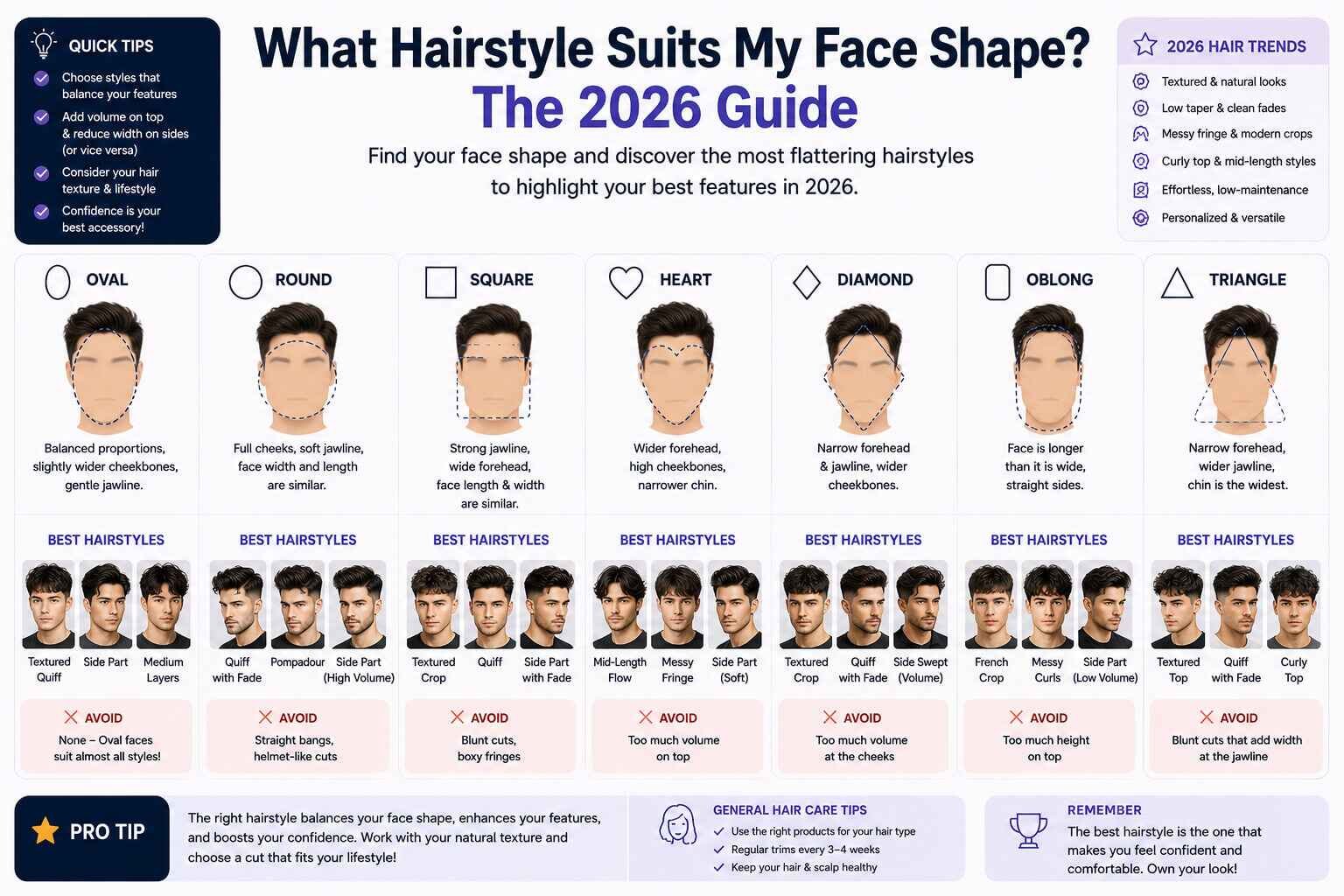
Most face shape hairstyle guides tell you the same five things. They recommend “add volume here” and “avoid width there” in broad strokes that leave you sitting in the barber’s chair with no idea what to actually request.
This guide is different. It tells you exactly which hairstyle suits your face shape, differentiates by hair type, and gives you the precise language to use with your barber — for all 7 face shapes, both male and female.
Don’t know your face shape yet? Use the free What Hairstyle Suits My Face Shape? The 2026 Guide, 3 minutes, precise result.
Why Face Shape Changes Everything About Your Haircut
A perfect haircut for a square jaw is not the same as a crop for a narrow chin. Most men and women never hear this from their barber. The result is walking out of every appointment with a nagging feeling that something is off — even when the cut itself is technically excellent.
The principle is simple: your haircut should visually balance your face’s proportions. A face that is longer than wide needs width. A face that is wider than long needs height. A face that is symmetrical and balanced can wear almost anything. The specific cut you choose should work with your bone structure rather than against it.
Face shape charts reduce faces to basic outlines, ignoring forehead height, cheek width, and eye spacing. What actually determines whether a haircut works involves more than 20 measurable facial cues — not just the outline. This guide uses the proportional ratios measured by the face shape calculator to give more specific recommendations than any shape-only chart can.
First — Confirm Your Face Shape
Before applying any of the recommendations below, confirm your actual shape. The four measurements that define your face shape are:
- Face length: Hairline centre to chin tip
- Forehead width: Widest point, about a finger’s width above brows
- Cheekbone width: Outer eye corner to outer eye corner
- Jawline width: Widest point across the jaw
Enter these into the free face shape calculator for your exact shape and L/W ratio. The ratio is as important as the category — an oblong face at 1.5 needs different recommendations from one at 1.8.
Hairstyles by Face Shape — All 7 Covered
Oblong Face Shape — The Priority: Break the Length
Oblong faces have a length-to-width ratio of 1.5:1 or above, with consistent widths from forehead to jaw. The proportional goal is adding horizontal visual weight and reducing vertical length.
Women — Best cuts ranked:
1. Wolf cut with layers (★★★★★): The current #1 recommendation for oblong female faces in 2026. The curtain fringe at brow level interrupts the vertical face line immediately. The layered body adds horizontal volume at the mid-face. The shaggy texture distributes visual weight sideways rather than downward.
Ask your stylist for “a wolf cut with face-framing curtain bangs to the brow, heavy layers starting at chin level, and texturising throughout.”
2. Chin-length bob or lob (★★★★★): The horizontal cut line at chin or shoulder level creates the most direct visual counterweight to oblong proportions. Best in wavy or lightly textured form to avoid adding length signals.
Tell your stylist: “Lob hitting at or just below the collarbone, with soft waves and face-framing layers. Keep it full at the ends.”
3. Full blunt fringe (★★★★☆): A blunt fringe across the brow is the single most effective cut element for oblong faces. It reduces the perceived face length immediately by blocking the upper vertical zone. Works with any length below.
Tell your stylist: “Full fringe sitting at the brow line, blunt or lightly textured. Keep it dense rather than wispy.”
4. Curtain bangs (★★★★☆): More versatile than a full fringe and easier to grow out. Parted at the centre with lengths framing toward the temples. The 2026 pick for oblong and long face shapes — they visually shorten the face without the commitment of a full fringe.
What to avoid: Very long straight hair worn loose without layers. Centre-parted sleek flat styles. High updos or tight buns that add crown height. These make an already long face appear significantly more elongated.
Men — Best cuts ranked:
1. Textured side quiff (★★★★★): Hair swept to the side at crown level with horizontal movement rather than upward volume. The side direction adds perceived width at the forehead level.
Ask your barber: “Mid fade on the sides, 3 inches on top, textured and swept to the side rather than upward. No pompadour height.”
2. Curtain hair (★★★★★): Centre-parted with lengths sweeping outward toward temples. One of the strongest 2026 trends and the most face-shape-appropriate for oblong.
Tell your barber: “Curtain hair — taper on the sides, 3–4 inches on top, parted at the centre with the lengths swept outward.”
3. French crop with fringe (★★★★☆): Short, blunt fringe at brow level with a tapered or faded back and sides. The fringe creates a horizontal visual bar directly at the face’s most visible level.
Ask your barber: “French crop, skin fade, fringe sitting at my brow line — blunt, not too long.”
- What to avoid: Pompadours and any style adding vertical crown height. Mohawks. Top knots. These extend the face’s dominant vertical axis.
- What to tell your barber: “I have an oblong face — longer than wide — so I need horizontal movement and nothing that adds height at the crown. I want the emphasis going sideways, not upward.”
Oval Face Shape — The Priority: Almost Anything Works
Oval faces — L/W ratio 1.25–1.45, cheekbones as the widest point — are the most hairstyle-versatile shape. A textured quiff, a classic pompadour, a medium-length side part, or a messy fringe all maintain the natural symmetry of the oval face and allow you to play with movement and structure.
- Women: Long, polished waves or a blunt “power bob” are the 2026 picks. Oval faces can wear virtually any length — the choice becomes about hair texture and personal style rather than face correction.
- Men: A textured quiff, a classic pompadour, a medium-length side part, or a messy fringe all maintain the natural symmetry of the oval face. The only genuine limitation is avoiding styles that actively hide the face’s balanced proportions.
What to tell your barber: “Oval face — I have a lot of flexibility. I want [specific style]. I’m choosing based on personal preference rather than face shape correction.”
Round Face Shape — The Priority: Add Height and Length
Round faces — L/W ratio near 1.0, soft jaw, consistent widths — need styles that create vertical emphasis.
- Women: Long layers or a “Lobed” (long bob) with a side part are the 2026 picks. The goal for round faces is to create the illusion of length — avoid styles that end exactly at the jawline as this emphasises width. Side parts are more effective than centre parts because they create asymmetry that breaks the circular visual impression.
- Men: High fade with textured top, pompadour, or quiff — any style that adds controlled crown height elongates the face. High fades, pompadours, undercuts, and quiffs help create a longer, more defined look for round faces.
What to tell your barber: “Round face — I need height at the crown and length visually. Mid to high fade on the sides, volume upward on top. Side part rather than centre.”
Square Face Shape — The Priority: Soften the Jaw
Square faces are defined by strong jaw angularity and roughly equal widths. The styling goal is softening, not hiding, the jaw’s strength.
- Women: Wispy, curtain bangs or long shag-style layers that hit mid-face. Soft texture is key — a texture paste can help break up the lines of a blunt cut to soften the overall look.
- Men: Textured crops, quiffs, and high fades balance a strong jawline, while side parts or pompadours add height and refinement. Soft waves and medium-length styles are more flattering than very short sides that expose the jaw.
What to tell your barber: “Square face — strong jaw. I want softer, textured styles that don’t add more angularity. Side-swept movement rather than geometric precision.”
Heart Face Shape — The Priority: Add Width at the Jaw
Heart faces are wide at the forehead and cheekbones, tapering to a narrow chin. The styling goal is to add perceived width at the jaw level.
- Women: Chin-length cuts that add volume at the jaw are the strongest choice. Lobs with fullness at the ends, side-swept bangs that narrow the forehead. Avoid heavy volume at the top.
- Men: Medium-length styles with fullness below the cheekbones. A beard is one of the most effective tools — it adds jaw-level mass directly. Styles that add forehead-level width (wide quiffs, high flat tops) should be avoided.
What to tell your barber: “Heart face — wide forehead, narrow chin. I need body and fullness at jaw level and nothing that adds width at the forehead.”
Diamond Face Shape — The Priority: Add Width at Forehead and Chin
Diamond faces are widest at the cheekbones with a narrow forehead and jaw. The styling goal is to balance the cheekbone-dominant structure by adding forehead and chin width.
- Women: Side-swept bangs are the single best tool — they add visual width to the narrow forehead. Chin-length styles and soft waves around the jaw level add chin-area fullness. Styles swept tightly back that expose the dramatic cheekbone-to-forehead width contrast should be avoided.
- Men: French crop with fringe adds forehead-level width. Wide textured quiff at crown level achieves the same. Any style that adds volume at the very top of the head rather than at cheekbone level is effective.
What to tell your barber: “Diamond face — my cheekbones are the widest part. I need forehead-level width and nothing that emphasises my cheekbones more.”
Triangle Face Shape — The Priority: Add Volume at Crown and Forehead
The triangular face shape is the most challenging to pair with a suitable style. The pronounced jawline is offset by a narrow forehead and cheekbones. Short, sharp cuts are an absolute no-go — they emphasise the gap between wide and narrow sections. The goal is to add width and volume to the top half of the face to balance the strong jawline.
- Women: Statement bangs or curtain bangs are the most effective single element — they add forehead-level width directly. High updos and buns add crown height that counterbalances the jaw. Long straight hair ending at jaw level is the worst choice — it adds visual mass at exactly the wrong level.
- Men: Pompadour or textured quiff with deliberate crown height. French crop with a wide fringe. Any style where the widest visual point is at the crown or brow level rather than the jaw level.
What to tell your barber: “Triangle face — jaw is wider than my forehead. I need crown and forehead volume. The height goes up, not out at the sides.”
By Hair Type — The Variable Everyone Ignores
The correct cut for your face shape depends as much on your hair texture as your face shape. The same “recommended” style produces completely different results on fine straight hair versus thick curly hair.
- Fine straight hair: Blunt cuts, French crops, bobs — styles where the cut edge itself creates visual weight. Volume fades quickly, so avoid styles requiring sustained root lift. Oblong faces with fine hair: curtain bangs are excellent because the fringe creates horizontal weight without requiring volume maintenance.
- Thick straight hair: Almost any recommended style works as intended. The main risk is over-volume — discuss with your barber which areas to texturise to avoid unintended bulk.
- Wavy hair: Natural wave does the horizontal-emphasis work for oblong and round faces with minimal effort. Curly hair and wolf cuts are particularly effective because the wave carries the style. Don’t fight the natural movement.
- Curly or coily hair: Curls add volume in all directions. For oblong faces, this is inherently flattering — the volume distributes horizontally. For round faces, defined length management matters more than the cut outline. Always see a stylist who specialises in your curl pattern.
The Barber Script — What to Actually Say
The most useful thing about knowing your face shape is being able to brief your barber precisely. Here are complete scripts for each shape:
- Oblong: “I have an oblong face — notably longer than wide. I want to avoid any height at the crown and add horizontal movement instead. [Specific cut]. Keep everything sweeping sideways.”
- Oval: “Oval face — good proportions, I have flexibility. I want [specific cut] — my choice is based on preference, not face correction.”
- Round: “Round face — I want height and length. [Specific cut] with the volume upward. Side part preferred over centre. Avoid anything that adds width at the sides.”
- Square: “Square face with a strong jaw. Soft texture over precision geometry. [Specific cut] — I want movement and softness rather than sharp lines at the jaw.”
- Heart: “Heart face — wide forehead, narrower jaw. I need fullness below the cheekbones and lighter volume at the top. [Specific cut].”
- Diamond: “Diamond face — cheekbones are widest. I want forehead-level width and jaw-level fullness. [Specific cut with fringe or side-swept element].”
- Triangle: “Triangle face — jaw is my widest point. I need crown height and forehead width. The volume needs to go upward to balance the jaw. [Specific cut].”
Frequently Asked Questions
What hairstyle suits my face shape if I have an oblong face?
For oblong faces, the best hairstyles add horizontal width and avoid vertical height. Women: wolf cut, curtain bangs, chin-length bob, full fringe. Men: curtain hair, French crop, textured side quiff. The consistent principle — any style where the cut or volume sweeps sideways rather than upward. Confirm your face is oblong using the free face shape calculator before choosing a cut.
What hairstyle suits me if I don’t know my face shape?
Measure your forehead width, cheekbone width, jaw width, and face length with a flexible measuring tape. Enter these into the face shape calculator to identify your shape in seconds. The result gives you your L/W ratio and shape category — both of which determine which hairstyle recommendations apply to you.
Does hair texture affect which hairstyle suits my face shape?
Yes, significantly. Fine straight hair behaves very differently from thick curly hair, even when the cut is identical. For oblong faces with fine hair, blunt cut elements (fringes, bobs) create the horizontal weight that fine hair can’t hold through volume. For oblong faces with curly hair, the natural curl provides horizontal volume automatically — almost any oblong-appropriate style works effortlessly.
What hairstyle suits my face shape if I’m male with an oval face?
A textured quiff, a classic pompadour, a medium-length side part, or a messy fringe all work well for oval-faced men — the shape is versatile enough to support almost any style. The practical recommendation: choose based on your lifestyle and hair type rather than face shape correction, since oval faces don’t require correction.
Is the “what hairstyle suits my face shape” question different for men and women?
The underlying proportional principles are the same — face length, cheekbone position, and jaw width drive the same styling logic for both genders. The specific cut options differ because the available range of lengths and styles differs. A round-faced man and a round-faced woman both need height and length signals from their hairstyle, but the cuts that deliver this look are completely different.
Confirm your face shape in 3 minutes with the free face shape calculator — then use the results above to find your best hairstyle.
