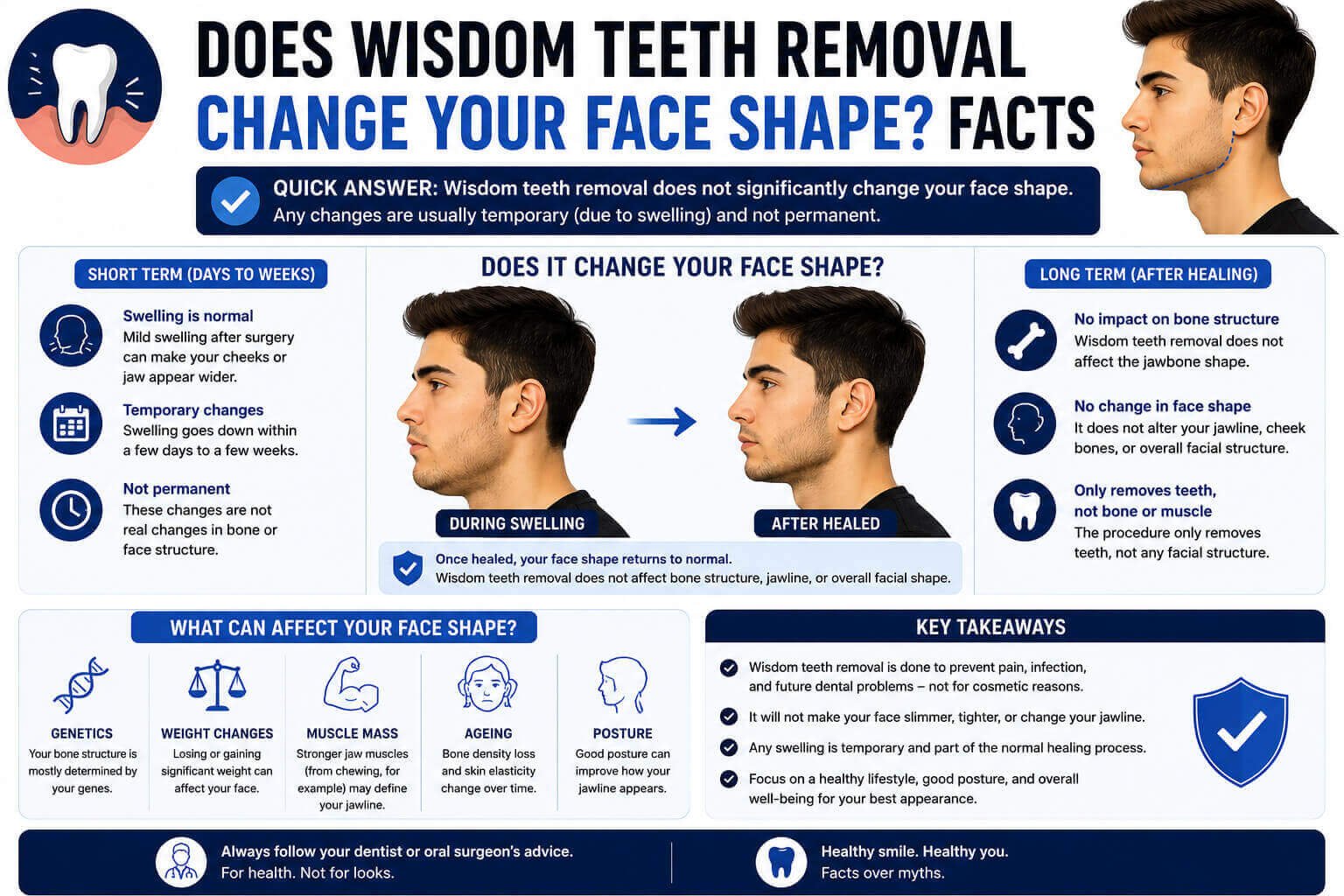
Wisdom teeth removal does not permanently change your face shape. While temporary swelling is common during healing, your facial bone structure and external appearance remain unchanged once recovery is complete.
That is the complete answer for most people. But “most people” conceals some genuine nuance worth understanding before your extraction — particularly around what your face looks like during recovery, why some people report visible changes, and what is actually happening structurally.
Why People Think Wisdom Teeth Change Face Shape
The concern comes from a logical assumption: Wisdom teeth are at the back of the jaw, removal involves significant dental surgery, and the jaw is a primary structural component of your face shape. If something changes in the jaw, surely the face changes too?
The problem with this logic is that the jaw’s contribution to face shape comes from its bone structure — specifically, the width of the jaw arch, the angle of the jaw corners, and the jaw’s relationship to cheekbones and forehead. Wisdom teeth are molars. They sit in the jawbone, but they do not support the jaw’s width, angle, or structural dimensions. Removing them leaves the jawbone itself entirely intact.
What removing wisdom teeth does change: the socket left behind heals over weeks. The surrounding gum tissue heals. Temporary post-surgical swelling resolves. The jawbone resorbs slightly in the specific location where the tooth root was, but this resorption is localised deep in the jaw, not in the external dimensions that determine face shape.
What the Research Shows
A pilot study measuring 3D soft and hard tissue changes after wisdom teeth extraction found that the facial soft tissue volume on the extraction side decreased slightly in the short term, then returned to approximately the original level in the long term. The paired test showed no significant difference in the shape or volume between the extraction side and the non-extraction side.
The same study noted an important distinction: compared to the minimal discriminative threshold of the naked eye — approximately 2 mm — even if buccal change existed, the quantity was still far from being recognised. Changes smaller than 2mm are not visible to the human eye at normal social distance.
The practical conclusion from the clinical evidence: any structural change from wisdom teeth extraction is both small and temporary. The changes that people notice are soft tissue and swelling changes, not bone structure changes.
What Actually Happens During and After Extraction
- Immediately post-surgery (Days 1–3): Significant swelling in the cheek and jaw area adjacent to the extraction site. This swelling can be substantial — the face appears puffier, and the jaw line looks less defined. This is inflammation from the surgical procedure, not a structural change.
- Recovery phase (Days 4–14): Swelling reduces progressively. Ice packs, elevation, and anti-inflammatory medication accelerate this. By day 14, most visible swelling has resolved for straightforward extractions.
- Full healing (Weeks 4–12): The socket closes fully with gum tissue. The jawbone begins normal remodelling around the empty socket. By 12 weeks post-extraction, no visual difference from pre-surgery is detectable in the vast majority of cases.
- Long-term (months to years): Some modest bone resorption in the specific extraction socket area, but this is deep within the jaw and not visible externally. The jaw’s external dimensions — width, angle, and the features that determine face shape — remain unchanged.
What Your Face Shape Means for Recovery Expectations
This is the section no dental site covers — because orthodontists think about extraction sites, not face shape geometry.
Different face shapes have different soft tissue distributions around the jaw, which affects how visible post-extraction swelling appears:
- Round Face Shape: Round faces have more facial soft tissue volume throughout the mid-face and jaw area. Post-extraction swelling may appear more noticeable because it adds to an already fuller-looking face. Recovery timelines are the same; appearance during the swelling phase may be more pronounced. Good news: as swelling resolves, the return to baseline is cleaner because the face has consistent soft tissue volume throughout.
- Oblong Face Shape: Oblong faces have less mid-face fullness and more clearly defined jaw lines. Post-extraction swelling may appear asymmetrically visible — particularly if one side is extracted before the other. The defined jaw line becomes temporarily obscured during swelling. Recovery reveals the original jaw line fully, as the bone structure supporting it is entirely unaffected.
- Square Face Shape: Square faces have strong jaw definition as their primary characteristic. The jaw angle — the structural feature that creates the square’s distinctive look — is entirely bone-based and unaffected by extraction. Swelling during recovery may temporarily soften the jaw’s visual angularity. Once resolved, the jaw angle returns to its pre-surgery appearance completely.
- Heart Face Shape: Heart-faced patients have a narrower jaw to begin with. Post-extraction swelling may be relatively less visible because there is less facial volume at the jaw level to begin with. The chin-to-jaw proportions that define the heart shape are unaffected.
- Diamond Face Shape: Diamond faces have prominent cheekbones above the jawline. The extraction site is below and behind the cheekbone level. Post-extraction swelling is in the lower jaw region, which may temporarily reduce the dramatic cheekbone-to-jaw contrast that defines diamond faces. As swelling resolves, the characteristic cheekbone prominence returns fully.
The Exaggerated Claims
“My face looks slimmer after wisdom teeth removal.”
Some people do report this. The most likely explanations are not structural: temporary reduction in soft tissue volume during healing, weight loss from eating softer foods post-surgery, reduced facial tension from eliminating the pressure of impacted teeth, or simply noticing the jaw more because attention was drawn to it. None of these is a permanent change in face shape.
“My jawline is more defined after removal.”
If a wisdom tooth is severely impacted and causing inflammation, removing it eliminates chronic low-grade swelling that may have been masking jaw definition. Resolving an infection-related process can make the jaw appear slightly more defined — but again, this is inflammation resolution, not bone structure change.
“My face shape changed.”
Proper post-surgery care helps ensure any puffiness resolves within one to two weeks. If someone perceives their face shape has changed longer-term after wisdom teeth removal, the change is more likely related to weight loss from dietary changes during recovery, general ageing between the procedure and the comparison point, or a pre-existing change they were attributing to the surgery.
What to Expect — Timeline
| Phase | What You See | Is It Permanent? |
|---|---|---|
| Days 1–3 | Significant swelling, puffy jaw and cheek | No — inflammation |
| Days 4–14 | Swelling is decreasing, and jaw definition is returning | No — healing |
| Weeks 2–4 | Near-normal appearance | No — still healing |
| Months 1–3 | Full normal appearance | Yes — this is permanent |
| Long-term | No visible difference from pre-surgery | Yes — stable |
When to See Your Face Shape Results Post-Surgery
If you had your face shape assessed before wisdom teeth removal, there is no need to reassess after — the result will be the same once healing is complete.
If you want to confirm, wait at least 12 weeks post-surgery before using the face shape calculator at oblongfaceshape.com to measure your shape. At 12 weeks, all soft tissue swelling and healing-phase changes have resolved. Your measurements at that point reflect your permanent bone structure — unchanged from before surgery.
Frequently Asked Questions
Does wisdom teeth removal change your face shape permanently?
No. Wisdom teeth removal does not permanently change face shape. Facial bone structure and external appearance remain unchanged once recovery is complete. Any changes during recovery — swelling, temporary puffiness, reduced jaw definition — resolve fully within two to twelve weeks, depending on extraction complexity.
Why does my face look different after wisdom teeth removal?
The most common reason is post-surgical swelling. The cheek and jaw tissue adjacent to the extraction site swells as part of the normal inflammatory healing response. This swelling resolves as healing progresses. Other factors: dietary changes during recovery (softer foods, reduced appetite) may cause modest weight loss, and reduced chronic inflammation from removing an impacted tooth may actually improve jaw definition compared to pre-surgery.
Does wisdom teeth removal change the jawline?
No. The jawline is shaped by the jaw bone’s external dimensions — its width, angle, and relationship to the chin. Wisdom teeth are internal jaw molars; removing them leaves the jaw bone’s external structure completely intact. Post-extraction swelling may temporarily obscure the jawline during recovery; it returns to its pre-surgery appearance once healing is complete.
Can wisdom teeth cause face shape changes before removal?
Severely impacted wisdom teeth can cause chronic low-grade inflammation and swelling in the surrounding gum and jaw tissue. This inflammation — not the tooth itself — can make the jaw area appear slightly fuller. Removing the impacted tooth eliminates this inflammation source, which may make the jaw appear more defined post-recovery. This is the most legitimate mechanism by which wisdom teeth removal might positively affect jaw appearance — and it is inflammation resolution, not structural change.
Should I measure my face shape before or after wisdom teeth removal?
Measure after — at least 12 weeks post-surgery. At that point, all swelling has resolved, and your measurements reflect your permanent bone structure. Pre-surgery measurements may be slightly affected by any chronic swelling from impacted teeth; post-surgery measurements at 12 weeks+ are the most accurate baseline for your permanent face shape category.
Use the free face shape calculator at oblongfaceshape.com — takes 3 minutes and works best at least 12 weeks after any wisdom teeth extraction, once healing is complete.
