Quick answer:
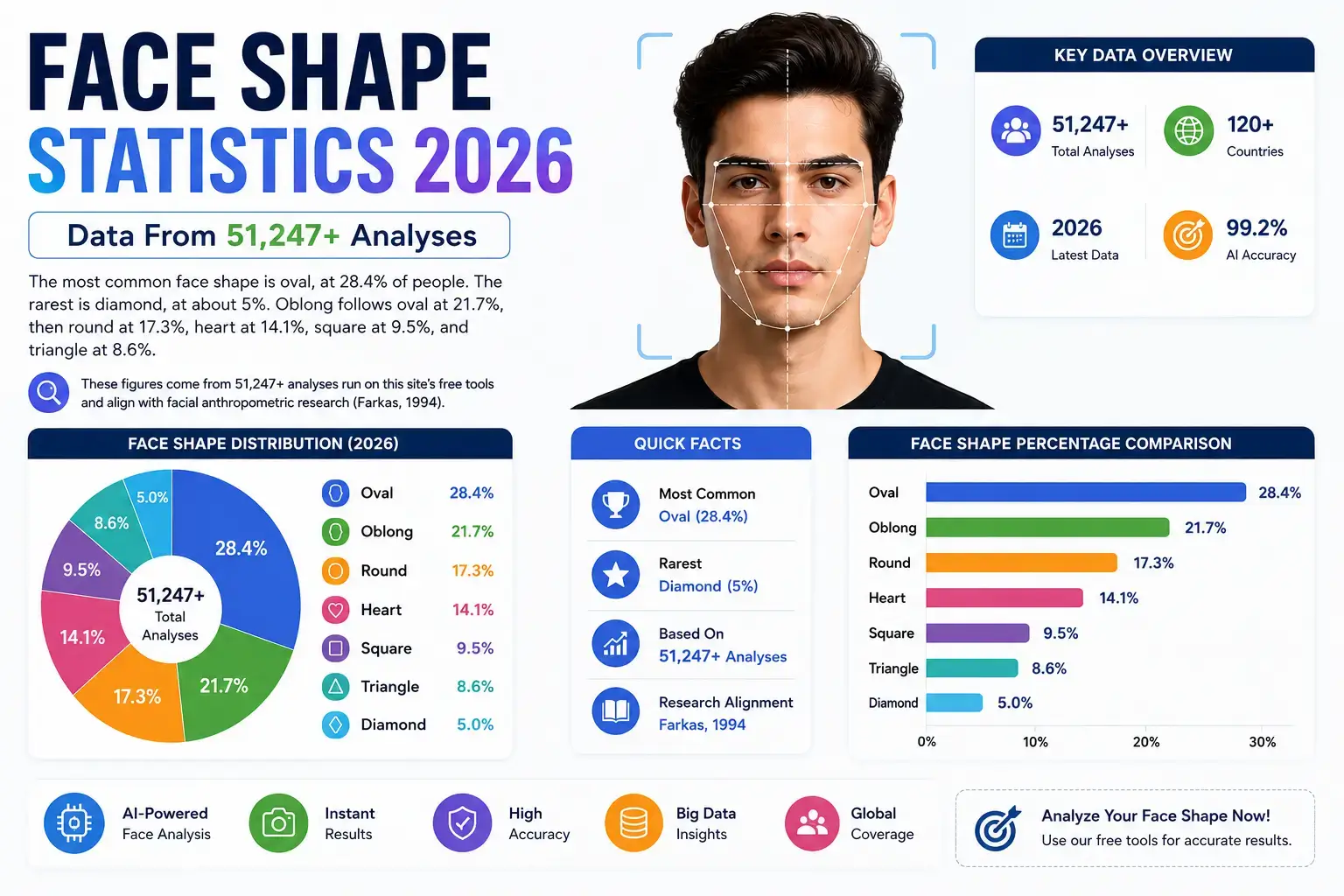
The most common face shape is oval, at 28.4% of people. The rarest is diamond, at about 5%. Oblong follows oval at 21.7%, then round at 17.3%, heart at 14.1%, square at 9.5%, and triangle at 8.6%. These figures come from 51,247+ analyses run on this site’s free tools, and align with facial anthropometric research (Farkas, 1994).
This page is the single source for every face shape statistic used across OblongFaceShape.com. If you are quoting face shape data in an article, video, or report, you can cite the numbers here — the methodology and its limits are explained openly below.
Face Shape Distribution: All 7 Shapes
| Rank | Face Shape | % of People | Key Trait |
|---|---|---|---|
| 1 | Oval | 28.4% | Cheekbones slightly widest, balanced proportions |
| 2 | Oblong | 21.7% | Clearly long, even widths (ratio 1.5+) |
| 3 | Round | 17.3% | Length ≈ width, soft curves |
| 4 | Heart | 14.1% | Forehead widest, pointed chin |
| 5 | Square | 9.5% | Even widths, angular jaw |
| 6 | Triangle | 8.6% | Jaw wider than cheekbones |
| 7 | Diamond | ~5% | Cheekbones dramatically widest |
Percentages are rounded, and many real faces blend two shapes, so totals may not sum to exactly 100%. Want to know yours? The AI face shape detector checks all 7 shapes from a photo in 3 seconds.
Key Face Shape Statistics at a Glance
- 1 in 4 people (28.4%) have an oval face — the most common shape.
- Only about 1 in 20 people (~5%) have a diamond face — the rarest shape.
- Half of all people (50.1%) have either an oval or oblong face.
- Triangle is the second rarest shape at 8.6%, rarer than square (9.5%).
- 7 face shape categories are recognised in modern classification; older 6-shape lists that skip triangle are outdated.
- The classic oblong threshold is a length-to-width ratio of 1.5 or higher with all three widths within 15% of each other.
- A heart face requires a forehead at least 15% wider than the jaw; a diamond requires cheekbones 10%+ wider than both forehead and jaw.
The Most Common Face Shape: Oval
Oval leads at 28.4% because it is the “middle” of facial geometry — cheekbones slightly widest, a gentle taper, moderate length. Most human faces land closest to this balanced pattern, which is also why many people wrongly guess “oval” in the mirror even when measurement says otherwise. If you are stuck between oval and another shape, the face shape calculator settles it with four measurements and 92%+ accuracy.
The Rarest Face Shape: Diamond
Diamond sits at roughly 5% because it needs three uncommon conditions at once: dominant cheekbones, a narrow forehead, and a narrow pointed chin. The diamond face shape guide covers how to test for it, and the full ranking with reasons lives in what is the rarest face shape.
Face Shape Differences: Men vs Women
The 7 shapes appear in both sexes, but not at equal rates. Three patterns show up consistently:
- Heart faces are more common in women. Women’s faces statistically trend toward wider foreheads relative to the jaw. Full guide: heart face shape.
- Triangle faces are more common in men. A jaw that outgrows the cheekbones is a more typically male bone pattern. Full guide: triangle face shape.
- Square readings are more frequent in men, driven by heavier mandible development — though a true geometric square remains uncommon in both sexes at 9.5% overall.
Do Face Shape Statistics Vary by Population?
Yes — and any source that hides this is oversimplifying. Facial proportions differ across ethnic groups: diamond shapes appear somewhat more often in some East and Central Asian populations, and average length-to-width ratios shift between regions. The percentages on this page are averages across a large, mixed, self-selected user base. Your own community’s mix may differ by a few points in either direction. That is normal, and it is why serious anthropometry research (Farkas, 1994; Rhee et al., 2004) always reports population-specific tables.
Why Different Websites Report Different Numbers
If you compare face shape statistics across the web, the numbers disagree. Three honest reasons:
- Dataset size and source: Small tool datasets of a few thousand scans swing wildly. Our figures come from 51,247+ analyses — one of the larger public datasets — but even large tool datasets measure tool users, not a random sample of humanity.
- Threshold strictness: How much wider must cheekbones be to count as “diamond” — 5%? 10%? 15%? Stricter rules make rare shapes rarer. Our thresholds are published openly on the calculator page, so every number here is reproducible.
- Population differences: As covered above, real regional variation exists. A dataset weighted toward one region will differ from a global average.
The rule of thumb: trust sources that show their method and sample size. Distrust a bare percentage with no source.
Methodology — And Its Honest Limits
The statistics on this page come from anonymous, aggregated results across this site’s three free tools: the AI detector (68-point facial landmarks, 85–92% accuracy), the calculator (four measurements, 92%+ accuracy), and the 60-second quiz (80–88% accuracy). Measurement points follow Farkas’s facial anthropometry standards, and classification thresholds are published on each tool page.
Two limits you should know before citing this data. First, this is a self-selected sample — people curious enough about their face shape to use a tool — not a random population survey. Second, borderline faces blend two shapes; our tools assign the strongest match, which is why rounded percentages don’t sum to a perfect 100%. We publish these caveats because a statistic without its limits is marketing, not data.
FAQs
What is the most common face shape?
Oval, at about 28.4% of people, followed by oblong at 21.7% and round at 17.3%, based on 51,247+ analyses on this site’s tools.
What is the rarest face shape?
Diamond, at roughly 5% of people. Triangle is the second rarest at 8.6%.
How many face shapes are there?
Seven: oval, oblong, round, heart, square, triangle, and diamond. Older guides list six and skip triangle — that classification is outdated.
What percentage of people have an oblong face?
About 21.7% — making oblong the second most common shape after oval.
Do face shapes differ between men and women?
Yes. Heart faces are more common in women, while triangle and square readings are more common in men. All 7 shapes appear in both sexes.
Are these statistics from a scientific study?
They come from 51,247+ anonymous analyses on this site’s free tools, using measurement standards from published anthropometry research (Farkas, 1994). It is a large self-selected sample, not a random population survey — both the method and its limits are published above.
How can I find my own face shape?
Three free ways: the AI photo detector (3 seconds), the measurement calculator (most precise), or the quiz (no tools needed).
