Quick answer:
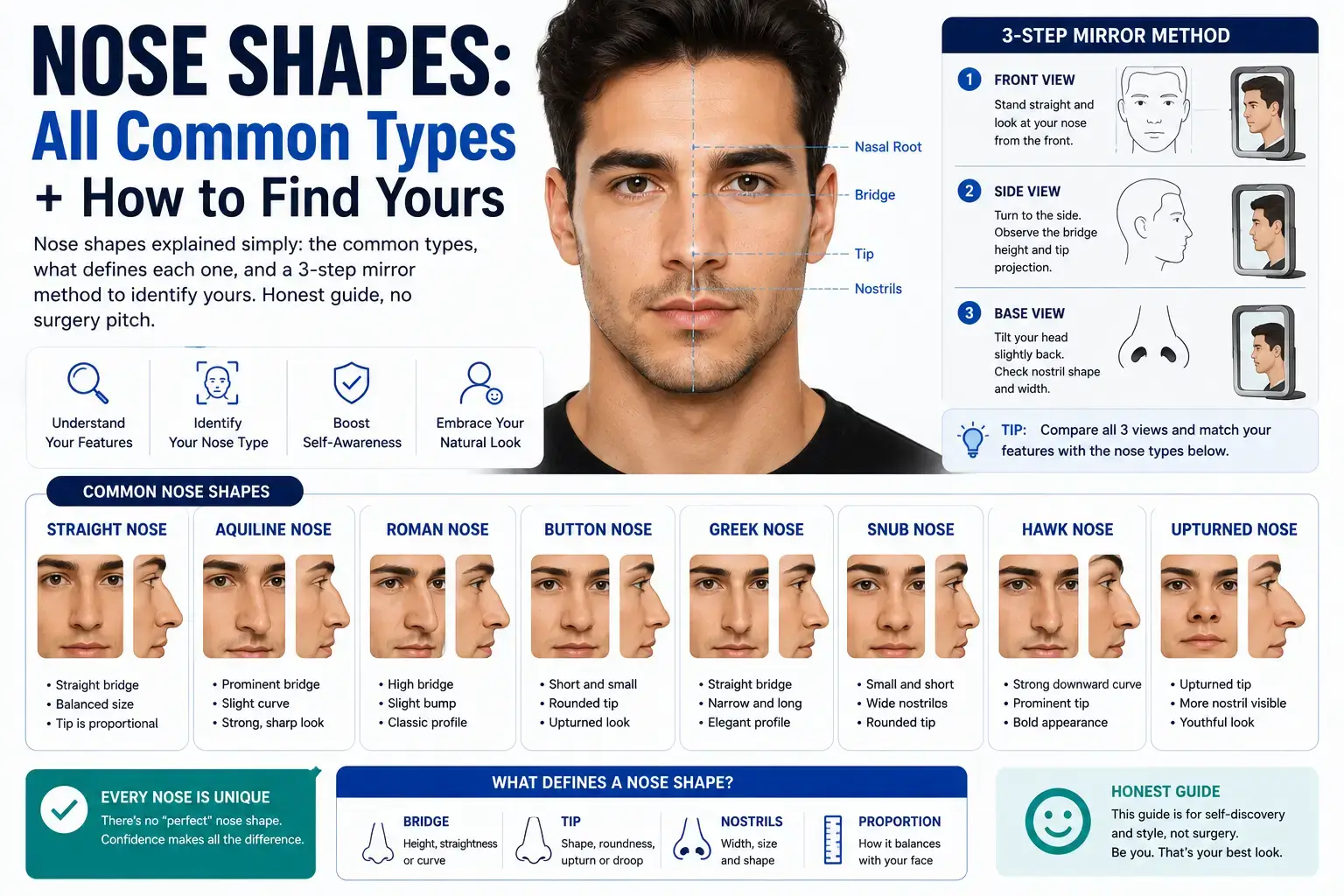
Nose shapes are identified from your profile (side view), not the front. Check three things in order: your bridge line (straight, curved outward, or curved inward), your tip angle (upturned, level, or downturned), and your width. A straight bridge is often called a Greek nose, an outward-curved bridge is aquiline or Roman, an inward dip with a lifted tip is a snub nose. Most noses combine features from more than one category, which is completely normal.
One honest note before the list: nose shape names are descriptive labels, not medical categories. Different websites use different names for the same shapes, and there is no reliable published data on which shape is most common, despite the percentages some sites invent.
The Common Nose Shapes
| Shape | Bridge (Profile View) | Tip | Key Identifier |
|---|---|---|---|
| Straight (Greek) | Perfectly straight, root to tip | Level | No curve or bump anywhere on the bridge |
| Aquiline (Roman) | Curved outward, prominent | Often slightly downturned | The visible convex curve or bump |
| Snub | Small, slightly curved inward | Clearly upturned | Short length, lifted tip showing nostrils from front |
| Button | Small and rounded | Soft, rounded | Compact overall, gently rounded tip |
| Bulbous | Any bridge type | Wide, rounded, dominant | The tip is noticeably wider than the bridge |
| Hawk (hooked) | Strongly curved outward | Sharply downturned | Like aquiline but more dramatic in both curve and tip |
| Fleshy | Soft, less bony definition | Full | Larger soft-tissue presence overall |
| Nubian | Long bridge | Wide base | Length plus a wider nostril base |
| Crooked | Deviates left or right | Any | The bridge line is not vertical from the front |
How to Identify Your Nose Shape in 3 Steps
- Step 1: The bridge test: Take a profile photo or use two mirrors. Trace the line from between your eyebrows to your tip. A straight line means Greek. An outward curve or bump indicates an aquiline or Roman family. An inward dip means a snub family.
- Step 2: The tip test: Still in profile, does your tip point slightly up (snub, button), sit level (straight), or angle down (aquiline, hawk)? The tip separates similar bridges. An outward bridge with a mild tip is aquiline; the same bridge with a sharply hooked tip is a hawk nose.
- Step 3: The width check: Now face the mirror. Compare your nostril base to your bridge width. A tip clearly wider than the bridge points to bulbous or fleshy; a wide base with a long bridge points to Nubian.
The Myths Worth Skipping
Many articles on nose shape claim that certain shapes indicate personality or intelligence, or that they belong to specific ethnic groups. According to the research summarized on Wikipedia’s aquiline nose entry, no scientific evidence supports any such linkage. Nose shapes, like eye color, appear across geographically diverse populations. Enjoy the identification, skip the fortune telling.
Also worth knowing: most sites ranking for nose shapes are surgery clinics, and their guides quietly frame every shape as something to fix. This guide has no procedure to sell you. Your nose shape is a feature, not a flaw.
Nose Shape and Your Face Shape
Your nose sits inside a larger system. Classical proportion analysis compares nose width to inter-eye distance and mouth width; our free golden ratio calculator runs automatically from a photo. And your overall face shape matters more than your nose for styling decisions like glasses and hairstyles.
FAQs
What are the different nose shapes?
The most commonly used categories are straight (Greek), aquiline (Roman), snub, button, bulbous, hawk, fleshy, Nubian, and crooked. Names vary between sources because these are descriptive labels, not standardized medical terms.
How do I know my nose shape?
Check your profile view in three steps: bridge line (straight, outward curve, or inward dip), tip angle (up, level, or down), then width from the front. The bridge line alone sorts most noses into the right family.
Which nose shape is most common?
No reliable published data exists. Sites quoting exact percentages for nose shapes are inventing them.
Is nose shape genetic?
Largely yes. Nose structure is strongly hereditary, though it can also change gradually with age as cartilage continues developing throughout life.
What is the rarest nose shape?
There is no honest answer, because nose shape distribution has never been reliably measured in a large published dataset. Any site naming a “rarest” nose shape is guessing.
