Quick answer:
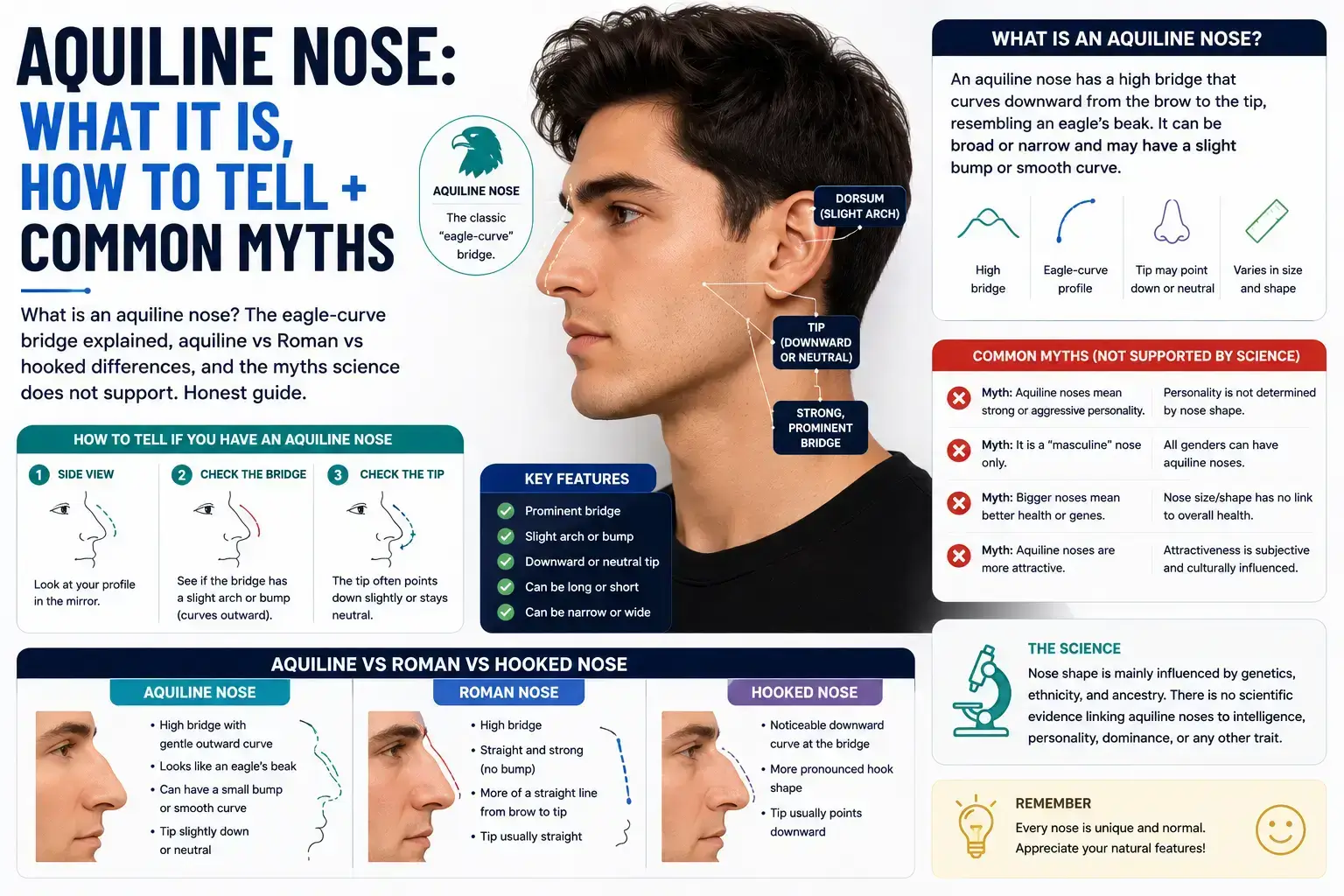
An aquiline nose has a prominent bridge with an outward (convex) curve, giving it a slightly bent profile. The word comes from the Latin aquilinus, meaning eagle-like, a reference to an eagle’s curved beak. Aquiline and Roman nose describe the same shape: aquiline is the anatomical term, Roman is the cultural one. To check yours: look at your profile, and if the line from your brow to your tip curves outward or shows a bump, you are in aquiline territory.
How to Tell If You Have an Aquiline Nose
Take a profile photo (side view), because an aquiline nose is nearly invisible from the front. Look for these traits:
- A convex bridge line. The defining feature: the bridge curves outward or carries a visible bump, rather than running straight.
- A prominent bridge. The nose projects noticeably from the face in profile.
- A tip that sits level or angles slightly down. A gentle downward tendency is common; a sharp downward hook pushes it toward the hawk category instead.
If your bridge is perfectly straight from root to tip, that is the Greek nose, the classic contrast to aquiline.
Aquiline vs Roman vs Hooked: Clearing Up the Confusion
- Aquiline vs Roman: Anatomically the same shape. “Aquiline” is the descriptive anatomical term; “Roman” is the cultural name, from the profile’s prevalence in ancient Roman statues and figures like Julius Caesar. Some sites claim subtle differences, but the mainstream view is that the distinction is semantic, not physical. Full cultural background on our Roman nose guide.
- Aquiline vs hooked (hawk): A matter of degree. Both curve outward, but the hawk nose has a more dramatic curve and a sharply downturned tip. Aquiline reads as a refined curve; hawk reads as a pronounced hook.
- Aquiline vs Greek: Opposites on the bridge test. Greek is perfectly straight; aquiline visibly curves.
The Myths Science Does Not Support
An honest section most aquiline nose articles skip. Throughout history, writers have linked the aquiline nose to nobility, intelligence, leadership, and specific ethnic groups. According to the evidence summarized on Wikipedia, no scientific studies support any such linkage. Like eye color or a widow’s peak, the aquiline shape appears across geographically diverse populations worldwide. The associations are cultural storytelling, not biology.
Worth saying plainly, because most pages ranking for this term are surgery clinics: an aquiline nose is a normal, common facial feature. It only warrants medical attention if a structural issue affects breathing, which is a doctor’s call, not a website’s.
Styling Notes for an Aquiline Nose
If you want to work with your profile rather than against it, the honest options are simple. Hairstyles with some volume or texture balance a prominent profile. Glasses with a defined bridge sit naturally on a strong nose bridge, and your frame choice should be driven by your overall face shape anyway. Beyond that, the aquiline profile has been considered striking for two thousand years of art history; it needs no fixing.
FAQs
What is an aquiline nose?
A nose with a prominent bridge that curves outward, giving a slightly bent profile. The name comes from the Latin for eagle-like, referencing an eagle’s curved beak.
Is an aquiline nose the same as a Roman nose?
Yes, anatomically. Aquiline is the anatomical descriptor, and Roman is the cultural term for the same convex-bridge shape.
Is an aquiline nose attractive?
Attractiveness is not determined by any single feature. The aquiline profile has been depicted admiringly in classical art for centuries, and modern research ties perceived attractiveness far more to overall proportion and symmetry than to nose shape. Try the free face symmetry test if you are curious about your overall balance.
Is an aquiline nose linked to a specific ethnicity?
No. Despite persistent stereotypes, no scientific evidence links the aquiline shape to any ethnic group; it appears in populations worldwide.
What is the difference between an aquiline nose and a hooked nose?
Degree. Both curve outward, but a hooked or hawk nose has a stronger curve and a sharply downturned tip, while aquiline is the milder, more gradual version.
