Quick answer:
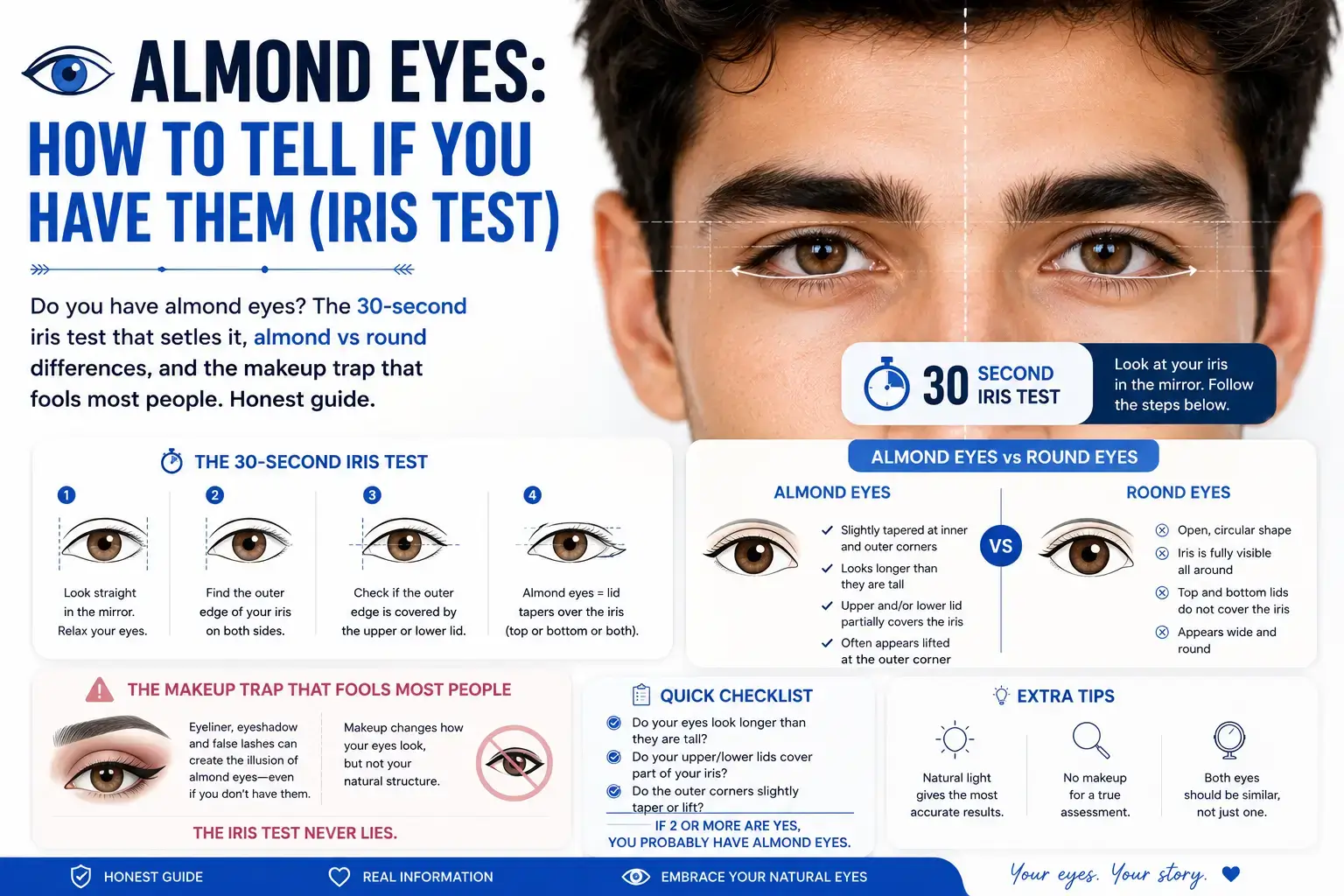
You have almond eyes if your iris touches both your top and bottom eyelids, with white visible only at the sides, and your eyes taper to soft points at the corners. The 30-second check: look straight into a mirror with a relaxed face. If you can see white above or below the colored part of your eye, you are in round territory instead. This iris test is the single most reliable separator, and it works better than comparing your eyes to photos.
The Iris Test, Step by Step
- Stand in front of a mirror in even light. Relax your face completely: eyebrows down, jaw loose, no smile. Expression changes eye shape more than people realize, and raised brows make almost any eye look rounder.
- Look straight ahead, not up at the mirror.
- Check the colored circle of your eye. Does your upper eyelid cover its top edge, and your lower lid meet its bottom edge?
Iris touching both lids, white only at the sides: almond. The lids frame the iris in an elongated curve, like an almond lying on its side. White visible above or below the iris: round. The eye reads as more circular and open.
The 5 Traits of Almond Eyes
- Iris touches the top and bottom eyelids
- Eyes appear noticeably wider than they are tall
- Both corners taper to soft points
- A visible eyelid crease (if there is no crease, see monolid in our eye shapes guide)
- The outline stays elongated in a bare-faced, front-facing photo
That last one matters most, which brings us to the trap.
The Makeup Trap: Test Bare-Faced
Here is the check most guides skip. Winged eyeliner, lash extensions, and corner-darkening shadow are all specifically designed to make eyes look more almond. If the taper only exists with makeup on, your natural shape may be round or a mix. The honest method: compare one bare-eye photo with one styled photo. Your true eye shape is whatever survives the makeup remover.
Almond vs Round: Side by Side
| Check | Almond | Round |
|---|---|---|
| White above/below iris | No, only at the sides | Yes |
| Width vs height | Clearly wider than tall | Closer to equal |
| Corners | Taper to soft points | Rounded |
| Typical crease | Visible, follows the elongated line | Visible, with a soft curve |
Remember that shapes combine with modifiers: hooded almond, upturned almond, and downturned almond are all common, real combinations. Most people are a mix, and the mix is the accurate answer.
Is Almond the Most Common Eye Shape?
You will read this claim everywhere, and we will not repeat it, because no reliable population study backs it. Unlike face shapes, eye shape distribution has never been measured in a large published dataset. Any percentage you see attached to eye shapes was invented somewhere along the content chain. What we can say honestly: the almond category is broad, so many eyes qualify at least partially.
FAQs
How do I know if I have almond eyes?
Do the iris test: look straight into a mirror with a relaxed face. If your iris touches both eyelids and white shows only at the sides, while your corners taper to points, you have almond eyes.
What is the difference between almond and round eyes?
The iris. Almond eyes have an iris framed by both lids with white only at the sides; round eyes show white above or below the iris, making them look more circular.
Can you have hooded almond eyes?
Yes. Almond describes the outline; hooded describes the lid behavior. They combine freely, and combinations are the norm rather than the exception.
Do almond eyes change with age?
The underlying outline stays essentially the same, but upper-lid skin loses elasticity over time, so almond eyes often gain hooding with age. The base shape does not become round.
What makeup suits almond eyes?
Almost everything, which is why makeup artists praise the shape. The elongated outline supports both subtle looks and dramatic wings without needing corrective technique.
