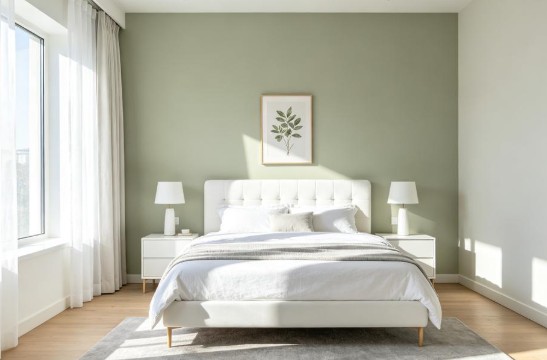
French Gray 18 is probably the most misleadingly named color in the Farrow & Ball deck. You expect gray. You get green. I painted my dining room with it thinking I was getting a warm neutral gray, and what showed up was a dusty sage that I ended up loving. Here’s what you’re actually buying.
What Is French Gray 18?
French Gray is a warm sage-green from Farrow & Ball with an LRV around 43. That puts it in the mid-tone range — dark enough to be a real color on the wall, light enough that it won’t make a room feel small. Farrow & Ball calls it “much more green than grey,” which is the most honest thing a paint company has ever said about one of its own colors.
It’s inspired by 19th-century French decorative wallpapers, and you can feel that heritage. It reads as earthy and muted — a sage that doesn’t try too hard. It works in living rooms, bedrooms, hallways, kitchens, and on exteriors. The color has been in the F&B lineup for a long time, and it’s one of their most popular sellers.
Is French Gray 18 Actually Green?
Yes. The dominant undertone is green — specifically a warm, earthy sage-green with a yellow-gray base underneath. In daylight, French Gray reads as a soft sage. By lamplight, it settles into more of a muted green-gray. But the green is always present.
The gray in the name isn’t a lie exactly — there is gray in there. But it plays a supporting role. The green leads. I toggled it against a true warm gray on Coloraw under different lighting, and the green was unmistakable in every preview. If you’re expecting a gray with a green whisper, this isn’t it. It’s a green with gray keeping things calm. That’s a very different color. Go in knowing that, and you’ll be happy.
French Gray vs. Hardwick White — Which Should You Pick?
Hardwick White No. 5 is the Farrow & Ball comparison that puts French Gray into context. Both are warm neutrals with green in the mix, but the balance is reversed.
Hardwick White is a truer gray with subtle green undertones. It reads as a warm, muted gray that hints at green without committing to it. French Gray is a green with gray undertones — the green is the main event. Hardwick White is lighter too, making it feel more neutral and airy on the wall. If you want green that stays in the background and a color that reads as gray first, Hardwick White is safer. If you want that earthy sage quality front and center, French Gray is the one.
How Does It Look in Different Lighting?
South-facing rooms bring out the most balanced version. Warm light keeps the sage quality alive without the color going too yellow-green. It reads as a warm, grounded sage that feels natural and easy. This is where French Gray looks its best.
North-facing rooms push the gray forward. The green doesn’t disappear, but it mutes down and the color reads quieter and cooler. Some people actually prefer this — the sage becomes subtler and the room feels calmer. East rooms shift through the day. West rooms warm up in the evening and the sage glows.
Farrow & Ball paints respond to light more dramatically than most brands, so these shifts are real and visible. Warm bulbs at 2700K emphasize the sage. Cool daylight above 4000K pushes the gray.
Does French Gray 18 Work on Exteriors?
It works beautifully, and it’s actually one of Farrow & Ball’s favorite recommendations for exterior woodwork and front doors. In their Exterior Eggshell, French Gray reads as a soft sage that sits naturally against greenery and stone.
In direct sunlight, the color lightens slightly and the green becomes more pronounced. In shade it deepens and the gray pushes forward. On the body of a house, French Gray creates a warm, muted facade that’s more interesting than a standard neutral. Front doors in French Gray against a white or pale exterior are a classic F&B combination. Garden furniture is another popular use — the sage tone blends with landscaping.
What Trim Color Pairs Best With French Gray?
Farrow & Ball Pointing is a natural partner. It’s a warm off-white that complements French Gray’s earthy quality. Wimborne White is another solid option — slightly cleaner and brighter. Both create a soft contrast that lets the sage show without feeling cold.
For a crisper look, All White gives you maximum contrast. I checked French Gray 18 on Paintuma against several trim colors on real wall scenes, and Pointing looked the most cohesive. For darker accent trim, Down Pipe or Railings from F&B add a grounded contrast. If you’re mixing with non-F&B trim, Benjamin Moore White Dove OC-17 or Sherwin-Williams Alabaster SW 7008 pair well.
What Are the Closest Matches From Other Brands?
Sherwin-Williams Evergreen Fog SW 9130 is the comparison that comes up most. Both are muted sage-greens at a similar mid-tone depth. Evergreen Fog sits at LRV 30 — noticeably darker — and leans slightly cooler with more gray. French Gray is lighter and warmer, with more visible yellow-green. They’re in the same family but not interchangeable.
Benjamin Moore Saybrook Sage HC-114 is another comparison. It’s warmer and more saturated — more obviously green. October Mist 1495 is lighter and far grayer. No exact dupe exists across brands because F&B’s pigment density and chalky finish create a look that other formulas don’t replicate. Bring a large painted swatch for any matching attempt.
Should You Sample French Gray Before Buying?
Absolutely — and Farrow & Ball colors need sampling more than most. The pigment-rich formula means the color looks different on the wall than on a screen or even on a chip. And the green in French Gray is strong enough that it’ll surprise you if you’re expecting gray.
Order one of F&B’s sample pots and brush it onto a large section of two walls. Watch it in daylight and lamplight over two full days. If the sage quality delights you, commit. If you wanted gray and got green, that’s your sign to look at Hardwick White or Cornforth White instead.
For a quick digital preview first, paintcolorvisualizer.com lets you upload a photo of your own room and test the color for free. It works for interior and exterior. It won’t capture F&B’s chalky finish, but it shows you the tone and depth fast.
Bottom line: French Gray 18 is a warm sage that barely earns the “gray” in its name. Embrace the green, pair it with warm whites, and it’ll give you one of the most character-rich neutrals you can put on a wall.
