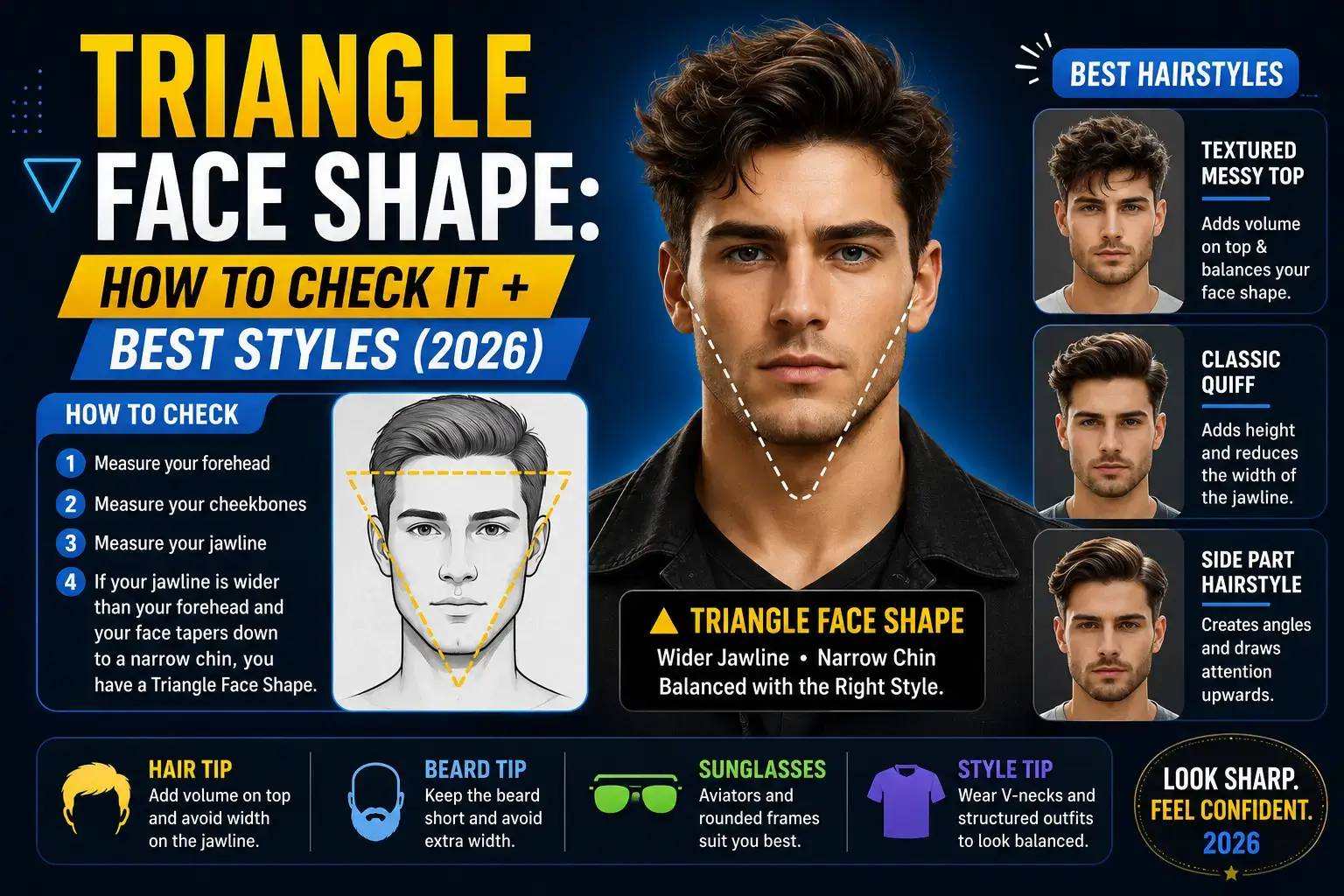
A triangle face shape means your jaw is the widest part of your face, your cheekbones sit narrower, and your forehead is the narrowest of all. It is also called a pear face shape, and about 8.6% of people have it. This guide shows you how to check yours in 60 seconds, then gives the exact hairstyles, glasses, beard styles, and makeup that balance a wide jaw — for men and women, in plain simple words.
Quick answer: You have a triangle face shape if your jaw measures wider than your cheekbones, and your cheekbones measure wider than your forehead. The face gets wider going down. The one styling rule that fixes everything: add volume at the top of your head, keep it tight at the jaw.
| Triangle Face Shape | Quick Facts |
|---|---|
| Other name | Pear face shape (same thing) |
| Widest point | The jaw |
| Narrowest point | The forehead |
| How common | About 8.6% of people — second rarest after diamond (~5%) |
| More common in | Men (stronger jaw development) |
| Styling rule | Volume up top, slim at the jaw |
| Best hairstyles | Bangs & high buns (women), pompadour & quiff (men) |
| Best glasses | Cat-eye, browline / clubmaster |
| Celebrities | Jennifer Aniston, Jared Leto, Ryan Reynolds, Elizabeth Olsen |
What Is a Triangle Face Shape?
Picture a triangle sitting on its wide base. That is the outline of this face: narrow at the top, wide at the bottom. The jawline is the star feature. It is often strong, with clear corners you can see and feel.
Three width checks define it. Your jaw is the widest. Your cheekbones are at least 10% narrower than your jaw. Your forehead is the narrowest of the three. Face length does not matter much here — a triangle face can be short or long. What matters is the widening from top to bottom.
In many women's styling guides you will see the name pear face shape. Do not let that confuse you — pear and triangle are the exact same shape with the same rules.
How Do I Know If I Have a Triangle Face? (60 Seconds)
- 1Measure three widths. With a soft tape, measure your forehead at its widest, your cheekbones between their highest points, and your jaw straight across its corners.
- 2Compare them. If jaw > cheekbones > forehead, you have a triangle face. If it is the other way around (forehead widest), you have a heart face shape instead.
- 3Or skip the tape. The free AI face shape detector reads your face from a photo or selfie in 3 seconds, and the face shape calculator checks your numbers with 92%+ accuracy.
Triangle vs Inverted Triangle vs Heart (Don't Mix These Up)
This is where most guides go wrong, and where most people apply the opposite of the right advice. The direction of the triangle changes everything.
| Shape | Widest Point | Styling Direction |
|---|---|---|
| Triangle (pear) | Jaw — face widens going down | Add volume UP TOP (crown, forehead) |
| Inverted triangle / heart | Forehead — face narrows going down | Add volume DOWN LOW (jaw, chin) |
| Square | Jaw and forehead nearly equal | Soften angles with waves and curves |
Simple memory trick: add volume where your face is narrow. Triangle faces are narrow up top, so the volume goes up top. Heart faces are narrow at the chin, so the fullness goes low. If you are not sure which you are, run the 60-second quiz before styling anything.
Best Hairstyles for Triangle Face Shape — Women
Every good style here does one job: it adds width and height at the crown and forehead, so the jaw stops being the only wide point on the face.
Best Hairstyles for Triangle Face Shape — Men
Best Glasses for Triangle Face Shape
The frame rule is the hair rule in disguise: pick frames with their visual weight at the top.
| Frame | Rating | Why It Works |
|---|---|---|
| Cat-eye | ⭐⭐⭐⭐⭐ | Upswept corners put all the weight at brow level, widening the upper face |
| Browline / clubmaster | ⭐⭐⭐⭐⭐ | The bold top bar draws a strong horizontal line across the forehead |
| Round | ⭐⭐⭐⭐ | Soft curves calm the angular jaw for a friendlier look |
| Aviators | ⭐⭐⭐⭐ | Wide at eye level, balancing the wider jaw below |
Avoid: small narrow rectangles (they make the jaw look bigger by contrast) and bottom-heavy frames that add weight near the chin.
Best Beard Styles for Triangle Face Men
Here is the part most guides get backwards. Your jaw is already wide, so a beard must never add side width. It should add length at the chin instead.
Makeup & Contouring for a Triangle Face
The makeup goal is the same as the hair goal: brighten the top, shade the bottom.
- 1Highlight the outer forehead and temples. This is the strongest single move — light makes the narrow zone look wider.
- 2Contour the jaw corners. A soft shadow along the jaw angle (not the chin) quietly slims the widest point.
- 3Sweep blush upward. Place it on the cheekbones and blend up toward the temples to pull the eye higher.
- 4Go bold on brows. Defined, arched brows give the upper face structure. Skip thin, sparse brows.
Celebrities With a Triangle Face Shape
Jennifer Aniston is the classic example — notice how her signature layered styles always carry volume at the crown. Jared Leto leans on textured, layered hair. Ryan Reynolds pairs his jaw with browline glasses and lifted styles. Elizabeth Olsen favours side-swept volume and cat-eye sunglasses. Every one of them follows the same rule this guide teaches: volume up top, calm at the jaw.
Triangle Face Shape: FAQs
What is a triangle face shape?
A triangle face shape means your jaw is the widest part of your face. Your cheekbones are narrower than your jaw, and your forehead is the narrowest of the three. The face gets wider as it goes down, like a triangle pointing up from a wide base. It is also called a pear face shape. About 8.6% of people have it, based on 51,000+ analyses on this site.
Is triangle the same as pear face shape?
Yes. Triangle and pear are two names for the same face shape: a jaw wider than the cheekbones, and cheekbones wider than the forehead. Stylists writing for women often say pear, while most face shape guides say triangle. The styling rules are identical.
What is the difference between triangle and inverted triangle face shape?
They are opposites. A triangle face is widest at the jaw (bottom), so you add volume at the top of your head. An inverted triangle, usually called a heart face, is widest at the forehead (top), so you add volume near the jaw. Using the wrong advice makes your face look less balanced, so check which one you have first with a quick measurement or the free AI detector.
What hairstyle suits a triangle face shape?
For women: full or curtain bangs, high buns, root-volume blowouts, and layered cuts with volume at the crown. For men: pompadour, textured quiff, side-swept undercut, and textured crop. The rule is simple: add volume at the top of your head and keep the sides tight below cheek level. Avoid chin-length blunt bobs and buzz cuts.
What glasses suit a triangle face shape?
Cat-eye and browline (clubmaster) frames are the best picks because their visual weight sits at the top, which widens your narrow forehead area. Round frames soften the strong jaw, and aviators add width at eye level. Avoid small narrow frames and bottom-heavy frames that add weight near the jaw.
Is a triangle face shape attractive?
Yes. A strong, defined jaw is linked with a confident, striking look in both men and women. The goal of styling a triangle face is balance, not fixing anything: adding a little width at the top of the face lets the strong jaw work as a feature instead of dominating the whole face.
Is triangle face shape rare?
Fairly rare. Triangle appears in about 8.6% of people, based on 51,000+ analyses from this site's tools. Only diamond is rarer at roughly 5%. Oval is the most common at about 28%, followed by oblong at around 22%. Triangle is more common in men than women.
What beard suits a triangle face shape?
A circle beard or rounded goatee is the best choice because it puts hair at the chin centre, not the jaw sides, so it does not make the widest part of your face wider. Short even stubble also works because it softens the jaw edge. Avoid full wide beards, which add bulk exactly where a triangle face is already widest.


1 thought on “Triangle Face Shape: How to Check It + Best Styles (2026)”