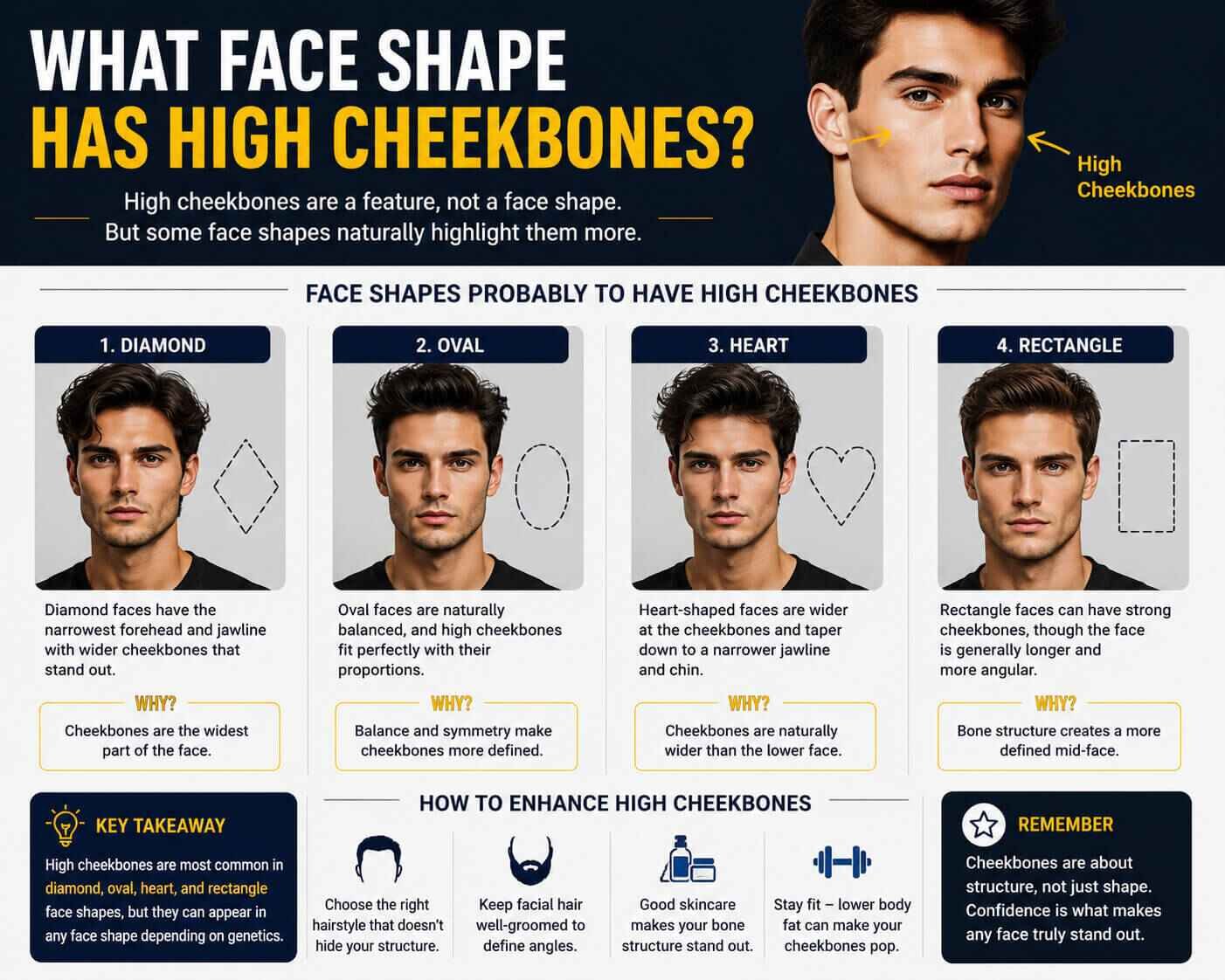
The direct answer: High cheekbones are most common in oval, diamond, and heart-shaped faces, where the midface looks more sculpted.
But “most common in” is not the same as “defined by” — and the distinction matters for identifying your face shape. Each of these three shapes has high cheekbones for a different geometric reason, and the way those cheekbones relate to the rest of the face is what actually identifies the shape.
What “High Cheekbones” Actually Means
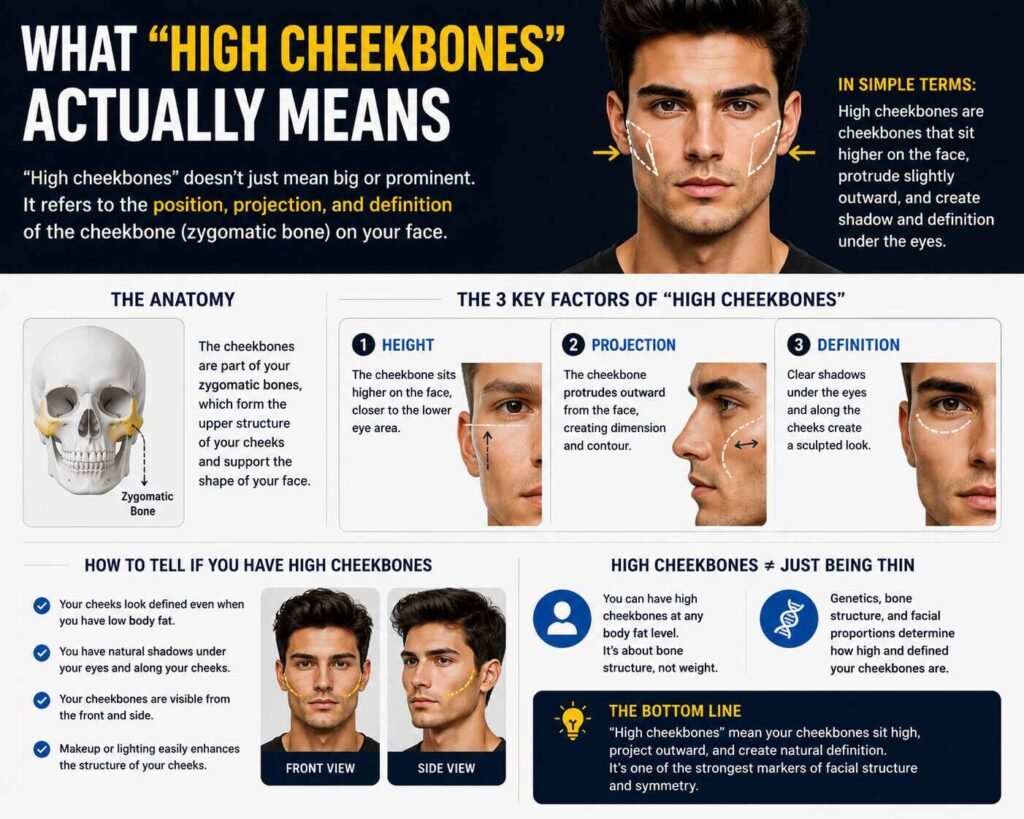
High cheekbones are not about how prominent your cheekbones feel when you press them. They are about vertical placement: High cheekbones occur when the zygomatic bones sit higher on the face, just below the eyes, creating a more defined and sculpted appearance.
A simple self-test: Place your thumb at the top of your ear and your index finger at the side of your nose. Imagine a straight line between these two points. If your cheekbones sit above this line, you have high cheekbones.
High cheekbones are a bone structure feature — they don’t change with weight fluctuation in the same way that cheek fat does. If you have them, they are visible regardless of body weight. If you don’t, no amount of contouring will replicate the structural characteristic — though makeup can create the visual illusion.
Diamond Face Shape — High Cheekbones as the Defining Feature
The diamond face is the shape most structurally defined by high, prominent cheekbones. Not just high — dominant. A diamond face shape is distinguished by a narrow forehead and jaw structure combined with prominent, wide cheekbones. The face reaches its widest point in the middle and exhibits a sharp V-shape from top to bottom.
In diamond faces, the cheekbones are not just high — they are the widest point of the entire face, sitting visibly wider than both the forehead above and the jaw below. This creates the distinctive diamond silhouette: narrow at the top, widest at the middle, narrow again at the chin.
When you smile, your cheekbones become even more pronounced, emphasising the diamond-shaped proportions. This is one of the most reliable self-identification tests for diamond face shape.
Measurement confirmation: If your cheekbone width is 15% or more greater than both your forehead width and your jaw width, you have a diamond face shape. Enter your four measurements in the face shape calculator at oblongfaceshape.com — the calculation will confirm whether your cheekbones are dominant enough to be classified as diamond.
Oval Face Shape — High Cheekbones as the Widest Balanced Point
Oval faces also have cheekbones as their widest point — but with a key difference from diamond: the width differential is gentler. For oval faces, cheekbones are the widest point, but the face is longer than it is wide, featuring rounded edges and balanced proportions throughout.
Where diamond faces show dramatic narrowing above and below the cheekbones, oval faces show a gentle, gradual taper — more like a softened egg shape than a sharp diamond. The cheekbones are prominent and the widest feature, but they don’t dramatically dominate the forehead and jaw width.
This is the critical distinction between oval and diamond: Both have cheekbones as the widest point, but in diamond, this is dramatic and structural; in oval, it is moderate and balanced. The main difference lies in proportions — diamond face shapes have the widest point at the cheekbones with a narrow forehead and jawline, while oval face shapes are longer than they are wide, featuring rounded edges and balanced proportions throughout the face.
Heart Face Shape — High Cheekbones Plus Wide Forehead
Heart faces have high, prominent cheekbones — but unlike oval and diamond, the widest point of a heart face is the forehead, not the cheekbones. The cheekbones sit just below the forehead’s width, and together they form the wide upper face that characterises the heart shape.
Heart face: wider forehead and cheekbones with a narrow jawline and chin. The cheekbones are high and visible, but they sit within a broad upper-face structure rather than protruding as the dominant widest point. Where diamond faces narrow both upward and downward from the cheekbones, heart faces narrow only downward.
Which Shapes Do NOT Have High Cheekbones?
- Round face: Round faces have cheek fullness — but this is facial fat distribution, not high zygomatic bone placement. The cheeks feel full and rounded because of soft tissue volume, not because the zygomatic arch sits high. Round faces often have low-to-moderate cheekbone placement with the face’s width distributed broadly across the mid-face.
- Square face: Square faces are defined by jaw angularity and consistent widths throughout, not by cheekbone prominence. The jaw is the defining structural feature; cheekbones are present but not dominant.
- Oblong face: Oblong faces have consistent widths from forehead to jaw — the cheekbones are not the widest point and not particularly prominent in relation to the overall face structure. The face’s defining feature is its length-to-width ratio, not cheekbone dominance.
- Triangle face: Triangle faces are widest at the jaw — the opposite of cheekbone-dominant shapes. Cheekbones sit between the forehead and jaw widths, neither prominent nor defining.
The Quick Self-Test: Is Your Face Shape Cheekbone-Dominant?
- Pull your hair fully back and look straight at a mirror in a neutral expression
- Note the widest part of your face — is it at cheekbone level (just below and outside the eyes)?
- Compare that width to your forehead and jaw widths
- If cheekbones are clearly wider than both: diamond or oval (check whether the difference is dramatic = diamond or moderate = oval)
- If cheekbones and forehead are of similar width and both wider than the jaw: heart
- If jaw, cheekbones, and forehead are all similar: Oblong or square (check jaw angularity)
For a precise measurement: Use the free face shape calculator at oblongfaceshape.com. Enter your cheekbone width, forehead width, jaw width, and face length. The result will tell you not just which shape you are, but your confidence scores for all seven shapes — showing you exactly how cheekbone-dominant your specific proportions are.
Why High Cheekbones Are Associated With Attractiveness
High cheekbones are frequently cited in aesthetic research as a marker of facial attractiveness — this may partly explain why nearly 1 in 4 users scanning with a face type detector lands in the diamond category.
The attractiveness association has two components: structural and visual. Structurally, high zygomatic bones create naturally defined shadows under the cheekbones in directional lighting, which is why diamond and oval faces photograph particularly well and why many models have this bone structure. Visually, prominent cheekbones create definition in the mid-face that contrasts with softer features and reads as facial structure rather than facial fullness.
The age component is also relevant: high cheekbones can help maintain facial definition with age by supporting the midface, which may help delay visible sagging. Prominent cheekbones maintain definition even as skin loses elasticity.
Frequently Asked Questions
What face shape has the highest cheekbones?
Diamond face shape is most structurally defined by prominent high cheekbones — they are the widest and most dominant feature of the face. The diamond face shape is distinguished by a narrow forehead and jaw combined with prominent, wide cheekbones, with the face reaching its widest point in the middle. Oval and heart shapes also have high cheekbones, but in oval the cheekbone prominence is more moderate, and in heart the forehead is equally wide.
Do I have high cheekbones if I have an oval face?
Yes — oval faces typically have cheekbones as their widest point, which is a characteristic of high cheekbone placement. The difference from diamond is the degree: oval cheekbones are prominent but not dramatically wider than the forehead and jaw. If your cheekbones are the widest facial point with a moderate width differential, you have both an oval face shape and high cheekbones.
Can you have high cheekbones with a round face?
Round faces can have high zygomatic bones structurally, but the face’s soft tissue volume often reduces how visible this structure is. What round faces have is cheek fullness, which comes from fat distribution more than from high bone placement. As weight decreases, someone with a round face may discover more visible cheekbone structure underneath.
What face shape is associated with “model” cheekbones?
Diamond and oval face shapes are most associated with the high, prominent cheekbones common in professional modelling. The specific photogenic quality of diamond faces comes from their dramatic cheekbone prominence, which creates natural shadow and definition under studio lighting. Many professional models have diamond or oval face shapes specifically because this cheekbone structure works exceptionally well under directional photography lighting.
Does losing weight reveal high cheekbones?
Weight loss reduces facial fat volume, which can make cheekbones that were structurally high but visually obscured more visible. If your underlying bone structure has high zygomatic placement, losing weight often reveals this by removing the soft tissue layer covering it. This is why some people find their perceived face shape shifts after significant weight loss — they may discover diamond or oval characteristics that weren’t visible at a higher body weight.
Check whether your cheekbones are your widest facial point using the free face shape calculator at oblongfaceshape.com — enter your four measurements and the result will show your cheekbone-to-forehead-to-jaw width ratio precisely.
