Quick answer:
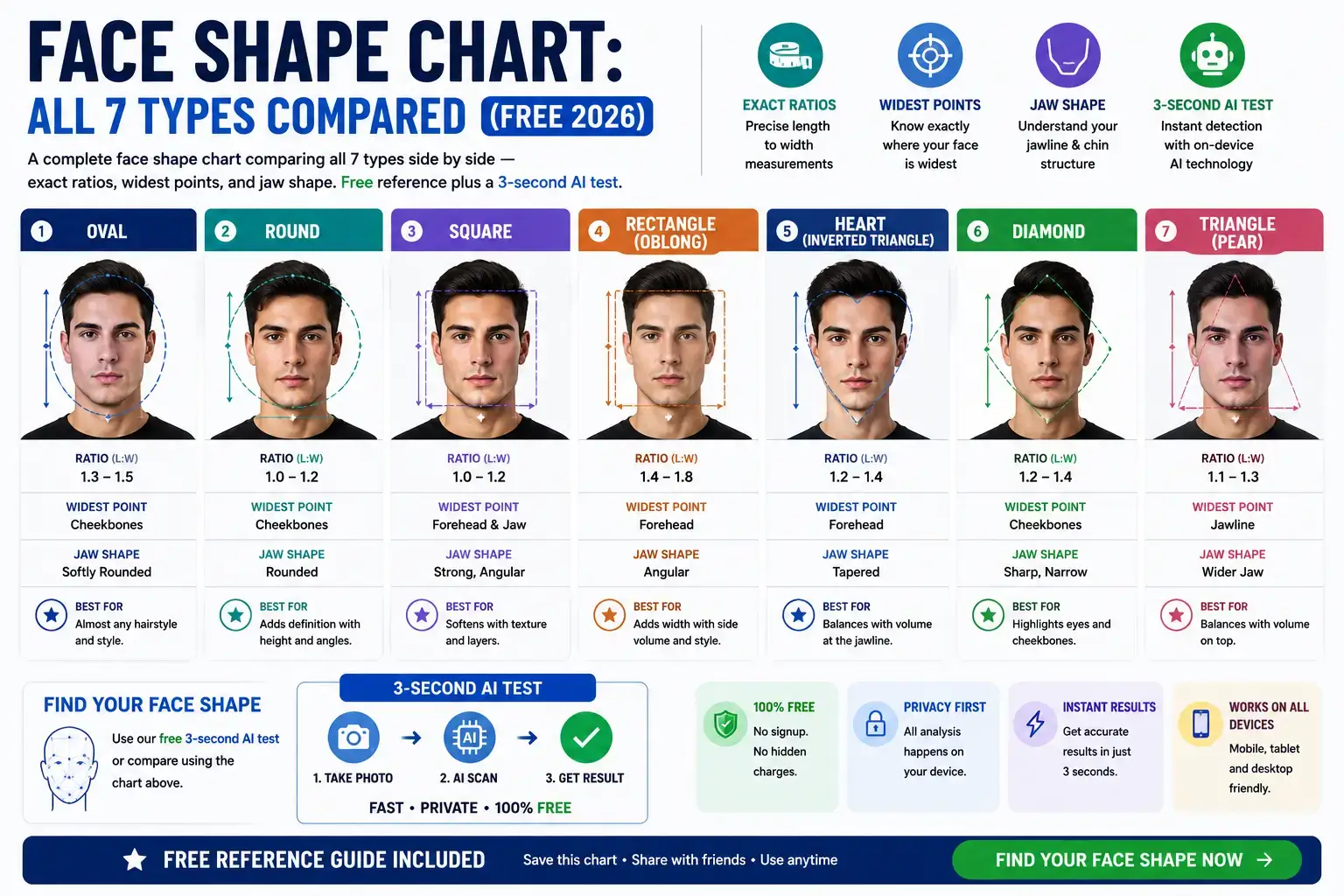
A face shape chart works best when you compare features in order, not one at a time. First check your length-to-width ratio — this splits the 7 shapes into “compact” (round, square) versus “elongated” (oval, oblong) groups. Then find your widest point — forehead, cheekbones, or jaw — which narrows it further. Finally, check your jaw shape — curved or angular — which is often the final tie-breaker. The table below has exact numbers for all 7 shapes; the free AI detector runs this same sequence automatically in 3 seconds.
Most face shape charts just show 7 pictures side by side and expect you to pick the one that “looks right.” That’s why so many people misjudge their own shape — a single feature (a strong jaw, a wide forehead) grabs attention and skews the guess. A chart is only useful if it tells you what order to check things in.
The Complete Face Shape Chart
| Shape | Length Ratio | Widest Point | Jaw | % of People |
|---|---|---|---|---|
| Oval | 1.25–1.45 | Cheekbones (gentle lead) | Soft, rounded | 28.4% |
| Oblong | 1.5+ | Even (all three close) | Rounded or mild point | 21.7% |
| Round | 1.0–1.15 | Cheekbones (soft) | Curved, no corners | 17.3% |
| Heart | Varies | Forehead (15%+ wider than jaw) | Narrow, tapered | 14.1% |
| Square | 1.0–1.25 | Even (all three close) | Angular, defined corners | 9.5% |
| Triangle | Varies | Jaw (widest point) | Wide, strong | 8.6% |
| Diamond | 1.3–1.5 | Cheekbones (10%+ wider than both) | Narrow, pointed | ~5% |
(Percentages from this site’s face shape statistics, based on 51,247+ analyses.)
How to Read This Chart in 3 Steps
- Step 1 — Length ratio: Divide your face length (hairline to chin) by your average width (forehead + cheekbones + jaw, divided by 3). This one number immediately splits the field: under 1.2 means round or square territory; over 1.45 means oval or oblong territory. Everything else sits in between and needs step 2.
- Step 2 — Widest point: Now look at where you’re widest. Forehead clearly widest → heart. Jaw clearly widest → triangle. Cheekbones clearly widest → oval or diamond. All three close together → oblong or square (the ratio from step 1 tells you which).
- Step 3 — Jaw shape: This is the tie-breaker for the two pairs that share a ratio range: round vs square (both compact — trace your jawline; a smooth curve is round, a visible corner is square) and oval vs diamond (both cheekbone-led — diamond’s forehead and jaw are both noticeably narrow; oval’s taper is gentler).
Why Charts From Different Sites Disagree
If you’ve compared face shape charts across a few websites and gotten different labels, here’s the honest reason: thresholds aren’t standardized. How much wider does a forehead need to be to count as “heart”? Different sites use 10%, 15%, or “noticeably” — with no number at all. This site publishes its exact thresholds (visible in the table above and on each shape’s page) specifically so results are reproducible, not just a guess dressed up as an answer.
Quick Visual Cues (No Measuring Tape)
| If your face looks… | You’re probably… |
|---|---|
| Longer than wide, edges taper gently | Oval |
| Clearly long, edges fairly straight | Oblong |
| About as wide as tall, all curves | Round |
| Forehead wide, chin comes to a point | Heart |
| Compact with a strong angular jaw | Square |
| Jaw wider than your forehead | Triangle |
| Cheekbones are the widest part | Diamond |
Use this table for a first guess, then confirm with the face shape quiz (60 seconds, no measuring) or the AI detector (photo or camera, 3 seconds) for a precise, numbers-based result.
FAQs
What are the 7 face shapes?
Oval, oblong, round, heart, square, triangle, and diamond. Some older guides list only 6 and skip triangle — that classification is outdated.
How do I use a face shape chart to find my shape?
Check your length-to-width ratio first, then find your widest facial point (forehead, cheekbones, or jaw), then check your jaw shape if needed as a tie-breaker. This order resolves most mix-ups faster than comparing pictures side by side.
Why did I get a different result on different face shape charts?
Different sites use different thresholds for the same shape names, and few publish their exact numbers. This chart’s ratios and percentages are published openly so results are consistent and reproducible.
Which face shape is most common?
Oval, at 28.4% of people, followed by oblong at 21.7%. See the full face shape statistics for the complete breakdown.
Is there a printable or downloadable face shape chart?
The table above works as a quick printable reference. Pin it or screenshot it for offline use, and use the free AI detector for your personal, exact result.
