Quick answer:
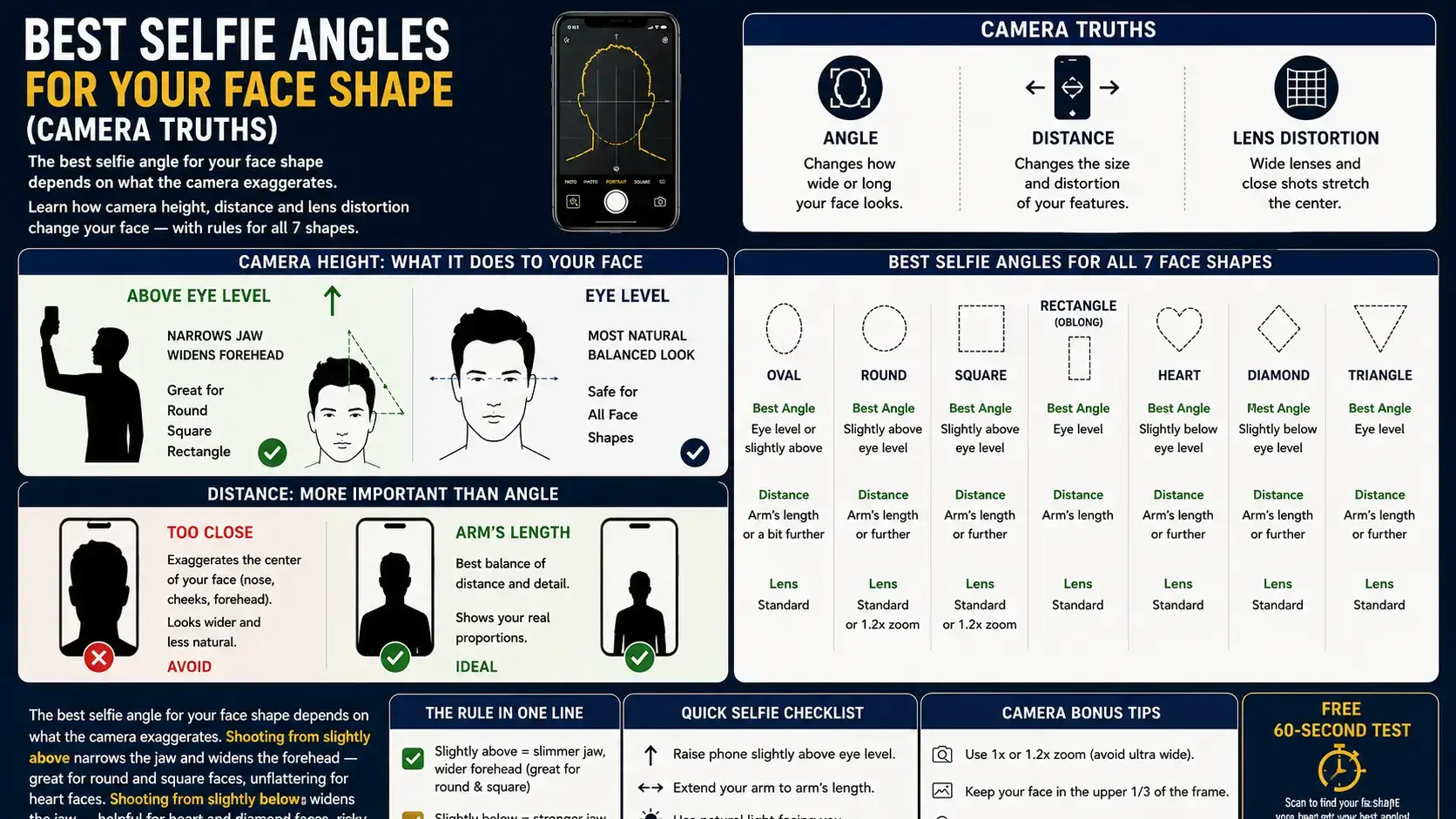
The best selfie angle for your face shape depends on what the camera exaggerates. Shooting from slightly above narrows the jaw and widens the forehead — great for round and square faces, unflattering for heart faces. Shooting from slightly below widens the jaw — helpful for heart and diamond faces, risky for triangle and square. Distance matters even more than angle: a phone held close distorts the centre of your face outward; arm’s length or further shows your real proportions.
One honest thing first, because this site is built on measurement: flattering angles and accurate angles are different things. Everything below is for looking your best in photos. If you’re photographing your face to measure it — for the AI face shape detector — use the opposite of every trick here: straight-on, chin level, arm’s length, neutral expression. Tricks flatter; they also distort the numbers.
The Three Camera Physics That Change Your Face
- Height (the big one): Camera above eye level → forehead grows, jaw shrinks. Camera below → jaw grows, forehead shrinks. Even 10–15 degrees visibly shifts the balance.
- Distance: Phone lenses are wide-angle. Held close (under ~40 cm), they push the nose and centre-face forward and pull the ears back — every face looks longer and narrower than reality. Arm’s length or a tripod plus zoom shows truer proportions.
- Tilt of your head: Chin down = eyes bigger, jaw softer, face shorter. Chin up = jaw dominant, face longer. Small moves, big effects.
Best Angle by Face Shape
- Oval (28.4%): Straight-on at eye level is genuinely your best angle — balanced faces photograph truthfully. Experiment freely; you’re correcting nothing.
- Oblong / long (21.7%): Your enemy is added length. Keep the camera at eye level, slightly further away (close phones lengthen the centre-face), chin level or a touch down, and turn your head 10–20° for a slight three-quarter view — it adds visual width the way side-volume hairstyles do. Avoid low angles with chin up.
- Round (17.3%): Shoot slightly above eye level with chin gently down and forward (“turtle” the chin toward the lens) — it defines the jawline and lengthens the face. Straight-on flash flattens features; angled light adds the definition round faces want.
- Heart (14.1%): The classic “from above” selfie angle works against you — it inflates your already-widest forehead and shrinks your chin. Shoot at eye level or a touch below, chin neutral, to give the lower face presence. Three-quarter turns also soften the forehead line.
- Square (9.5%): Slight above angle plus a 15–30° head turn — the turn breaks the symmetry of the angular jaw, and the height softens it. Straight-on emphasises the jaw’s corners.
- Triangle (8.6%): Treat it like heart in reverse: slightly above eye level so the wide jaw narrows and the forehead gains presence. Avoid below-angle shots entirely — they’re the single most jaw-widening camera position.
- Diamond (~5%): Eye level, straight-on or minimal angle, with soft frontal light. High angles shrink your narrow chin further; low angles shrink your narrow forehead. Your cheekbones photograph beautifully at neutral positions — let them.
Lighting: The 20% That Feels Like 80%
Angle sets geometry; light sets depth. Soft, slightly-above frontal light (a window works) flatters every shape. Hard overhead light shadows the eyes and deepens cheek hollows — it makes diamond and oblong faces look gaunt. Light from below is unflattering on all seven shapes; there are no exceptions worth listing.
FAQs
What is the most flattering selfie angle?
Slightly above eye level with the chin gently down works for the most shapes — but it backfires on heart faces (widens the forehead) and shrinks pointed chins. Your face shape decides; see your section above.
Why does my face look longer in selfies?
Phone lenses are wide-angle: held close, they stretch the centre of the face forward and make every face look longer and narrower. Hold the phone at arm’s length or further for truer proportions.
Which angle should I use to measure my face shape from a photo?
Straight-on, camera at eye level, chin parallel to the floor, arm’s length away, hair pulled back, neutral expression. Flattering tricks distort measurements — accuracy needs the boring angle.
Does the front or back camera show my real face?
The back camera, generally — it’s higher quality and used at greater distance. Front cameras add mild distortion and often beautify by default; check your settings before trusting what you see.
Why do I look different in the mirror than in photos?
Mirrors show you flipped, and your brain is used to that version. Photos show the unflipped face plus lens distortion. Neither is “wrong” — but measurements, not impressions, settle your actual face shape; the full statistics show how the 7 shapes actually distribute.
