Quick answer:
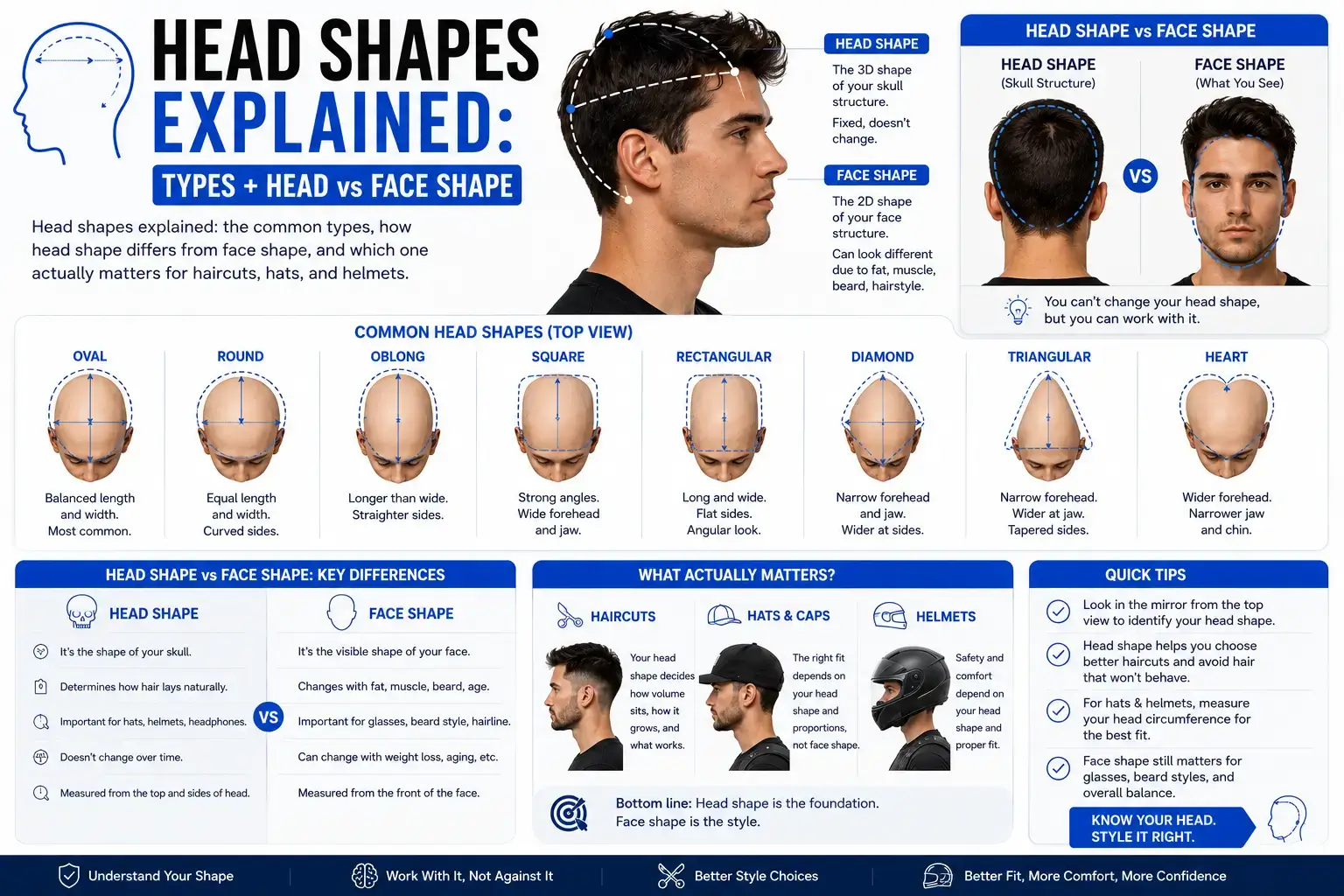
Head shape and face shape are different things that people constantly mix up. Head shape describes the skull’s overall form, seen best from above or behind: rounder versus longer, and flatter versus curved at the back. Face shape describes the front view: the outline from hairline to jaw. For most everyday decisions (haircuts, glasses, styling), what you actually want is your face shape. Head shape matters mainly for hats, helmets, close-cropped haircuts, and infant development.
Head Shape vs Face Shape: The Distinction
Anthropologists describe head shape with the cephalic index, a ratio of skull width to length (reference on Wikipedia). Broadly: longer, narrower skulls at one end, shorter, wider skulls at the other, and most people in between. None of this is visible from the front, which is why two people with identical face shapes can need different helmet sizes.
Face shape is the front-view outline: the system of 7 shapes (oval, oblong, round, square, heart, triangle, diamond) covered across this site, identified by length-to-width ratio, widest point, and jaw angle. If you searched head shapes but you are choosing a haircut or glasses, the face shape chart is the page you actually need.
Common Head Shape Descriptions
- Round head: Width and length close to equal when viewed from above.
- Long (oval) head: Noticeably longer front-to-back than side-to-side, the most common adult pattern.
- Flat back: The rear of the skull is flatter than average. Common, usually harmless in adults, and mostly relevant to how short haircuts sit.
- Pointed or peaked crown: The top of the skull rises to a subtle peak, noticeable mainly with very short hair.
An honest note: unlike face shapes, everyday head shape labels have no standard system at all. Barbers, helmet makers, and doctors each use their own vocabulary for the same skulls.
Where Head Shape Actually Matters
- Very short haircuts: Buzz cuts and skin fades reveal the skull’s true contours. A flat back or peaked crown, invisible under longer hair, becomes part of the look. Good barbers adjust fade heights to flatter the skull, which is why the same buzz cut reads differently on different heads.
- Hats and helmets: Fit is driven by skull shape, not face shape. If round hats always feel tight front-to-back, your head is likely on the longer end.
- Babies: Infant skulls are soft, and persistent flat spots from sleeping position are a real (and treatable) topic. That is a pediatric matter; if you are here about a baby’s head shape, speak to your pediatrician rather than a styling site.
FAQs
What are the different head shapes?
Common descriptions are round, long (oval), flat-backed, and peaked, based on the skull viewed from above or behind. Unlike face shapes, there is no standardized everyday system.
What is the difference between head shape and face shape?
Head shape is the skull’s overall 3D form (best seen from above); face shape is the front-view outline from hairline to jaw. Haircut and glasses advice runs on face shape; hat and helmet fit runs on head shape.
How do I know my head shape?
Look down at a top-view photo, or feel the back of your skull: flatter or curved, longer or rounder. For very short haircuts, your barber reads this in seconds.
Does head shape matter for haircuts?
Only for very short cuts, where the skull’s contours show. For all other lengths, face shape is the deciding factor; find yours with the free face shape quiz.
