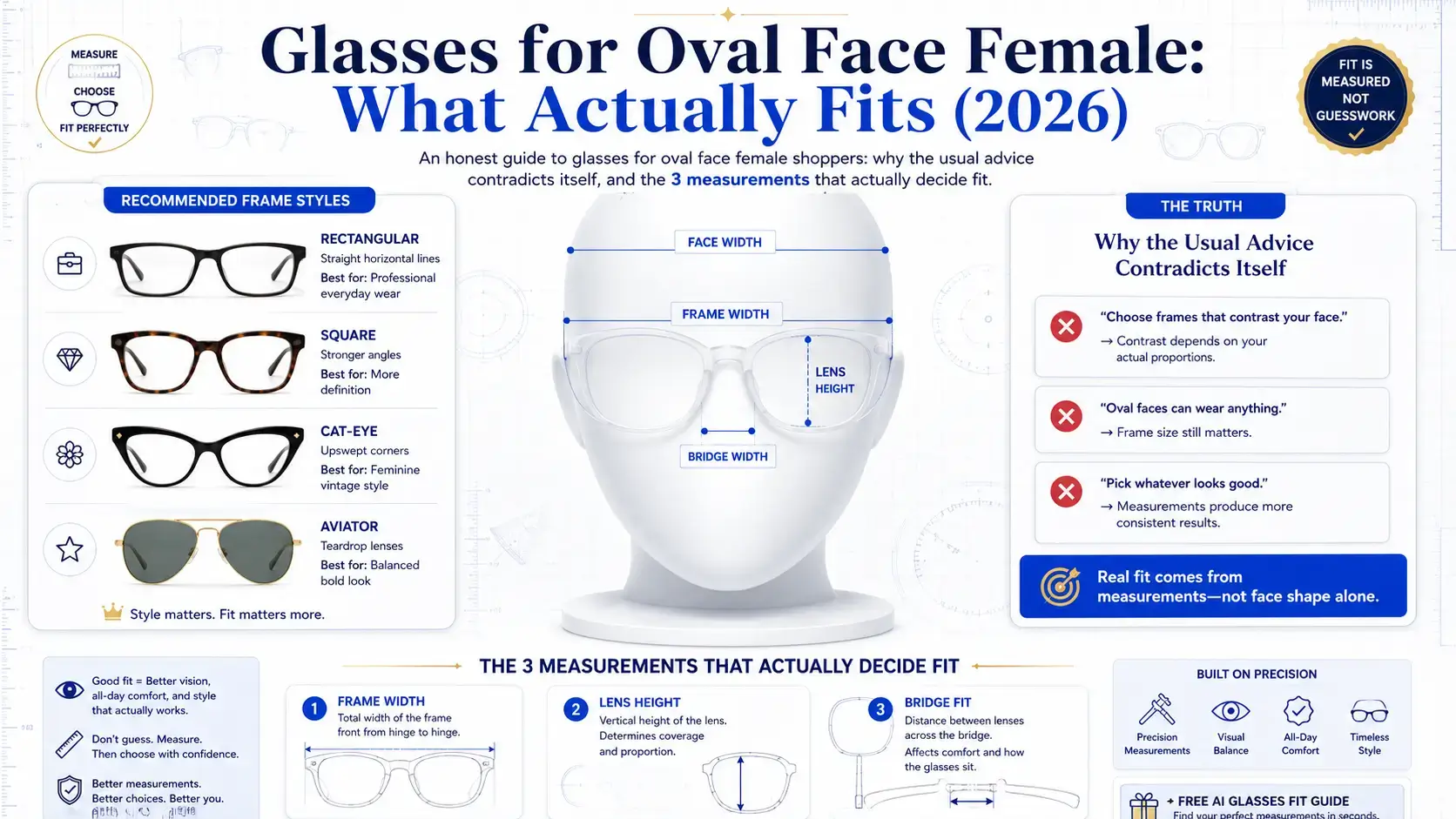
Quick answer:
For an oval face, the four frame styles most often recommended are square, rectangular, cat-eye, and aviator, because their straight lines contrast with soft facial curves. But here is the part most guides skip: face shape is the weakest of the three things that decide whether glasses suit you. Frame width, bridge width, and your pupillary distance matter far more, and unlike face shape they are measurable in millimetres. This guide covers both, starting with the styles and ending with the numbers that actually stop a frame from slipping, pinching, or straining your eyes.
First, the Honest Problem With Face Shape Advice
Search this topic, and almost every result on page one is an eyewear retailer. Nearly all of them give the same answer: an oval face is “the most versatile” shape and can wear almost anything.
That advice is not wrong, but notice what it does. If every frame suits you, every frame on their shelf qualifies. It is a comfortable message for a seller.
It also falls apart under pressure. Two major retailers give opposite advice on the same question: one warns that oversized frames can unbalance the even proportions of an oval face, while another says to avoid small or narrow frames and go bigger. Both are large, well-known brands. Both are talking about oval faces. They contradict each other.
The reason is simple. Frame-to-face-shape matching is a styling convention passed between beauty guides, not a tested standard. There is no published measurement system behind it, no agreed thresholds, and no way to check who is right. That does not make it useless, but it does mean you should treat it as taste, not science.
The 4 Frame Styles Usually Recommended (And Why)
Here is the conventional advice, presented honestly as convention rather than fact.
| Frame Style | The Logic Behind It | Best When You Want |
|---|---|---|
| Rectangular | Straight horizontal lines contrast with a softly curved jaw and add definition | A clean, professional look that works daily |
| Square | Stronger angles than rectangular, more visual weight | Sharper features without harshness |
| Cat-eye | Upswept corners lift attention toward the cheekbones | A retro or more dramatic, feminine look |
| Aviator | Teardrop lenses and a brow bar add a straight line at the top | Boldness while keeping features visible |
The shared idea across all four is contrast. An oval face has gentle, even curves, so frames with defined edges create a small amount of visual tension. That is genuinely what makes these styles look intentional rather than accidental.
Round frames also work, despite being the opposite approach. Curves layered on curves read as soft and retro rather than unbalanced. If a retailer tells you round frames are wrong for oval faces, that is a preference stated as a rule.
What Actually Decides Fit: 3 Numbers
Every pair of glasses has three numbers printed inside the temple arm, usually written like 52 □ 18 140. These are lens width, bridge width, and temple length in millimetres. They matter more than any style advice on this page.
1. Frame width vs your face width
Measure the widest part of your face, temple to temple, with a millimetre ruler held horizontally just below your eyes. Then match it:
- Under 130mm points to small frames
- 130 to 140mm points to medium frames
- Over 140mm points to large frames
The total frame width should sit close to your face width, within a few millimetres. Too narrow and the arms press into the sides of your head, which causes real headaches. Too wide and the glasses slide forward every time you look down.
2. Bridge width (14 to 24mm)
This is the gap between the lenses that rests on your nose, and it is the single biggest cause of glasses sliding. A narrow nose needs a smaller bridge; a wider nose needs a larger one. Where your nose bridge sits also matters: if it sits low, low-bridge-fit frames exist specifically for that.
3. Pupillary distance (PD)
This is the distance between the centres of your pupils, and it is the one with actual health consequences. Your pupils need to line up with the optical centre of each lens.
Get this wrong, and the mismatch creates a prismatic effect, which shows up as eye strain, headaches, blurry vision, or double vision. A narrow PD combined with very large lenses pushes the optical centres too far apart. A wide PD in small frames pushes them too close together. You can read more about how pupillary distance is used in lens fitting, and you can get the measurement free from your optometrist.
This is the honest answer to “can I just buy the trendy oversized pair?” Sometimes no, and not for style reasons.
What an Optician Can Fix, and What They Cannot
This distinction saves money and is rarely mentioned in face-shape guides.
| Can usually be adjusted | Cannot be fixed after purchase |
|---|---|
| Temple arms bent in or out for grip | Total frame width being too wide or narrow |
| Nose pads repositioned | Bridge width on plastic frames |
| Temple tips reshaped behind the ear | Lens width relative to your PD |
So a frame that is slightly loose is a quick shop visit. A frame that is genuinely the wrong width is a return, no matter how good it looks.
A Practical Way to Shop
- Confirm your face shape properly first. Many people assume oval when they are actually oblong, which changes the advice. The free face shape detector settles it in seconds, or compare traits on the face shape chart.
- Find a pair you already own that fits well and read the three numbers inside the arm. This is the fastest shortcut that exists.
- Get your PD from your optometrist, free, at your next appointment.
- Then choose style. Rectangular, square, cat-eye, aviator, or round. At this stage it genuinely is personal taste.
If you want the full picture of oval traits and styling beyond eyewear, the oval face shape guide covers hairstyles and makeup too, and more eyewear guides sit in the glasses section.
Frames That Sometimes Cause Trouble
Not rules, just patterns worth knowing:
- Very oversized frames can visually shorten and widen an oval face, which some people want and some do not
- Frames much narrower than your face tend to make the face look wider by contrast
- Very small lenses with a wide PD risk the optical-centre problem described above
- Heavy bottom-rimmed styles can drag attention downward on an already gently tapering face
Try them anyway. Every one of these looks good on someone.
FAQs
What glasses suit an oval face female?
Rectangular, square, cat-eye, aviator, and round frames all work well, because an oval face has even proportions with no single feature needing correction. Style is largely personal preference. Fit is decided by frame width, bridge width, and pupillary distance, which matter more than shape.
Can an oval face wear any glasses?
Close to it, yes, and that is why this shape gets called versatile. The real limits are physical: a frame that is too wide slides, one that is too narrow pinches, and lens width that clashes with your PD can cause eye strain regardless of how good it looks.
Are oversized glasses good for an oval face?
Retailers disagree on this openly. Some say oversized frames unbalance even proportions; others recommend going bigger. There is no measurement standard behind either claim, so try both and judge in a mirror rather than trusting the rule.
What size glasses should I buy?
Measure your face temple to temple. Under 130mm suggests small frames, 130 to 140mm medium, and over 140mm large. Then match the total frame width closely. Reading the numbers off a pair that already fits you is even more reliable.
Do I need my PD to buy glasses online?
Yes, for prescription lenses. Without an accurate pupillary distance, the optical centres can sit wrong, which causes strain and headaches. Your optometrist can give it to you free.
Is face shape really the best way to choose glasses?
It is a useful starting filter, not a rule. It narrows a huge catalogue down to a browsable shortlist. Once you are trying frames on, fit measurements and your own eye should decide.
