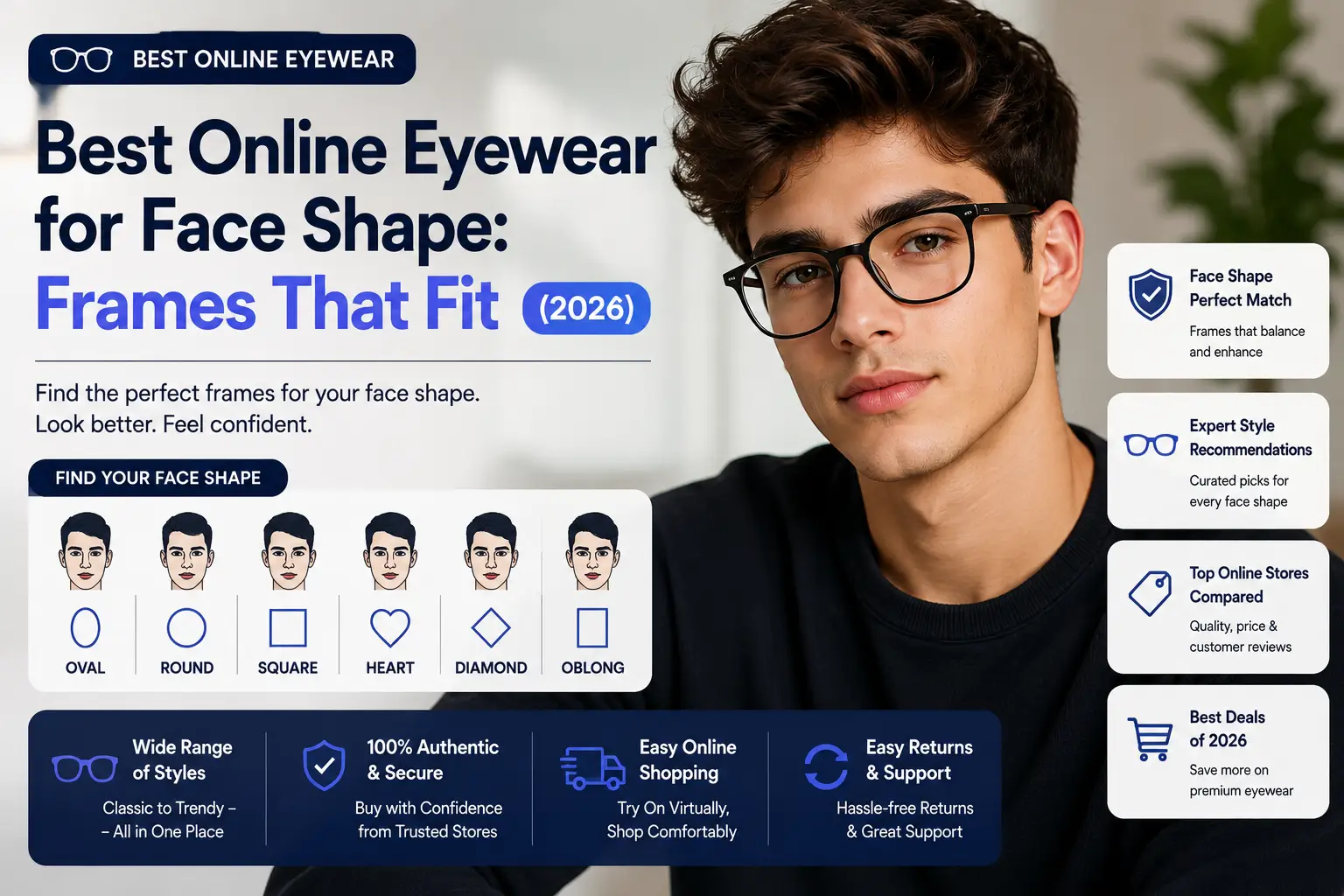
The right glasses frame for your face shape comes down to one principle: contrast. Angular frames soften round faces. Round frames soften square ones. Oblong faces need width, not height. The frame shape that works is usually the structural opposite of your face shape. Use this guide to find your face shape, match it to the right frames, and compare the five online retailers that provide the best face-shape guidance.
Not sure of your shape? Detect your face shape free → Free Face Shape Detector.
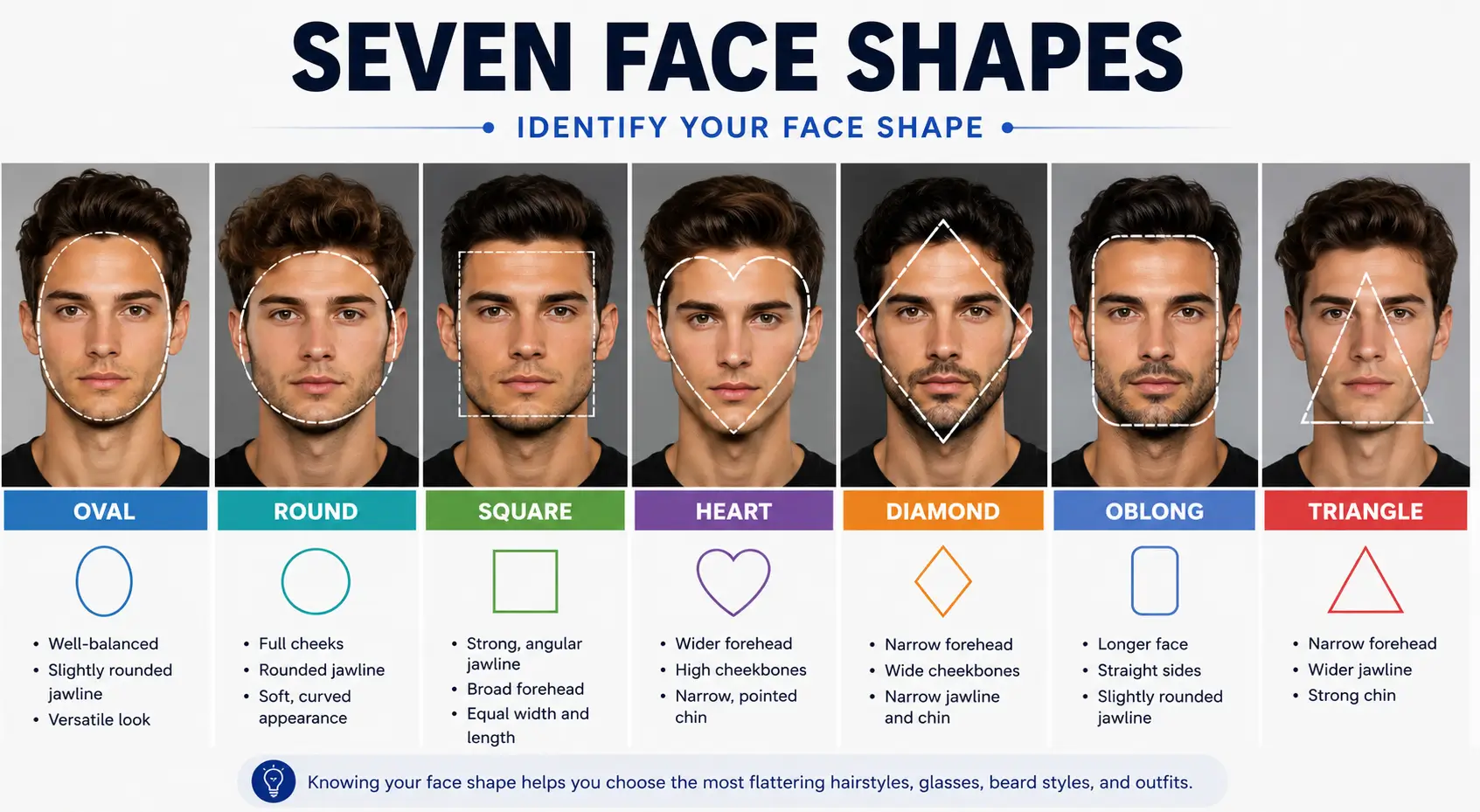
How to Know Your Face Shape Before You Shop
Shopping for glasses without knowing your face shape is like ordering a suit without knowing your measurements. You might get lucky. You probably won’t.
There are two fast methods.
The 30-Second Mirror Method
Stand arm’s length from a mirror and pull your hair back completely. Trace the outline of your face with a finger or a lipstick dot at four points: your hairline center, your chin tip, and each cheekbone edge. Then look at the overall shape: Is it as wide as it is tall? Narrow and long? Wide at the top and narrow at the bottom?
This gives you a rough classification in under a minute. It is good enough to narrow down frame options — but not precise enough to distinguish between, say, oblong and oval.
The 4-Measurement Method
Take four measurements with a flexible tape: face length (hairline to chin), forehead width (above the brows), cheekbone width (below the eyes), and jawline width (corner to corner). Divide face length by average width. A ratio above 1.5 points to oblong. Below 1.2 with equal widths points to round or square. Cheekbones clearly wider than both forehead and jaw points to diamond.
Enter your measurements for an instant result → Face Shape Calculator
If you would rather skip the tape measure, use seven visual questions to classify your shape in about 90 seconds.
Best Glasses Frames for Each Face Shape
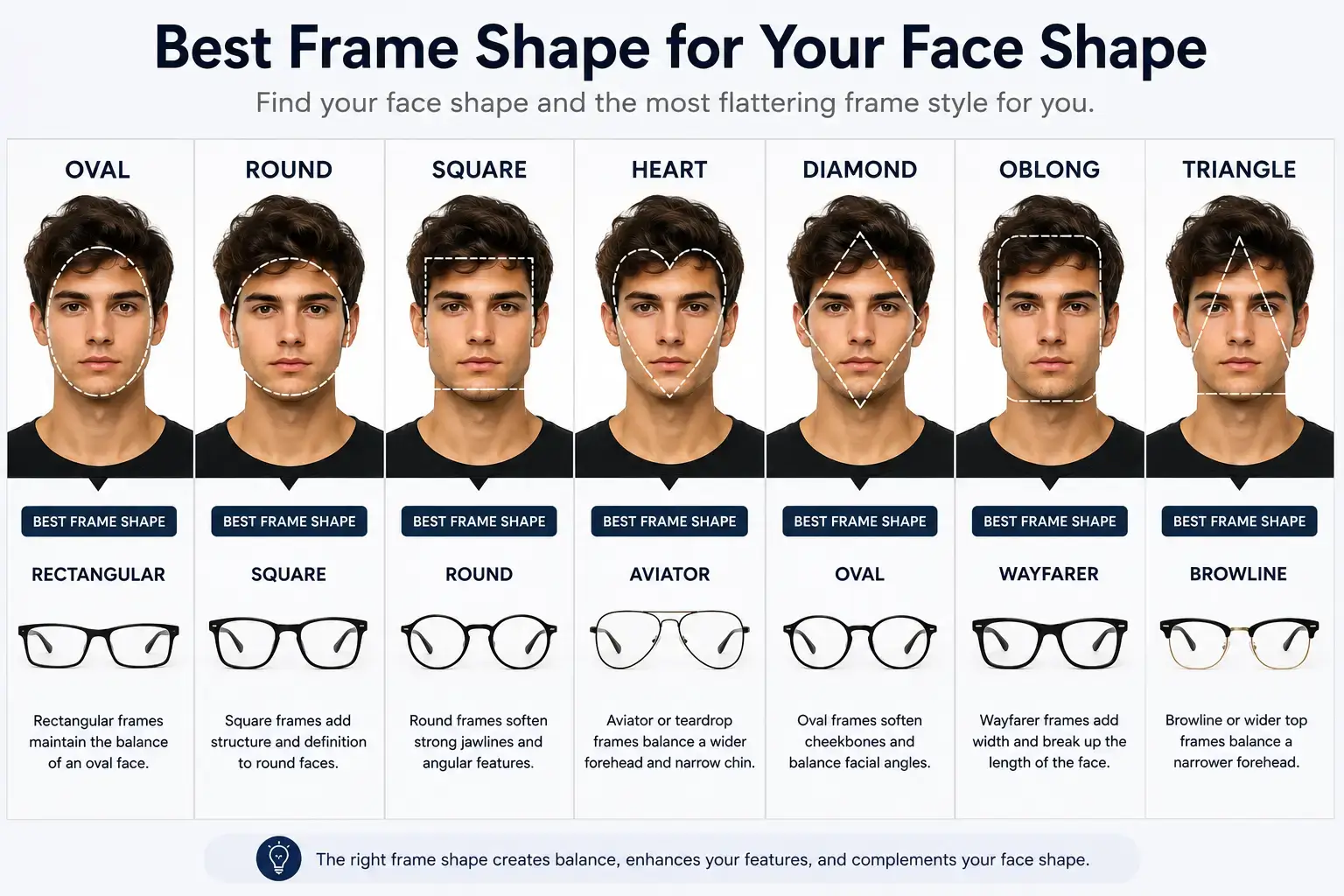
The matches below follow the proportion principles established in facial anthropometry research by Leslie Farkas (1994), whose landmark craniofacial measurement work established the landmark positions and ratio thresholds used to classify facial geometry. The styling principle in each case is contrast: use your glasses to add what your face shape lacks.
Oval Face Shape — Most Frames Work
Oval is the most balanced face shape: slightly longer than wide, with the cheekbones as the widest point and a gently tapered chin. Nearly any frame works. The only frames to avoid are those that disrupt the balance — extremely oversized styles that overwhelm the face, or very narrow frames that make the face appear longer.
- Best frames for oval: Wayfarers, aviators, round frames, cat-eye, geometric.
- Avoid: Very oversized rectangular, very small rimless.
Round Face Shape — Choose Angular
Round faces are as wide as they are tall, with soft curves and no defined jaw corners. The goal is to add the perception of length and reduce perceived width. Angular, geometric frames accomplish both.
- Best frames for round: Wide rectangular (the strongest choice), square frames, angular geometric, browline/clubmaster.
- Avoid: Round frames — they mirror the face shape exactly, reinforcing the circular proportion. Oval frames also add width in the wrong direction.
Square Face Shape — Soften the Jaw
Square faces have a strong, angular jawline and roughly equal widths across forehead, cheekbones, and jaw. The goal is to soften that angularity — which means curves.
- Best frames for square: Round frames, oval frames, classic aviators (teardrop shape), browline with curved lower lenses.
- Avoid: Square or rectangular frames that echo the jaw geometry. Flat-topped wayfarers.
Oblong Face Shape — Add Width
Oblong faces are significantly longer than wide (length-to-width ratio of 1.5 or above) with consistent widths. The goal is to add horizontal visual width and reduce the perception of length.
- Best frames for oblong: Wide frames that extend past the outer eye — oversized rectangular, round, wide oval, browline. The frame should be wider than it is tall.
- Avoid: Narrow frames, tall narrow rectangles, rimless styles that add no visual weight.
See the full oblong face shape glasses guide: [INTERNAL LINK: complete frame guide for oblong faces → Oblong Glasses category page]
Heart Face Shape — Balance the Forehead
Heart faces are widest at the forehead and taper to a narrow or pointed chin. The goal is to reduce visual emphasis on the upper face and add visual weight at the lower face.
- Best frames for heart: Round frames, wide oval, rimless-top styles, wide aviators (weight sits at mid-frame and below). Bottom-heavy frames with decorative lower rims work particularly well.
- Avoid: Cat-eye frames — the upswept outer corners add width at exactly the point that is already widest. Heavy browline frames for the same reason.
Diamond Face Shape — Highlight the Upper Face
Diamond faces have prominent, wide cheekbones as their dominant feature, with a narrow forehead above and a narrow jaw below. Diamond is the rarest face shape, appearing in approximately 5% of the adult population. The goal is to add width above the cheekbones, at the forehead level.
- Best frames for diamond: Cat-eye frames (the strongest option — they sweep upward and outward, adding width above the cheekbones), browline/clubmaster, oval frames wider than the cheekbones.
- Avoid: Narrow frames centered at cheekbone level, bottom-heavy frames, very small round styles.
Triangle Face Shape — Add Crown Width
Triangle (or pear) faces are widest at the jaw, narrowing upward to a relatively narrow forehead. The goal is to add visual width and presence at the forehead level.
- Best frames for triangle: Cat-eye frames (strongest choice), browline frames, aviators. Any frame with visual weight or detail at the top of the frame adds the needed upper-face width.
- Avoid: Bottom-heavy frames that add visual weight to the already-dominant jaw. Wide square frames.
The Science Behind Frame Shape Matching
Frame selection is not aesthetic guesswork. It follows the same proportional logic used in craniofacial measurement science. Farkas (1994) established that facial attractiveness correlates with balance across horizontal measurement points — forehead, cheekbone, and jawline widths that approach equality, combined with a length-to-width ratio near 1.3.
When your face deviates significantly from that balanced proportion — by being very round, very long, or top-heavy — the right frame shape compensates optically. A wide rectangular frame on a round face adds horizontal emphasis that extends beyond the face’s widest point, making it read as wider and therefore slightly longer. A round frame on a square face introduces a curved element that softens the jaw’s hard geometry by contrast.
The principle is consistent: glasses work best when they create proportion, not when they match it.
Best Online Eyewear Retailers Ranked by Face Shape Tools
Most online eyewear reviews rank retailers on price, return policies, and virtual try-on technology. Those are legitimate criteria. But for a shopper who is specifically trying to find frames for their face shape, the more relevant question is: how good is each retailer at helping you filter by face shape and recommending the right frames?
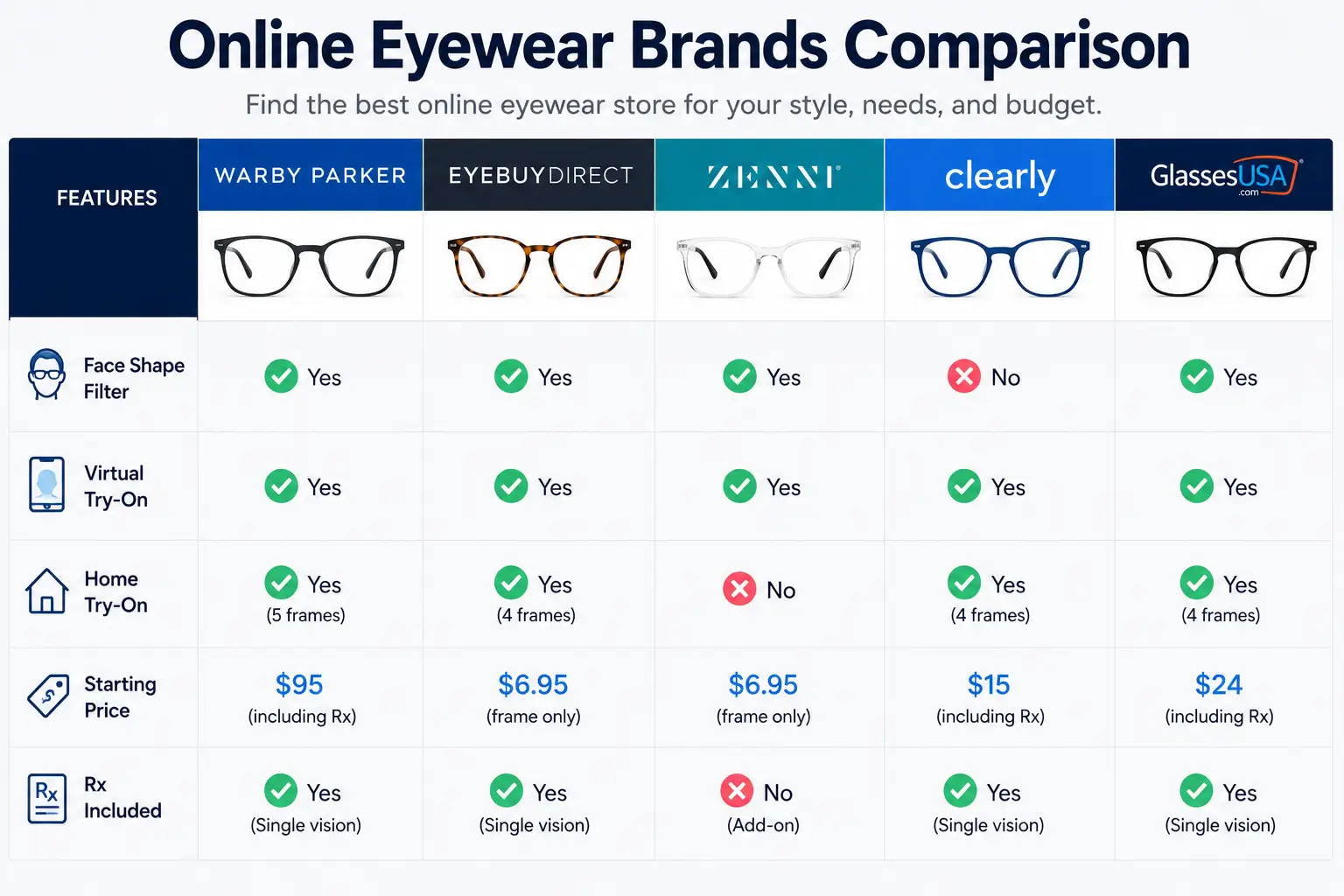
Here is how the top five retailers compare on that specific dimension, based on direct evaluation of their browsing and recommendation tools.
Warby Parker — Best Virtual Try-On
Warby Parker’s virtual try-on is the most technically advanced of any mainstream retailer. On iPhone X or later, it uses TrueDepth camera mapping to place frames in 3D on your face — the frames track head movement and tilt with realistic accuracy. The app also includes an AI Advisor that reads your face shape and recommends styles based on your proportions and previous interactions.
The face-shape browsing tool on the website is less detailed: you can filter by frame shape (round, rectangular, square, cat-eye, etc.) but there is no direct “my face shape is X, show me what works” filter. The Prescription Check app allows prescription renewal for eligible prescriptions.
- Frames from: $95. Home try-on: 5 frames, 5 days, free shipping both ways. Return policy: 30 days. FSA/HSA accepted.
- Face-shape tool rating: 4/5 — virtual try-on is excellent; face-shape filtering at browse level is average.
EyeBuyDirect — Best for Budget and Face-Shape Filtering
EyeBuyDirect is rated the top online eyewear retailer by Reviewed.com, noted for its wide range of prices, styles, and sizes. For face-shape shoppers specifically, it is the most useful: the site lets you filter simultaneously by frame shape, face shape, fit (narrow, medium, wide), and color. That combination is rare among online retailers and makes it genuinely practical for narrowing down options by face geometry rather than browsing thousands of frames manually.
EyeBuyDirect has a 14-day “Fit and Style” guarantee covering a one-time replacement or refund, and a one-year manufacturer’s warranty.
- Frames from: $7 (basic). Prescription included at many price points. Partnership with LensCrafters for in-person adjustments.
- Face-shape tool rating: 5/5 — the most complete face-shape filtering of any mainstream retailer.
Zenni Optical — Best Frame Volume
Zenni Optical has the largest frame collection of any online retailer, with an extensive 3D virtual try-on service that allows browsing by face shape. The sheer volume of frames is the main advantage — if you have a specific, niche requirement (a particular face shape combined with a very high prescription index, for example), Zenni’s selection gives you the best chance of finding it.
The face-shape filter is available but less granular than EyeBuyDirect’s. The virtual try-on is 3D and reasonably accurate. One limitation: Zenni offers only store credit or a 50% refund, excluding shipping, which is a weaker returns policy than competitors.
- Frames from: $7. No home try-on.
- Face-shape tool rating: 3.5/5 — excellent for volume; face-shape filtering is secondary to the search function.
Clearly — Best for International Shoppers
Clearly (clearly.ca / clearly.com.au) operates primarily in Canada and Australia and carries a wide range of prescription and non-prescription frames. The site includes a virtual try-on and a face-shape guide with frame recommendations per shape. Its face-shape filtering is functional — you can browse by frame shape — but it does not offer a direct “face shape → recommended frames” wizard in the way EyeBuyDirect does.
- Frames from: Approximately $29 CAD. Ships internationally.
- Face-shape tool rating: 3/5 — solid face-shape guide content but average filtering depth.
GlassesUSA — Best Designer Selection
GlassesUSA carries over 7,000 eyeglass frames including major designer brands, with a virtual try-on feature and a filter for face shape. Its face-shape filtering exists but does not integrate with the virtual try-on — meaning you find frames by face shape, then try them on separately, rather than the try-on suggesting shapes based on your face. For shoppers prioritizing designer brands over face-shape accuracy, it is the better choice. For those prioritizing face-shape matching, EyeBuyDirect is more useful.
- Frames from: $39 (basic), designer from $89+. FSA/HSA accepted.
- Face-shape tool rating: 2.5/5 — large selection, but face-shape tool and virtual try-on are not integrated.
Virtual Try-On Tools: What They Can and Cannot Do
Virtual try-on technology has improved substantially since 2022. The best implementations — Warby Parker on iPhone with TrueDepth, and Zenni’s 3D browser tool — produce realistic frame placement that tracks head movement. For color, style, and proportion assessment, they are genuinely useful.
What virtual try-on cannot reliably do: measure how a frame physically sits on your nose, assess temple arm length for comfort, or evaluate optical center alignment for progressive prescriptions. Licensed optometrists specifically warn that progressive prescriptions ordered online without in-person fitting carry real risk — three out of five testers in one evaluation had wearability issues with progressive lenses ordered entirely online, due to incorrect fitting heights.
For single-vision prescriptions and non-prescription frames, virtual try-on plus face-shape filtering is a reliable enough combination to shop confidently. For progressive prescriptions, use the virtual try-on for style selection, then confirm the fitting either at a local LensCrafters (EyeBuyDirect’s in-person partner) or a Warby Parker retail location before ordering.
Prescription Glasses Online for Your Face Shape
Buying prescription glasses online adds one constraint to face-shape selection: frame width. Prescription lenses are ground to sit in front of your pupils. If the frame is too wide for your pupillary distance (PD), the optical centers shift outward and cause visual distortion. If too narrow, the lenses crowd.
For face-shape matching, this matters because the ideal frame for your shape may not match your PD. A person with an oblong face who needs wide rectangular frames to add visual width should still verify that the frame width is within 5mm of their face width measurement to ensure the prescription sits correctly.
Most online retailers display frame width in millimeters in the product specs. EyeBuyDirect’s fit filter (narrow, medium, wide) makes it easier to pre-filter for physical fit before browsing by face shape. Warby Parker’s app includes a pupillary distance measuring tool directly.
Why Most Face Shape Glasses Guides Give You the Wrong Advice
Most face shape glasses guides tell you to pick a frame based on your shape and follow the matching rule strictly. They present it as a yes/no decision: you have a square face, so you get round frames. Full stop.
That is too blunt to be accurate.
The practical principle is proportional deviation, not shape category. If your face is slightly square — meaning your jaw is a little wider than average but not dramatically so — you do not need the most aggressively round frames available. A soft-cornered rectangular frame gives you enough angular softening without overcorrecting.
The shape category matters. But the degree of deviation from the balanced proportion determines how much correction you need. A slightly oval face can wear almost anything because it already sits close to the balanced ideal. A strongly oblong face — with a ratio above 1.7 — genuinely needs wide frames with strong horizontal emphasis, and narrow or rimless styles will look noticeably wrong.
Before you apply any frame rule, ask yourself: How extreme is my face shape from the balanced proportion? A mild deviation needs a mild correction. A strong deviation needs the full application of the rule.
Use our face shape checker tool to measure your exact length-to-width ratio and see how far your measurements fall from a balanced proportion. That number tells you how strictly to apply the frame matching rules above.
Frequently Asked Questions
What is my face shape for glasses online?
Measure four points — face length, forehead width, cheekbone width, and jawline width — then divide face length by average width. Alternatively, use a free face shape detection tool that analyzes a photo or accepts measurements directly and classifies your shape against all 7 categories.
Is there an app to find glasses that fit your face?
Yes. Warby Parker’s app (iOS and Android) offers the most accurate virtual try-on, using TrueDepth 3D face mapping on compatible iPhones and an AI advisor that recommends frame styles based on your face shape and proportions. Zenni’s 3D virtual try-on works in-browser without an app. VirTry, available on iOS, offers a standalone AR try-on tool with save and compare features.
Is Zenni or GlassesUSA better for face shape shopping?
Zenni is better for face-shape-based shopping because it allows you to filter by face shape and frame shape simultaneously across a much larger catalog. GlassesUSA has a broader designer selection and stronger insurance integration, but its face-shape tool and virtual try-on are not integrated into the same workflow. If face-shape matching is your priority, EyeBuyDirect is actually stronger than both — it offers simultaneous filtering by face shape, frame shape, and physical fit width.
Can AI pick the best glasses for my face?
Current AI tools do this reasonably well for style — Warby Parker’s AI Advisor identifies face structure and suggests styles. For prescription fitting, AI cannot replace the physical measurement of pupillary distance and optical center alignment. Use AI tools for style and proportion matching, then verify physical fit measurements before confirming a prescription order.
Conclusion
The frames that flatter your face shape follow one principle: structural contrast. Your glasses should add what your face shape lacks — width for oblong faces, angularity for round faces, softness for square ones. Identify your shape first, apply the matching rule with the degree of correction your proportions actually need, then use a retailer whose face-shape tools help you filter efficiently. EyeBuyDirect is the strongest option for face-shape filtering. Warby Parker leads on virtual try-on accuracy. For prescription orders, verify frame width against your PD before confirming.
Confirm your face shape before you shop.
