Quick answer:
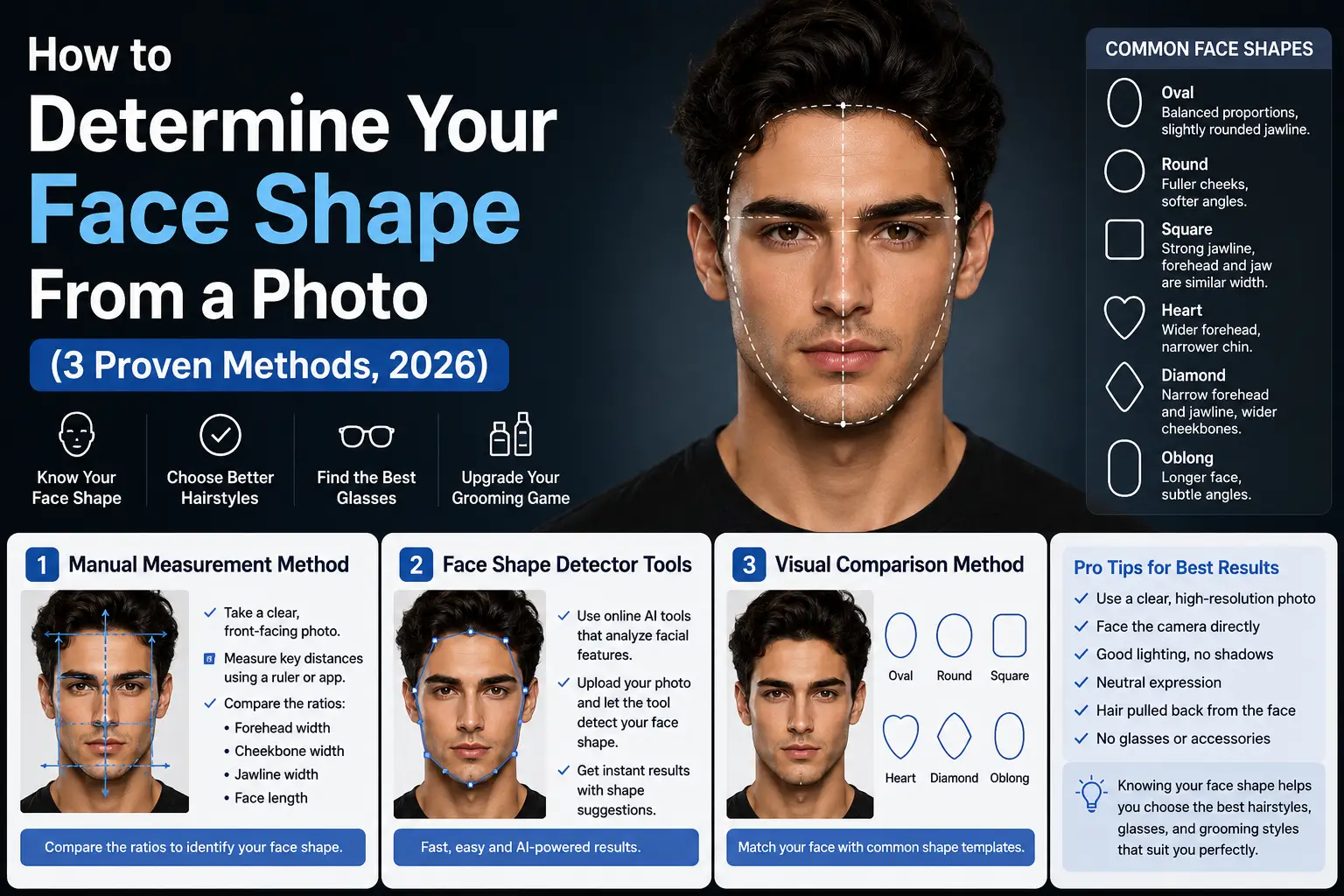
To determine your face shape from a photo, take a front-facing picture with hair pulled back, then measure four points — forehead width, cheekbone width, jawline width, and total face length — directly on the screen using a ruler app or our free detector tool. Divide face length by average width: a ratio near 1.0 means round or square, 1.2–1.4 means oval, 1.5+ means oblong, and an uneven width pattern points to heart, diamond, triangle, or inverted triangle.
That’s the short version. The rest of this guide walks through exactly how professional stylists and optometrists do this assessment, why photos can mislead you if you skip one step, and how to tell apart the two shapes people confuse most — heart and inverted triangle.
Why “What Face Shape Do I Have” Is Harder to Answer Than It Looks
Most people try to answer this by staring in a mirror, which is the least reliable method. A mirror image is flipped, slightly distorted by your distance from the glass, and your brain unconsciously smooths out asymmetry. A photo is more reliable because you can measure it directly — but only if it’s taken correctly.
Before you try to find your face shape from a photo, you need three things:
- A front-facing, well-lit photo. Side angles, tilted chins, and dramatic lighting all distort proportions. Phone selfies taken slightly below eye level widen the jaw artificially.
- Hair pulled back or tucked away. Bangs, volume, and fringe hide your real hairline and forehead width — the single most common reason people misidentify their shape.
- A neutral expression. Smiling raises the cheeks and can make a round face look narrower than it is.
How to Determine Face Shape From a Photo: Step-by-Step
This is the method optometrists and hairstylists use when a client asks, “What’s my actual face shape?” rather than guessing from a chart.
Step 1 — Take the photo: Stand at arm’s length from a wall, face the camera directly, and pull your hair back completely. Natural daylight works better than overhead indoor lighting, which casts shadows under the cheekbones and skews the reading.
Step 2 — Mark four points: On the photo (using a photo-editing app, a printed copy, or our drag-and-drop detector, which does this automatically), mark:
- The center of your hairline
- The tip of your chin
- The outer edge of your left cheekbone
- The outer edge of your right cheekbone
Step 3 — Take the three width measurements: Forehead width (a finger’s width above the eyebrows, edge to edge), cheekbone width (the widest point below the eyes), and jawline width (the outer corners of the jaw, not the chin tip).
Step 4 — Calculate the ratio: Divide face length (hairline to chin) by the average of your three width measurements. This single ratio, combined with which of the three widths is largest, is what separates one face shape from another — not a vague visual impression.
Step 5 — Compare against the reference ranges below.
How to Find Your Face Shape: The 7-Shape Reference Table
Once you have your length-to-width ratio and know which width measurement is largest, you can place yourself in one of these categories. These ranges follow the anthropometric landmark system established by Leslie Farkas’s craniofacial measurement research, which is still the baseline most face-shape classification tools build on today.
| Shape | Length/Width Ratio | Widest Point | Defining Trait |
|---|---|---|---|
| Oval | 1.2–1.45 | Cheekbones | Gentle taper to the chin |
| Round | ≤1.15 | Cheekbones | Soft curves, no sharp angles |
| Square | ≤1.2 | Jaw ≈ forehead | Strong, angular jawline |
| Heart | 1.1–1.3 | Forehead | Widow’s peak, pointed chin |
| Diamond | 1.1–1.4 | Cheekbones | Narrow forehead and jaw |
| Oblong | 1.5+ | Even across all three | Straight sides, longer face |
| Triangle | 1.0–1.2 | Jaw | Jaw wider than forehead |
If your forehead is clearly the widest point and your hairline is straight rather than peaked, you may actually be looking at an eighth commonly searched term — inverted triangle — which is closely related to the heart but distinct enough to deserve its own explanation.
Inverted Triangle Face Shape: How It’s Different From Heart
“Inverted triangle face shape” is one of the most frequently confused terms in face-shape content, and most existing guides get the explanation muddled. Here’s the accurate version, based on consistent definitions across optometry and styling sources.
An inverted triangle face shape has a forehead that is the widest part of the face, tapering down to a noticeably narrower jaw and chin — geometrically, a triangle standing on its point. It sits in the same family as the heart shape, and the two are frequently treated as variants of one another rather than fully separate categories. The distinction that matters:
- Hairline shape. A heart-shaped face typically has a widow’s peak — a visible V-dip in the center of the hairline. An inverted triangle has a straight or gently rounded hairline with no dip.
- Cheekbone prominence. Heart shapes often show more pronounced, rounded cheekbones. Inverted triangle faces taper more evenly from forehead to chin without a distinct cheekbone “high point.”
- Chin shape. Heart-shaped chins tend to come to a defined point. Inverted triangle chins are narrow but often slightly more rounded or squared off rather than sharply pointed.
Signs You Have an Inverted Triangle Face Shape
- Your forehead measurement is clearly your largest of the three width readings
- Your jawline is your narrowest measurement, with face length notably greater than jaw width
- Your hairline runs straight across rather than dipping into a peak
- Your face narrows steadily from forehead to chin without a single dramatic “widest point” in the middle
Styling an Inverted Triangle Face Shape
The goal is the same logic used for heart shapes: minimize forehead width, add width at the jaw. Side-swept bangs or a fringe that breaks up the forehead line work well, as do chin-length bobs that add visual volume right where the face is narrowest. For glasses, frames with detail or color weighted toward the bottom half — rather than heavy browline styles — help balance the proportions instead of exaggerating the forehead.
How to Tell What Face Shape You Have Without Measuring
If you don’t want to measure anything, there’s a faster (less precise) visual checklist:
- Look at your jaw first. Is it the widest part of your face, the narrowest, or about equal to your forehead?
- Look at your hairline. Straight, rounded, or peaked?
- Look at your chin. Pointed, rounded, or squared?
- Look at overall length. Does your face look noticeably longer than it is wide, or fairly balanced?
This four-question method gets most people to a reasonably accurate answer in under a minute, though it’s less reliable than the photo-measurement method above — visual estimation tends to undercount jaw width and overcount forehead width, which is why so many people initially misclassify heart and inverted triangle shapes as oval.
Common Mistakes That Throw Off Self-Assessment
- Measuring with bangs or hair covering the temples: This is the single biggest source of error, since it artificially narrows the forehead reading
- Tilting the chin down during the photo: This compresses face length and makes oblong or oval faces look rounder than they are
- Smiling during measurement: Raises cheek muscles and distorts the cheekbone width reading
- Using an old photo: Face shape can shift slightly with weight change, aging, or dental and orthodontic work, so a current photo matters
Frequently Asked Questions
Can I determine my face shape accurately from a phone selfie?
Yes, as long as the photo is front-facing, taken at eye level, and your hair is pulled back. Photos taken from below or at an angle distort the jaw and forehead proportions and will produce an inaccurate reading.
What’s the actual difference between heart and inverted triangle face shapes?
Both have a wide forehead tapering to a narrow chin. The difference is the hairline: heart shapes typically show a widow’s peak (a center dip), while inverted triangle shapes have a straight or gently rounded hairline with no dip, and generally less cheekbone prominence.
Why do I get a different face shape result every time I check?
Inconsistent lighting, hair position, camera angle, and facial expression are the most common reasons. Use the same conditions — hair back, neutral expression, front-facing, even lighting — every time you measure for a consistent result.
Does face shape change over time?
Slightly. Weight changes, aging (which can soften jaw definition), and dental or orthodontic treatment can shift your proportions over the years, though the underlying bone structure stays largely consistent through adulthood.
Is an online face shape detector as accurate as manual measurement?
A well-built detector that uses the same four-point measurement system as the manual method will produce comparable results, since it’s running the same ratio calculation — the accuracy depends on photo quality, not the tool itself. Try our free face shape detector for an instant read using either photo upload, live camera, or manual measurements.
