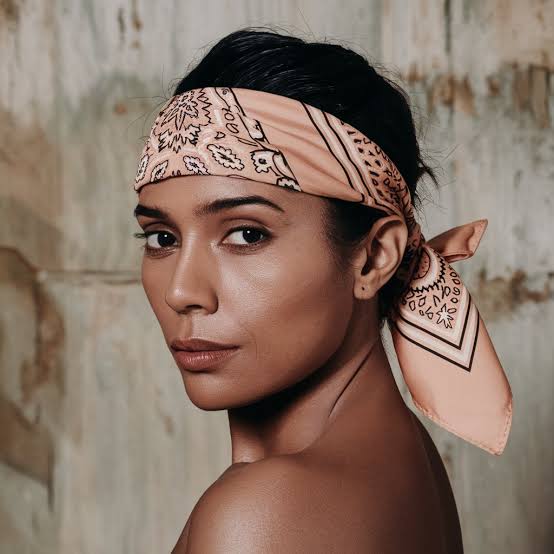
The golden rule for styling an oblong face is simple: add horizontal width, avoid anything that stretches the face vertically. It’s why boat necks work better than deep V-necks, why wide statement earrings beat long dangly ones, and why a bandana — tied the right way — can do more for an oblong face than almost any other accessory.
Tied the wrong way, though, a bandana does the opposite. A narrow strip pushed straight back off the hairline, or a tight triangle knotted high on the crown, adds height exactly where an oblong face doesn’t need it. The good news is that fixing this is entirely about the fold and the knot, not the accessory itself.
The Folds That Add Width
- The wide headband fold Fold a square bandana into a band roughly 2–3 inches wide rather than the usual thin strip. Worn across the forehead at the hairline, a wider band reads as horizontal width rather than a vertical accent, which is exactly what an oblong face benefits from. This is the same principle behind the wide-brim hats and headbands already recommended for this face shape — a bandana is just a softer, more versatile version of the same idea.
- The side-knot, not the center-back knot Tying the knot off to one side rather than dead center at the back breaks up the straight vertical line running down the back of the head. It also plays well with the side-swept bangs and side-part styles that already flatter oblong faces.
- The low, loose neck tie For bandanas worn around the neck rather than the head, a looser knot sitting slightly off-center adds visual width at the collarbone — the same effect boat necks and wide collars create. A tight, high, centered knot does the opposite, drawing a thin vertical line up toward the chin.
- Avoid the top-knot pirate wrap It’s a fun look, but tying a bandana high on the crown with the ends knotted upward adds height precisely where an oblong face is already long. Save this fold for rounder face shapes that can use the extra vertical lift.
Why Fabric Choice Changes How a Bandana Sits
A folded bandana has to hold its shape and stay put without pulling hair or slipping — and fabric affects both:
- Cotton bandanas are the classic choice but tend to crease sharply once folded, which can look stiff rather than soft, and they grip hair enough to leave dents or flyaways when removed.
- Silk bandanas fold with a softer, rounder edge instead of a hard crease, drape closer to the head without gapping, and glide over hair rather than gripping it — so no dent line when you take it off later in the day. The slight natural sheen also reads as more polished for the wider, folded styles described above, rather than looking like a workout accessory. Silk specialists like UR Silk work with exactly this kind of drape when cutting bandanas, since a stiffer weave won’t hold a wide fold the same way.
For anyone wearing a bandana as a daily styling piece rather than just for the gym, silk holds the wider folds recommended here noticeably better over a full day.
A Few Combos Worth Trying
- Wide headband fold + side knot — the most universally flattering combination for oblong faces, works with curtain bangs, waves, or a wolf cut.
- Loose neck tie, off-center knot — pairs naturally with a chin-length bob, adding width right at jaw level.
- Wide fold pushed back off the hairline (not tied at the crown) — good for third-day hair or slicked-back styles, since it still reads as horizontal rather than adding height.
The Takeaway
A bandana is one of the few accessories that can be folded and tied to work with an oblong face shape instead of against it — the trick is width over height, and a side or off-center knot over a centered one. Fabric matters too: a bandana that holds a soft, wide fold without denting hair will do more for the look than a thin cotton strip tied tightly.
For anyone who wants to try this in silk, UR Silk’s custom bandanas come in a range of sizes and prints suited to these wider, folded styles.
