Quick answer:
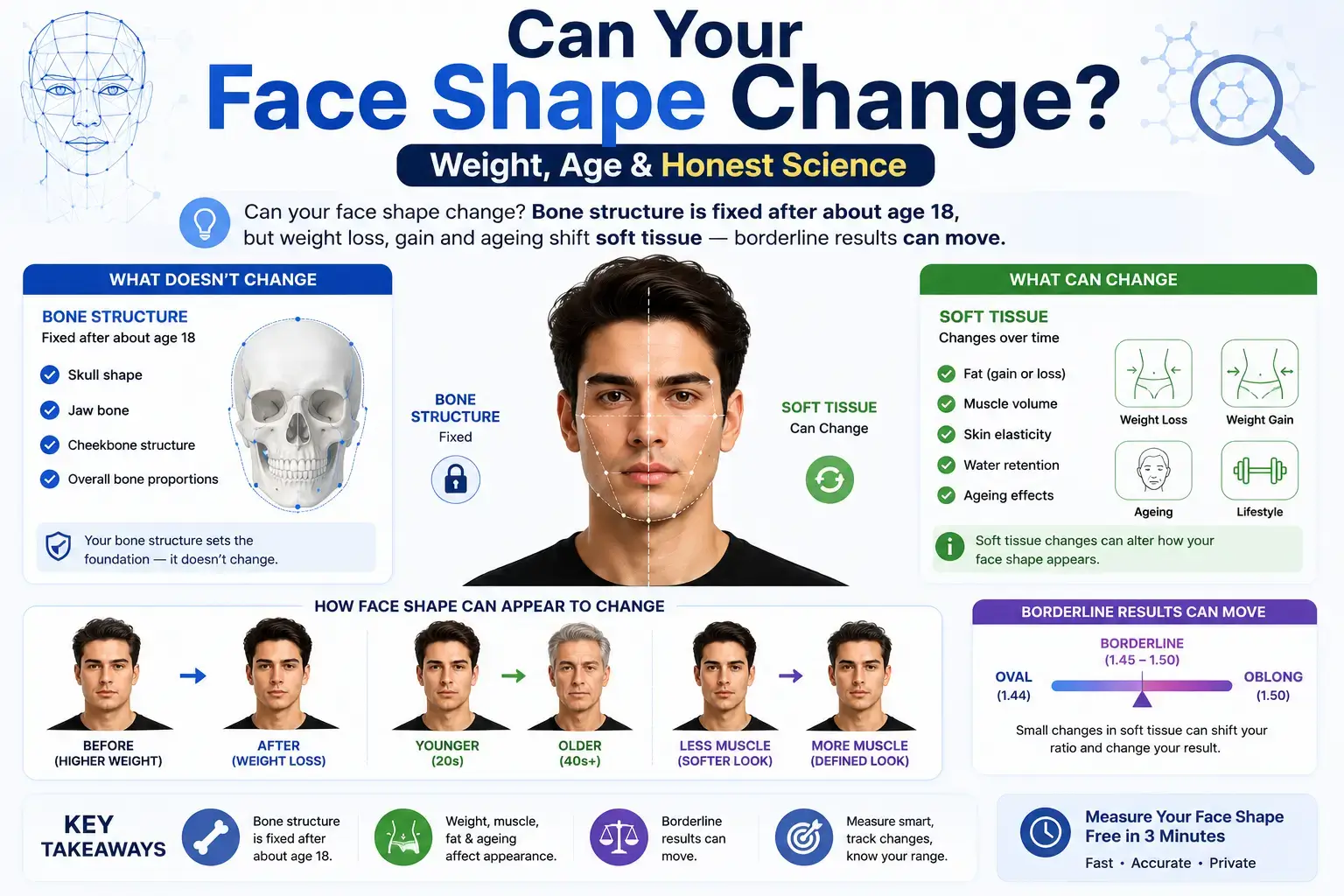
Your bone structure — the skeleton of your face shape — does not change after roughly age 18. But the soft tissue over it does: significant weight loss or gain, ageing, and even water retention can shift how your face measures. For most people the category stays the same. For borderline faces, a real change in measured shape is genuinely possible — a round reading can become oval after major weight loss, and an oval can drift toward oblong with age-related volume loss.
That’s the honest two-part answer most articles skip. Let’s break down each cause, with what actually changes and what doesn’t.
What Never Changes: Your Bones
Face shape is built on three bones: the temporal area (forehead width), the zygomatic arch (cheekbones), and the mandible (jaw). These finish growing in the late teens. After that, no diet, exercise, or skincare changes them. A true diamond face’s dominant cheekbones or a triangle face’s wide jaw are skeletal — permanent. This is why “face shape exercises” that promise to change your shape are selling fiction. Facial exercises can slightly affect muscle tone; they cannot move bone.
What Does Change: The Soft Tissue
- Weight loss and gain: Fat pads in the cheeks and along the jawline change with body weight. Significant weight loss slims the mid and lower face, making it measure longer and more tapered; gain does the reverse. This is the single biggest driver of real category shifts — typically round ↔ oval or oval ↔ oblong, the neighbouring pairs. A square face will not become a heart face by losing weight; the jaw bone is still there.
- Ageing: From roughly the 40s onward, faces lose fat volume in the cheeks and skin elasticity along the jaw. The common drift: the mid-face narrows, and the lower face softens, so long shapes read longer and jawlines read less angular. Again — a shift of a few measurement points, meaningful only for borderline faces.
- Temporary factors: Water retention, sodium, sleep, and hormones can swing facial measurements by small amounts day to day. This is why we recommend measuring with a neutral expression, in the morning, and never treating a single borderline reading as final.
So Should You Re-Measure? Yes — In These 3 Cases
- Your weight changed by more than ~10% of body weight since you last checked.
- Your last result was borderline (for example, a length-to-width ratio near 1.45–1.5, the oval–oblong border).
- It’s been 5+ years, and you’re making a big styling decision — a dramatic cut, expensive glasses, a beard overhaul.
Re-checking takes 3 minutes with the face shape calculator or 3 seconds with the AI photo detector. If two methods agree, trust the result.
What This Means Practically
Think of your face shape as a skeleton with a slider. The skeleton (your category’s core) is fixed; the slider (soft tissue) moves it a few points either way over a lifetime. About 1 in 4 people sit near a category border — for them the slider occasionally crosses a line, and their best styling rules genuinely update. For everyone else, the category you measure at 25 is the one you’ll have at 55, even as the face around it softens. Population-level numbers stay stable too: oval leads at 28.4% and diamond stays rarest at ~5% across age groups — see the full face shape statistics.
FAQs
Can your face shape change with weight loss?
Your bones don’t change, but weight loss slims the cheek and jaw fat pads, so a borderline face can genuinely shift category — most often round to oval. Re-measure after any major weight change.
Does your face shape change with age?
The bone structure stays fixed, but age-related volume loss narrows the mid-face and softens the jawline from the 40s onward. Borderline results can drift; strongly defined shapes stay put.
Can face exercises change your face shape?
No. Exercises may slightly affect muscle tone, but face shape is set by bone structure, which no exercise can move. Claims otherwise are marketing.
At what age is your face shape final?
The skeleton finishes developing around age 18. After that, only soft tissue changes — which shift measurements slightly, not the underlying structure.
How often should I re-check my face shape?
After any major weight change, or every few years if your last result was borderline. It takes 3 seconds with a free photo tool.
