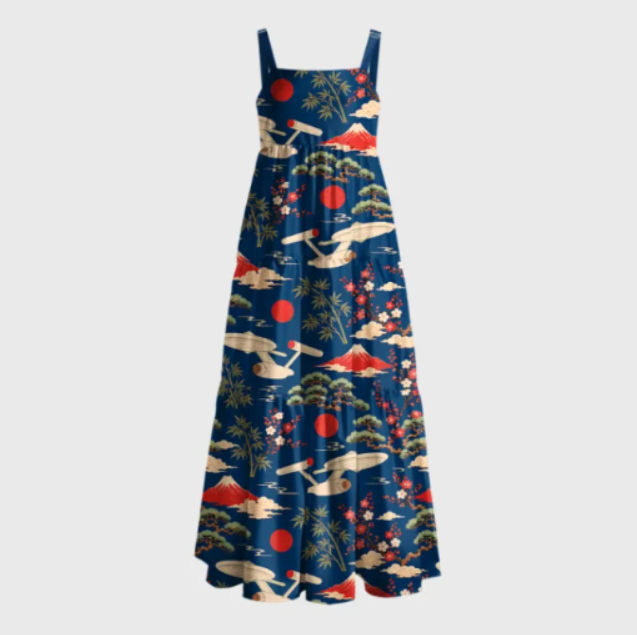
Three dresses. Same print, same fabric, same price. One has thin straps and a straight drop. One flares from the waist like a bell. One crosses over the front and ties at the side. They will look completely different on the same body, and most people pick based on the product photo rather than the cut.
That’s backwards. The silhouette decides how a dress fits and moves; the print is just what’s on it. If you’re choosing a geek maxi dress or any patterned dress, knowing these three cuts saves a lot of returns.
The Cami Dress
What it is
A dress with thin spaghetti straps and a fitted or semi-fitted bodice, falling either straight or in tiers to the hem. The tiered version — gathered horizontal panels that widen toward the floor — is the current default for casual maxis.
How it fits
The bodice does the shaping; everything below hangs loose. There’s no waistband, no closure, and often no zip — you pull it on. The straps are usually adjustable, which controls where the bodice sits on your torso.
Where it wins
Heat. A cami maxi is the coolest of the three by a wide margin. It’s also the easiest to layer: a tee knotted over it turns it into a skirt; a heather tee from Geeksoutfit’s geek shirts range does this without adding bulk; a jacket over it changes the whole register. And because the skirt is unstructured, it sits well on floors, folds into a small bag, and doesn’t crease into hard lines.
Where it struggles
Bust support is minimal — thin straps mean you’re relying on the built-in lining or your own undergarments. It also exposes shoulders, which is a plus or a minus depending on venue and sun.
The A-Line Dress
What it is
Fitted at the shoulders and bust, then flaring gradually from the waist (or just below) to the hem in the shape of a capital A. Often has a defined waist seam, sometimes a zip.
How it fits
Structured. The waist seam is a fixed point, so the dress fits well if your natural waist is where the seam falls and less well if it isn’t. Straps are usually wider; some versions have short sleeves.
Where it wins
Definition. If you want a clear waist and a skirt that holds its shape, this is the cut. It photographs well, works with belts, and reads a touch more polished than a cami.
Where it struggles
Less forgiving of torso length variation. Bulkier to pack. Warmer. And the flared skirt has a mind of its own in wind.
The Wrap Dress
What it is
Two front panels that cross over each other and tie at the side or back. Adjustable by design — you control how tight the wrap is.
How it fits
Highly adaptable. The wrap adjusts to the wearer, which is why it’s the classic “flatters everyone” recommendation. The V-neckline is deep by default.
Where it wins
Fit range. One size fits a wider spread of bodies than the other two. Also the most “dressed up” of the three — a wrap in a nice fabric passes at dinner without effort.
Where it struggles
Gaping. Sit down, lean forward, catch a gust, and the front can open more than you’d like. The tie needs re-adjusting through the day. Not ideal for a con floor or a beach.
A Quick Side-by-Side
| Cami | A-Line | Wrap | |
|---|---|---|---|
| Heat comfort | Best | Moderate | Moderate |
| Layering | Best | Limited | Limited |
| Waist definition | Low | High | Adjustable |
| Fit forgiveness | High (adjustable straps) | Low | Very high |
| Packability | Best | Worst | Good |
| Fuss factor | None | Low | Ongoing |
Which Cut Suits a Printed Dress?
This is where it gets interesting. Prints behave differently on each silhouette.
A cami with tiers shows an all-over print as continuous pattern — the gathers add texture, but there are no seams cutting through the artwork except the tier lines. Large-scale prints and busy artwork look their best here because there’s uninterrupted surface. That’s why the current wave of fandom-print dresses almost all use this cut. Geeksoutfit’s geek maxi dreses are tiered camis for exactly this reason: a woodblock-style spaceship or a sprawling fantasy map needs the long, uninterrupted fabric run a cami skirt provides, where an A-line’s waist seam or a wrap’s crossover would slice through the design.
An A-line suits smaller repeat prints — polka-dot-scale motifs — where the waist seam doesn’t interrupt anything important.
A wrap suits solids and subtle textures. Large prints get mismatched at the crossover and the tie bunches the pattern.
What Do You Actually Do With This?
Match the cut to the situation first, the print second.
- Convention, festival, beach, travel: cami. Comfort and layering win.
- Garden party, brunch, a day where you want a defined shape: A-line.
- Dinner, date, anywhere you want to adjust fit on the fly and don’t mind the tie: wrap.
Then choose the print that works on that cut. If you’ve fallen for a big graphic print, you’re going to be happiest in a cami whether you planned on one or not.
One Practical Test
Sit down in the dress. Stand up. Raise your arms. Bend to pick something up. The cami will pass all four without you thinking about it. The A-line will pass three and ride up slightly on the fourth. The wrap will need a tug after the first. None of that makes one better — it tells you which dress belongs on which day.
