The best sweater I’ve ever seen someone wear came from a church basement sale for four dollars. The second best came from an independent brand’s website for forty-two. Both were patterned knit cardigans. Both got asked about constantly. Only one of them took eleven Saturdays of digging to find.
That’s the whole thrifted-versus-new debate for statement knitwear in two sentences. Secondhand can be spectacular and cheap. New is reliable and available right now. Which one’s right depends on what you’re optimizing for, so here’s an honest comparison on the things that matter.
Cost
Thrift wins on sticker price, and not by a little. Patterned knits at secondhand shops run $5 to $20. Vintage stores that have already done the curating charge more, $30 to $80, which closes the gap considerably.
New statement knitwear from independent brands sits around $40 to $60. Designer knitwear is a different universe entirely and not really part of this comparison.
But sticker price isn’t the whole cost. Factor in time. If a good thrift find takes five hours of searching across several trips, and you’d otherwise earn or enjoy those hours, the four-dollar sweater cost a lot more than four dollars.
Verdict: thrift on price, new on cost-per-hour.
Quality and construction
This is where it gets interesting. Older knitwear, particularly from the 1980s and 1990s, was often made with heavier gauges and better yarn than fast fashion produces today. A thrifted wool cardigan from 1994 can outlast a new acrylic one from a mall brand.
But new isn’t a single category. Independent knitwear brands making patterned cardigans today frequently use jacquard construction and mid-weight yarns that are perfectly comparable to good vintage. A well-made new knit and a well-made vintage knit are roughly equal. A cheap new knit loses to both.
Verdict: draw at the quality tier that matters; avoid cheap new.
Uniqueness
Thrift’s biggest selling point. Nobody else has that exact sweater. Vintage patterns, discontinued designs, one-of-a-kind hand-knits: the secondhand rack is where genuinely unrepeatable pieces live.
New knitwear is by definition repeatable. That said, independent brands with specialized aesthetics produce designs that are nearly as distinctive in practice. The odds of running into someone wearing the same cryptid cardigan are low. Lower still if you’re outside a convention.
Verdict: thrift, but by less than you’d assume.
Is the pattern you want actually available secondhand?
Here’s the practical problem with thrifting for a specific aesthetic. Thrift stores are full of patterned knits. They’re mostly holiday sweaters, argyle, Fair Isle, florals, and abstract geometrics. Great if that’s the look you’re after.
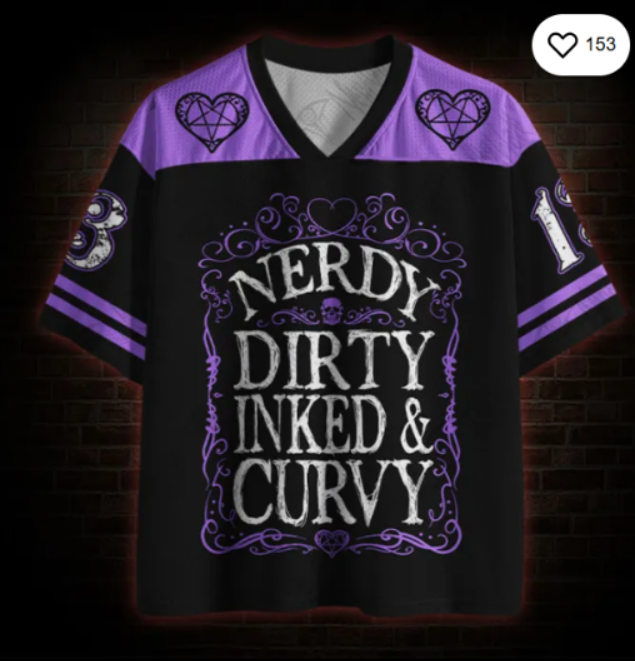
If you want a cardigan covered in Lovecraftian tentacles, occult symbols, or a retro horror motif, you will essentially never find that secondhand, because it barely existed as a category until recently. Alternative and fandom-themed knitwear is a new-market product. The nerdy cardigan sweaters now sold by specialist brands, with skeletons, moths, black cats, Cthulhu, and astrology charts knitted into the fabric, fill a niche that thrift racks simply don’t stock yet. Give it a decade and they’ll start showing up secondhand. For now, new is the only door. The same holds for fandom sportswear: a printed nerdy mesh jersey with a horror or gaming motif is a new-market product too, not something the thrift rack stocks yet.
Verdict: depends entirely on the pattern. Classic motifs, thrift. Alt and fandom motifs, new.
Fit and sizing
Thrift means you try it on, which is a genuine advantage. You know exactly how it fits before you pay. The downside is that you get the sizes that happen to be on the rack that day, and vintage sizing runs differently from modern.
New means size charts, measurements, and the occasional return. More effort up front, but you can get exactly your size in the cut you want.
Verdict: thrift for certainty, new for choice.
Condition and care
Secondhand knits come with history: pilling, stretched cuffs, a missing button, sometimes a faint smell that takes two washes to leave. Most of this is fixable with a fabric shaver and a cold wash, but it’s work.
New arrives ready. Whether it stays that way depends on how you wash it.
Verdict: new.
Ethics and sustainability
Thrift is the clear winner on environmental grounds: no new production, one less garment in a landfill. New knitwear from a small brand that makes in modest quantities is a defensible second; fast-fashion knitwear is the option to avoid.
Verdict: thrift, with small-batch new as a reasonable alternative.
So which should you do?
Both, deliberately. Use thrift for the classic patterns and plain knits: Fair Isle, argyle, chunky cable knits, solid wool cardigans. The supply is enormous and the prices are absurd. Use new for the specific: the exact cut in the exact size with the exact motif you actually want, especially anything alt, horror, or fandom-leaning, where the secondhand market hasn’t caught up.
A closet with two thrifted classics and one new statement knit is more interesting than three of either.
One rule for each
Thrifting: flip it inside out before you buy. Floating yarns behind the pattern mean it’s a real jacquard knit and worth the money; a plain inside means the design is printed and may not survive.
Buying new: read the garment measurements, not the label size, and check whether the pattern is knitted in or printed on. Then wash it cold and dry it flat, so in twenty years it turns up in a thrift store looking good enough for someone else to write about.
