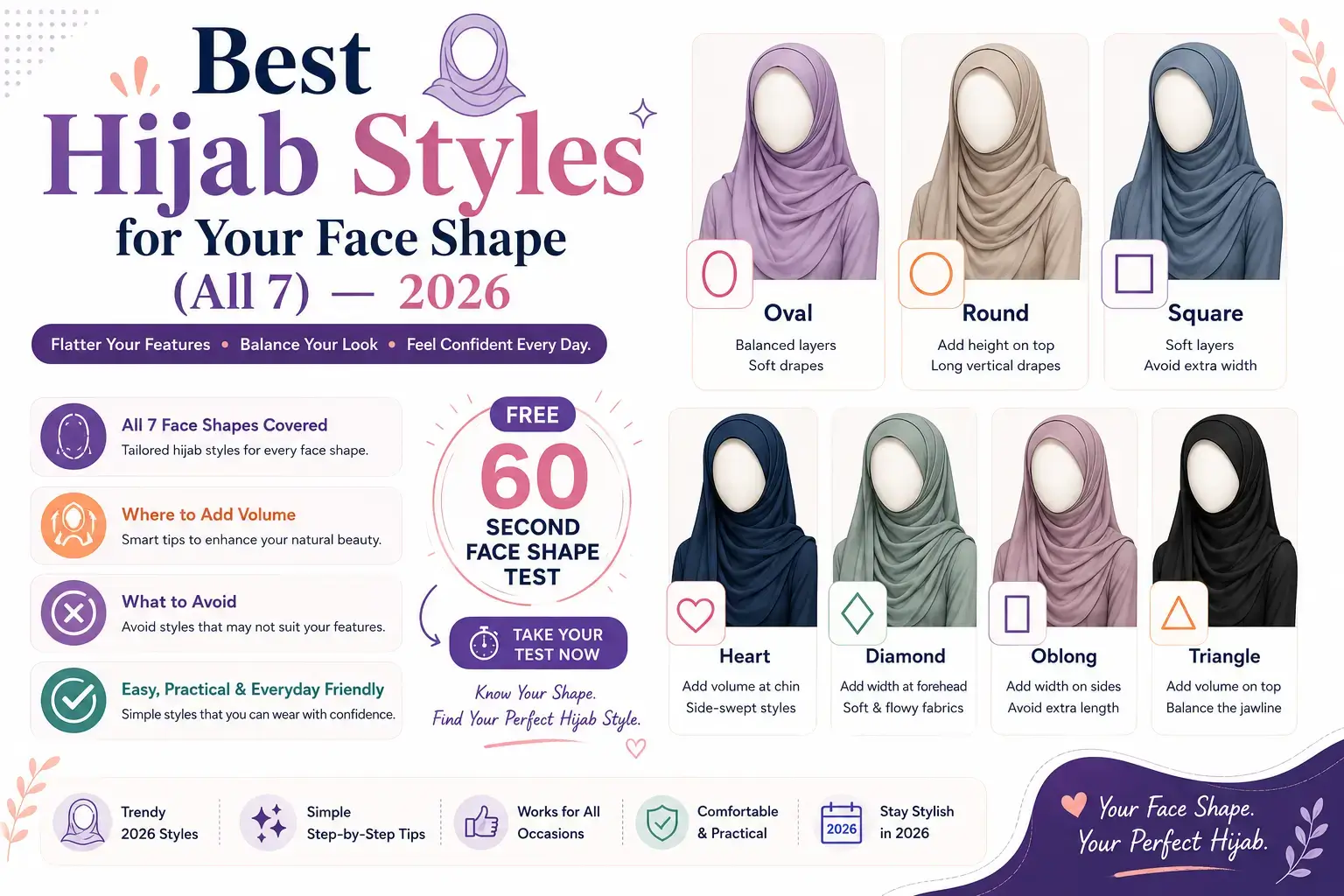
Quick answer:
The best hijab style for your face shape follows one simple rule — place fabric volume where your face is narrow, and keep it smooth where your face is wide. A round face suits height at the crown and a snug frame at the cheeks. A long (oblong) face suits soft side volume and a lower, wider drape. A heart face suits volume near the jawline. Find your shape first with the free 60-second face shape quiz or the AI detector, then jump to your section below.
Most hijab styling guides skip the measurement step and go straight to draping tutorials — which is why the same style can look elegant on one person and unflattering on another. The hijab frames the face completely, so it actually gives you more styling control than a haircut: you decide exactly where volume, height, and width sit. That control only helps if you know your shape. All 7 shapes are covered here; the face shape statistics page shows how common each one is.
First: The 60-Second Shape Check
Pull your hair back and compare three widths in a mirror — forehead, cheekbones, jaw — and judge whether your face is clearly longer than it is wide. Widest at cheekbones with modest length = oval. Clearly long with even widths = oblong. As wide as it is tall = round. Forehead widest with a pointed chin = heart. Cheekbones dramatically widest = diamond. Jaw widest = triangle. Even widths with an angular jaw = square. Unsure between two? The face shape calculator settles it with four measurements at 92%+ accuracy.
Oval Face: You Have Full Freedom
With balanced proportions, nearly every hijab style works — Turkish style, side drapes, loose shawl looks, snug sport styles. Your only guideline: keep the natural balance. Avoid extreme volume in any single zone, since your face doesn’t need correction in any direction.
Oblong (Long) Face: Add Width, Cut the Length
Your face is elegant and long — the goal is to widen, never lengthen visually.
- Best: soft volume at the sides of the head; a wide, rounded front edge that sits slightly lower on the forehead; loose drapes that add horizontal fullness at cheek level.
- Avoid: tall crown styles, high-volume underscarf bumps, and pulling the fabric tightly back — all of these stretch the visible face. A very high forehead line has the same effect.
- The full width-adding logic is the same as in the oblong hairstyles guide — the hijab gives you finer control.
Round Face: Add Height, Keep Sides Smooth
The exact opposite of oblong. Your face is as wide as it is tall, so create vertical lines.
- Best: gentle height at the crown (a modest volumizing scrunchie or Turkish-style structure), a front edge worn slightly higher, and fabric kept smooth and close at the cheeks. Letting a drape fall vertically down one side adds a lengthening line.
- Avoid: side volume at cheek level and very rounded front edges — both add width where you already have it.
Heart Face: Balance the Forehead, Soften the Chin
Your forehead is your widest point, tapering to a narrow chin.
- Best: a front edge worn slightly lower and angled to narrow the forehead line; fullness in the drape near the jaw and chin — exactly where your face narrows. A loosely wrapped chin-level drape is the hijab equivalent of the chin-length bob from the heart face shape guide.
- Avoid: high, wide front edges that expose the full forehead width, and tight wraps at the jaw that emphasise the taper.
Square Face: Soften the Angles
Even widths with a strong, angular jaw — the goal is curves.
- Best: rounded front edges, soft loose drapes that curve past the jaw corners rather than hugging them, and gentle crown height to add a little length.
- Avoid: sharp, straight-edged frames and snug wraps that trace the jawline — they echo the angles instead of softening them.
Diamond Face: Width at Top and Bottom, Calm at the Cheeks
Dramatic cheekbones with a narrow forehead and chin.
- Best: a slightly wider, fuller front edge (adds forehead presence) plus soft fullness near the jaw — balancing both narrow zones at once, as in the diamond face shape guide.
- Avoid: styles pulled tight at cheek level, which spotlight the cheekbones as the only wide point.
Triangle Face: Volume Up Top
Your jaw is wider than your forehead — so all the fullness goes high.
- Best: volume and structure at the crown and temples, a wide upper frame, and smooth, close fabric along the jaw.
- Avoid: jaw-level fullness and chin-heavy drapes — they widen your already-widest zone. Same logic as the triangle face shape guide.
Quick Reference Table
| Face Shape | Add Volume At | Keep Smooth At |
|---|---|---|
| Oval | Anywhere (balanced) | Everywhere equally |
| Oblong | Sides/cheeks | Crown (no height) |
| Round | Crown (height) | Cheeks / sides |
| Heart | Jaw/chin area | Forehead line |
| Square | Rounded edges, slight height | Jaw corners |
| Diamond | Forehead + jaw | Cheekbones |
| Triangle | Crown + temples | Jawline |
FAQs
Which hijab style suits a round face?
Styles with gentle crown height and smooth, close sides. A slightly higher front edge and a vertical side drape lengthen the look. Avoid cheek-level volume.
Which hijab style suits a long face?
Side volume with a lower, wider front edge. Avoid tall crown styles and volumizing bumps, which make a long face look longer.
How do I know my face shape for hijab styling?
Compare your forehead, cheekbone, and jaw widths, plus your face length. Or skip the guesswork: the free AI detector reads your shape from a photo in 3 seconds, entirely in your browser.
Does the underscarf style matter?
Yes — the underscarf sets your frame line. A volumizing underscarf adds crown height (good for round, bad for oblong), and how high or low it sits on the forehead changes your visible face length.
Do these rules work for all hijab fabrics?
The placement rules stay the same; fabrics change intensity. Stiffer fabrics hold structure (stronger effect), jerseys drape close (subtler effect). Start with the placement rule, then pick fabric by how much correction you want.
