Quick answer:
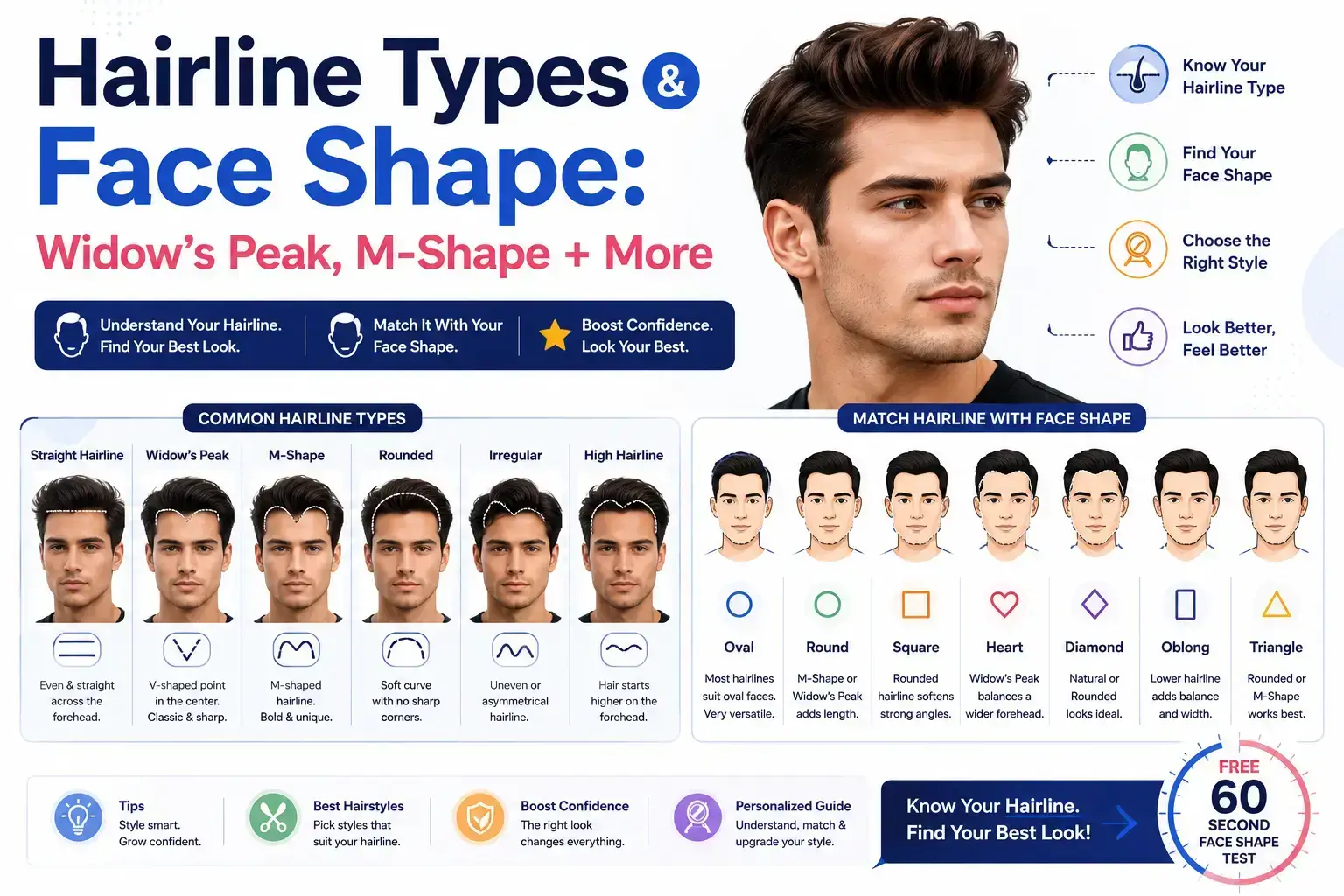
There are six common hairline types — straight, rounded, widow’s peak, M-shaped, uneven, and receding. Your hairline doesn’t change your bone structure, but it changes two real things: where your face length measurement starts and how your forehead visually reads. A receding hairline can make an oval face measure as oblong; a low straight hairline can make a long face read shorter. Here’s each type, what it does to your face shape result, and how to measure correctly.
Most face shape guides treat the hairline as scenery. It isn’t — face length is measured from the centre of your hairline to your chin, so the hairline literally sets the starting line of the most important number in shape classification. That’s why this page exists.
The 6 Hairline Types
- Straight: The hairline runs in a clean horizontal line. Most common in men. It frames the forehead as a neat rectangle and gives the most “standard” length measurement.
- Rounded: The line curves gently downward at the temples. Common in women. It softens the forehead’s corners and can make a wide forehead read slightly narrower — relevant if you’re borderline heart-shaped.
- Widow’s peak: A distinct V-shaped dip at the centre. Genetic, appears in all genders. Famously associated with heart faces — but here’s the honest correction to a common myth: a widow’s peak does not mean you have a heart face. Plenty of oval, round, and square faces have one. It’s a hairline trait, not a shape. (A heart face is defined by a forehead at least 15% wider than the jaw — hairline optional.)
- M-shaped: The line recedes at both temples while holding the centre, forming an M. Common in men from the 20s onward; it’s often the early stage of recession, but a mild M can also be a stable, lifelong hairline.
- Uneven: One side sits higher or dips differently than the other. Completely normal — perfect symmetry is rare — and it only matters for measurement if the difference is large (measure from the centre point).
- Receding: The whole line moves upward over time, most visibly at temples and centre. This is the type with the biggest face shape impact, covered next.
How Your Hairline Changes Your Face Shape Reading
Face length runs hairline-centre → chin. So:
- A receding or high hairline inflates face length: A face that measured oval (ratio 1.25–1.45) in your twenties can measure oblong (1.5+) at forty with the same bones — the start line simply moved up. If this is you, read oval vs oblong and re-test.
- A low hairline compresses face length: Genuinely long faces can measure a category shorter.
- A widow’s peak barely matters for measurement: Measure from the hairline’s general line, not the tip of the V.
- M-shape and temple recession widen the visible forehead at its top corners, which can nudge a borderline reading toward heart.
The honest measuring rule: use your current hairline, because styling decisions apply to the face people see today — but if your hairline has visibly moved, treat borderline results with extra care and confirm with the AI detector, which reads proportions from your full facial landmarks, not just the hairline. This is also one of the ways a face shape result genuinely shifts over time — more on that in Can Your Face Shape Change.
Styling Notes by Hairline
- Widow’s peak: Own it — centre and off-centre parts showcase it; slicked-straight-back styles emphasise it most. Hide it (if preferred) with a fringe or side-swept bangs.
- M-shaped / receding: Shorter textured styles with forward movement (French crop, textured fringe) cover the temples and reset the visible hairline lower. Avoid slicked-back and high-contrast fades at the temples, which spotlight recession. For long faces, this matters double — a rising hairline plus crown height is the most lengthening combination possible; the width-first rules in the men’s styling guide counter it.
- Straight/rounded: The most flexible; follow your face shape’s rules directly.
FAQs
What are the different hairline types?
Six common types: straight, rounded, widow’s peak, M-shaped, uneven, and receding. All are normal variations; several can occur together.
Does a widow’s peak mean I have a heart-shaped face?
No — that’s a myth. A widow’s peak often appears on heart faces but exists on every shape. A heart face is defined by measurements: a forehead at least 15% wider than the jaw with a tapered chin.
Does a receding hairline change your face shape?
It doesn’t change your bones, but it moves the starting point of the face length measurement upward, which can shift a borderline result — most often oval to oblong. Re-measure and confirm with a photo-based tool.
Where do I measure my face length from if my hairline is uneven or receding?
From the centre of your current hairline, straight down to the chin tip. If your hairline has visibly moved over the years, double-check any borderline result with the AI detector.
Which hairline type is most common?
Straight and rounded hairlines are the most common overall — straight more typical in men, rounded in women. Widow’s peaks are a frequent genetic variation across all groups.
