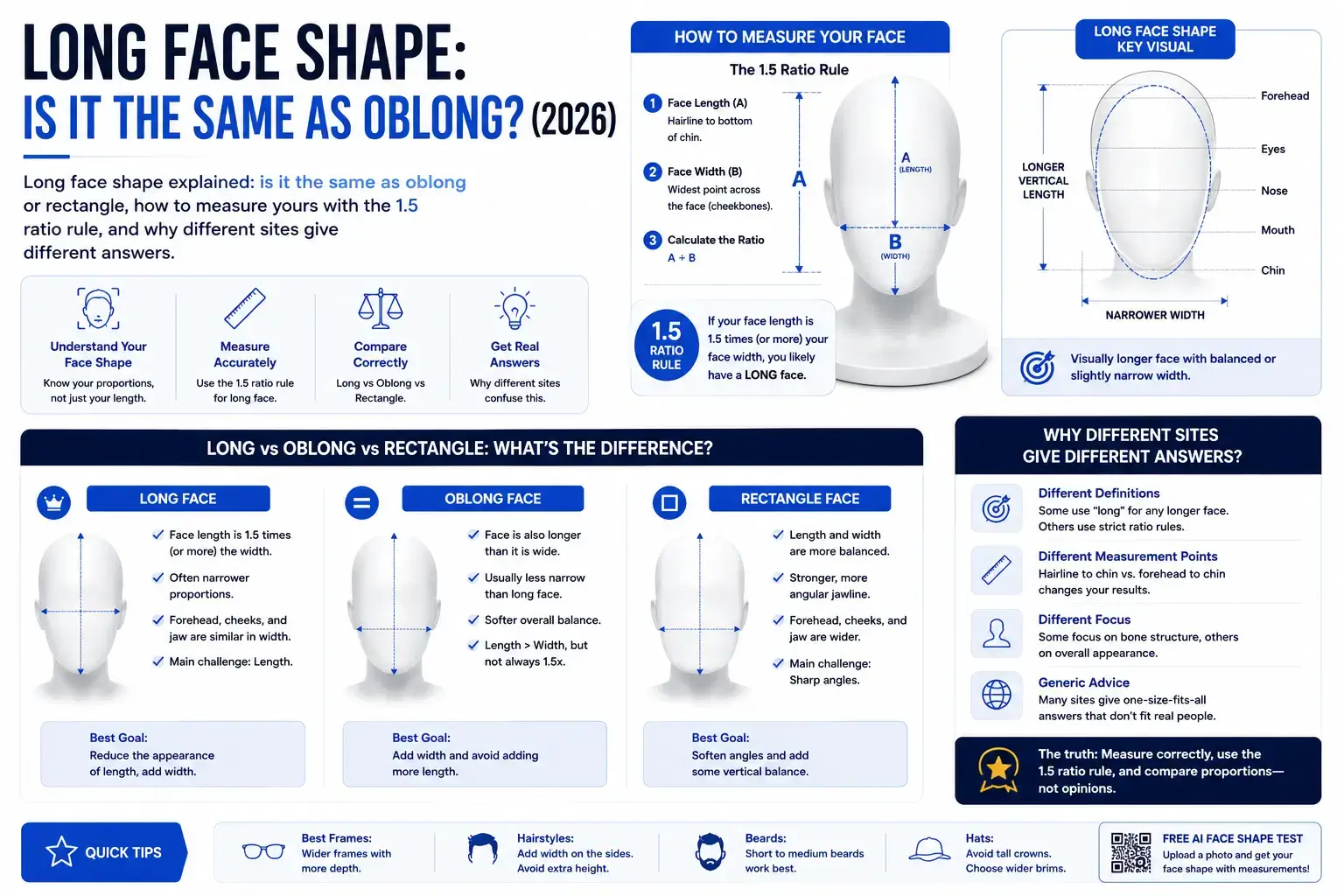
Quick answer:
Yes. Long face shape is the everyday name for what measurement guides call oblong. Both describe a face that is clearly longer than it is wide, with the forehead, cheekbones, and jaw staying close to the same width from top to bottom. The test is one number: divide your face length by your average width. 1.5 or above is a long face. Rectangle is the third name for the same family, usually reserved for a more angular jaw. This page settles the terminology, shows you how to measure, and then points you to the right styling guide.
The 3 Names, One Face Shape
If you have searched this topic, you have probably seen three different labels used for what looks like the same face. Here is how they actually relate.
| Term | Who uses it | What it means |
|---|---|---|
| Long face shape | Everyday speech, beauty blogs | Any face clearly longer than wide |
| Oblong | Measurement and styling guides | The technical term; widths stay consistent, jaw usually softer |
| Rectangle | Some styling guides | The same proportions with a more angular, defined jaw |
For choosing a haircut, glasses, or a beard, treat all three as the same. The styling logic does not change: add horizontal width, avoid adding height. The only place the distinction matters is jaw-level detail, which we cover in the rectangle vs oblong comparison.
Be aware that the oblong versus rectangle line is not standardised. Some guides split them by jaw angle, others say the difference has no practical effect at all. Nobody is enforcing a rule here, so do not worry if two sites label you differently.
How to Measure a Long Face Shape
Three minutes and a soft tape measure. Pull your hair fully back first, since a fringe or side volume hides the hairline and is the single most common cause of a wrong result.
Take four measurements:
- Face length from the centre of your hairline down to the tip of your chin
- Forehead width at its widest point
- Cheekbone width across the widest part, just below the outer eye corners
- Jaw width across the widest point of your jawline
Then do the maths:
- Average width = (forehead + cheekbones + jaw) ÷ 3
- Ratio = face length ÷ average width
Worked example: length 22 cm. Widths 14 + 15 + 13 = 42, divided by 3 = 14. Ratio = 22 ÷ 14 = 1.57, which is a long face.
| Your ratio | What it points to |
|---|---|
| 1.25 to 1.45 | Oval |
| 1.45 to 1.5 | Borderline, check width consistency |
| 1.5 and above | Long / oblong |
The second confirmation is width consistency. On a long face, your three widths sit close together, within about 15% of each other. If one width clearly dominates, you are likely a different shape even with a high ratio.
Prefer not to measure? The free face shape calculator does the maths from your four numbers, and the AI detector reads them straight from a photo.
Why Different Sites Give You Different Answers
This is worth knowing, because it explains a lot of confusion.
- Sites use different formulas: Some divide face length by average width as this page does. Others divide by cheekbone width only, which produces a higher number for the same face. A ratio of 1.5 on one method can read as 1.6 on another. Neither is wrong, but they are not comparable.
- Thresholds are not agreed: One guide calls 1.5 the cutoff, another uses 1.6, and plenty give no number at all and just say “noticeably longer.”
- Most guides do not publish their method: Face classification borrows from anthropometry, the science of measuring the human body, but beauty guides rarely state which measurements they used. That is why we publish the formula and the thresholds openly, so you can check the result yourself instead of trusting a label.
Long vs Oval: The Mix-Up Worth Fixing
This is the most common misidentification on the internet, and it goes one direction. People with long faces usually think they are oval, because oval is the flattering default that most guides lead with.
| Long / Oblong | Oval | |
|---|---|---|
| Ratio | 1.5 and above | 1.25 to 1.45 |
| Sides of face | Straighter, more parallel | Gently curved, tapering |
| Widths | All three close together | Cheekbones lead slightly |
| Overall read | Elongated, column-like | Balanced, softly tapered |
Mirrors are genuinely bad at judging length, which is why measuring beats guessing. Full breakdown in the oval vs oblong guide.
Styling a Long Face: The One Rule
Everything worth knowing compresses into a single principle:
Add horizontal width. Avoid vertical height.
A long face already has a strong vertical line. Anything that extends it (height at the crown, long straight centre-parted hair, a pointed goatee, narrow tall glasses) makes the face read longer. Anything that cuts across it (a fringe, waves, side sweep, wide frames, a fuller beard at the sides) balances it.
Quick reference:
| Element | Works well | Works against you |
|---|---|---|
| Women’s hair | Curtain bangs, chin-length bob, wolf cut, layers | Long straight centre-parted hair, high buns, sleek ponytails |
| Men’s hair | Curtain hair, textured side quiff, French crop, side part | Pompadours, mohawks, top knots, tight crops with no top volume |
| Glasses | Wide rectangular, browline, round, wide aviators | Narrow, small, or tall frames |
| Beards | Short boxed beard, fuller sides, stubble | Long pointed goatees, chin straps, tapered length |
For the full versions with step-by-step barber and stylist instructions: women’s hairstyles guide, men’s hairstyles and beards guide, and the glasses section.
Is a Long Face Shape Attractive?
Honest answer: that is not a question measurement can settle. A long face is a common, normal proportion, and it is well represented among actors and models, which tells you it photographs well. But no face shape ranks above another on attractiveness in any reliable way, and any site giving you a score for your shape is inventing it.
What is true is that a long face has a distinctive, defined silhouette that reads clearly on camera. If you want the longer discussion, we cover it in is an oblong face shape attractive. If you are curious about your own proportions specifically rather than your shape category, the golden ratio calculator measures your face against the classical 1.618 reference.
Well-Known Long Faces
Useful as visual reference points when you are trying to place your own shape.
- Men: Benedict Cumberbatch, Ben Affleck, Will Smith, Shawn Mendes
- Women: Blake Lively, Sarah Jessica Parker, Megan Fox, Kim Kardashian
The pattern in how they style it is consistent. The women use curtain bangs, waves, and mid-length cuts that break the vertical line. The men use side-swept styles and stay away from crown height.
FAQs
Is long face shape the same as oblong?
Yes. Long is the everyday name and oblong is the term used in measurement and styling guides. Both describe a face clearly longer than wide with consistent widths from forehead to jaw, and the styling advice is identical.
What is a long face shape?
A face with a length-to-width ratio of 1.5 or above, where forehead, cheekbones, and jaw are all close in width. The sides run relatively straight rather than curving inward, giving an elongated, column-like outline.
How do I know if I have a long face shape?
Measure your face length and your three widths, average the widths, then divide length by that average. A result of 1.5 or higher, with the three widths within about 15% of each other, points to a long face. The free face shape quiz gets you there in 60 seconds without a tape measure.
What is the difference between long and rectangle face shape?
Rectangle usually describes the same proportions with a more angular, squared jaw, while oblong describes a softer jawline. The distinction is not standardised across guides and does not change the core styling rules.
What hairstyles suit a long face shape?
Anything that adds horizontal width. Curtain bangs, chin-length bobs, wolf cuts, and layers for women. Curtain hair, textured side quiffs, and French crops for men. Avoid styles that add height at the crown.
Why did two websites give me different face shapes?
Because they likely used different formulas. Some divide face length by average width, others by cheekbone width alone, which produces a higher number for the same face. Thresholds also vary between guides, so always check which method a site is using.
